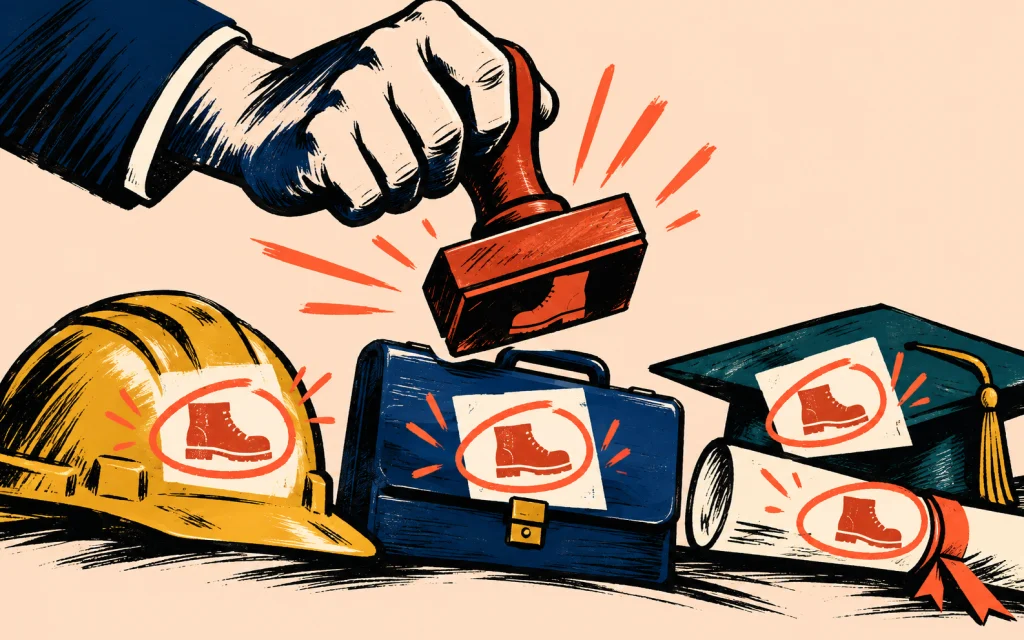
New Pew data shows six in 10 Americans now describe themselves as working class — including half of upper-income adults and college graduates. The label is becoming less about occupation and more about politics, status and how people understand their place in the economy.
The phrase “working class” used to carry a relatively clear image: people in factories, trades, warehouses, construction sites and service jobs whose income depended directly on their labor. That definition no longer describes how Americans are using the term. Sixty percent of U.S. adults now say “working class” describes them extremely or very well, according to a Pew Research Center analysis based on a January 2026 survey. That includes 50% of college graduates and 50% of upper-income Americans, along with 67% of middle-income adults and 57% of lower-income adults. Even among people who consistently pay their bills, have several months of emergency savings and say they can comfortably meet their expenses, half still identify as working class. Pew’s findings suggest the label is becoming less of an economic category and more of a social identity — one broad enough to include people who may not fit traditional definitions of working-class life at all.
That shift matters because class language plays an increasingly important role in American politics. Candidates across the ideological spectrum routinely promise to fight for “working families,” “working people” or “the working class,” but the constituency attached to those phrases is becoming harder to define. If half of upper-income adults consider themselves working class, then the term is no longer functioning primarily as shorthand for economic disadvantage. It can instead communicate a set of values: self-reliance, labor, cultural distance from elites, resentment toward institutions, or simply the belief that earning a living through work distinguishes someone from people perceived as wealthy enough not to need one. Pew explicitly notes that public debate frequently uses “working class” to mean different things — lack of a bachelor’s degree, a particular income level, blue-collar employment or simply earning money through work. That ambiguity is no longer a technical problem with the terminology. It is part of the political power of the label itself.
Republicans Have Claimed More of the Working-Class Identity
The most revealing divide is political. Sixty-seven percent of Republicans and Republican-leaning independents say working class describes them well, compared with 55% of Democrats and Democratic leaners. Pew found that this partisan gap persists even after taking income, education, occupation and other factors into account. Among Americans without bachelor’s degrees, 72% of Republicans identify as working class compared with 61% of Democrats. Among college graduates, the pattern remains: 56% of Republican graduates describe themselves as working class compared with 44% of Democratic graduates. The label therefore cannot be explained simply by educational attainment or traditional blue-collar employment. Partisanship itself has become associated with whether Americans see the term as part of their identity.
The gap becomes even more striking higher up the income ladder. Pew found a 23-point partisan difference among upper-income Americans, with 61% of upper-income Republicans identifying as working class compared with just 38% of upper-income Democrats. Among financially comfortable Americans with relatively few economic stresses, 60% of Republicans still identify as working class, compared with 39% of Democrats in similar circumstances. That tells us something important about the modern class divide: economic comfort does not necessarily weaken working-class identification for Republicans. In some cases, the identity appears to persist independently of material conditions. Someone can own a home, hold a college degree, have emergency savings and earn an upper-income salary while still viewing themselves as culturally or politically aligned with “working people.”
That helps explain a broader realignment in American politics. For much of the 20th century, Democrats built their coalition around organized labor and working-class economic interests, while Republicans were more closely identified with business and higher-income voters. Those lines have become considerably less stable. Education, geography, race, religion and cultural attitudes increasingly shape partisan identity alongside income. The Pew data does not prove that Republicans have become economically working class in a traditional sense. It shows something different: Republicans have become more likely to claim the working-class label, even when their socioeconomic circumstances resemble those of Democrats who do not. In other words, class is being expressed not only through what people earn, but through which political and cultural group they believe represents people like them.
Race Complicates the Story
The racial differences make the category even harder to treat as purely economic. Sixty-two percent of White adults, 59% of Hispanic adults, 54% of Black adults and 52% of Asian adults identify as working class, according to Pew. At first glance, White adults appear somewhat more likely than Black adults to use the label. But education changes that picture. Among adults without four-year degrees, 71% of White adults identify as working class compared with 53% of Black adults. Among college graduates, however, the pattern reverses: 58% of Black graduates and 61% of Hispanic graduates identify as working class, compared with 48% of White graduates and 45% of Asian graduates.
That difference may reflect how economic security is experienced across racial groups. A college degree does not produce identical economic outcomes for every American. Black and Hispanic professionals can hold degrees and middle-class occupations while still facing different levels of wealth, family financial obligations, housing access or labor-market vulnerability. Pew does not establish those mechanisms directly in this study, so the data should not be read as proving why those graduates retain a working-class identity. But the pattern does show why education alone is an inadequate proxy for class. A degree can change occupation and earnings without necessarily changing how people understand their economic position or relationship to work.
The same is true of occupation. Seventy-seven percent of blue-collar workers identify as working class, which is unsurprising. But so do 61% of workers in other occupations. Even within blue-collar work, partisanship remains visible: 82% of Republicans in blue-collar jobs identify as working class compared with 72% of Democrats. Among workers outside traditional blue-collar fields, 68% of Republicans identify with the term compared with 55% of Democrats. Pew is essentially showing that occupation still matters, but occupation is no longer enough to explain the identity.
“Working Class” Is Becoming a Political Brand
There is another number worth paying attention to: the identity is growing. In 2024, 54% of Americans said working class described them well. In 2026, that share reached 60%. That increase occurred across demographic, socioeconomic and political groups. It arrived during a period of persistent concern about housing, food, healthcare, energy and employment — pressures SSC has been tracking throughout the current midterm cycle. That context may help explain why even financially stable Americans resist seeing themselves as comfortably removed from working-class life. People can have good salaries and still feel dependent on every paycheck, vulnerable to layoffs, squeezed by housing costs or unable to accumulate the wealth traditionally associated with being securely middle or upper class.
But the growth of the label also creates an opportunity for politicians to empty it of economic specificity. If nearly everyone is working class, then promising to help the working class does not necessarily require answering difficult questions about wages, unions, labor protections, housing, healthcare or wealth concentration. A politician can invoke the identity culturally while pursuing economic policies that affect different parts of the group in very different ways. An upper-income professional, an hourly warehouse employee and a construction worker may all describe themselves as working class while having very different relationships to taxes, benefits, job security and asset ownership.
That is why the Pew findings are more consequential than another exercise in demographic labeling. America may be reaching a point where class identity and economic class are separating. Sixty percent of adults can call themselves working class, but they are not all living the same economic reality. Some are struggling to cover monthly expenses. Others have college degrees, stable savings and upper incomes. Some work with their hands; others work behind desks. And increasingly, the label appears to say as much about politics and cultural affiliation as it does about wages or occupation.
The political question now is who benefits from that ambiguity. “Working class” remains one of the most powerful identities available in American public life because it carries an assumption of legitimacy: these are the people who work, contribute and keep the country functioning. As more Americans claim the label, politicians will have even greater incentive to compete for it. But a category broad enough to include six in 10 adults can conceal enormous differences in wealth and power. The next fight over the working class may therefore be less about who belongs to it than about who gets to define what working-class politics is actually supposed to deliver.