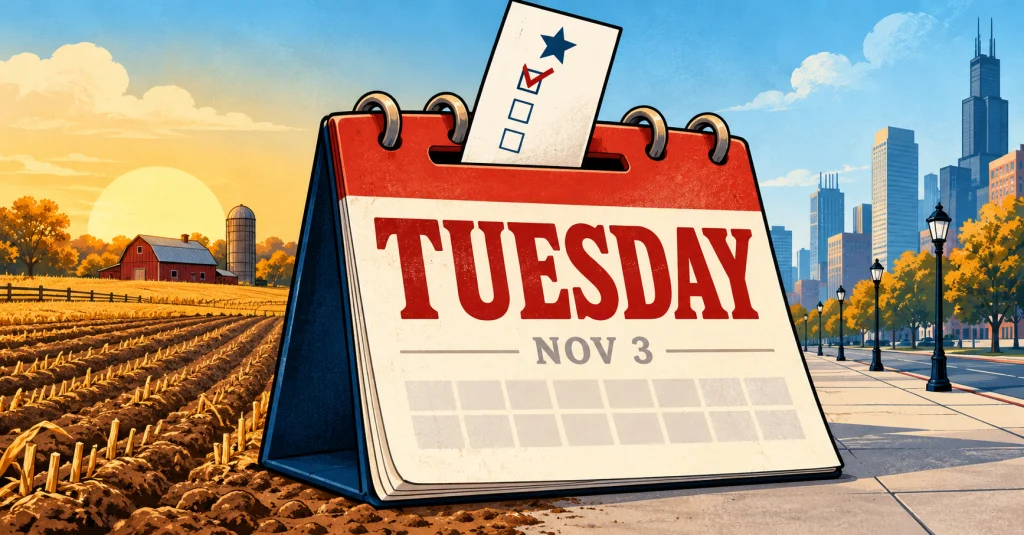
Most democracies hold national elections on weekends or public holidays. The United States remains among a minority that routinely votes on ordinary weekdays, raising questions about whether an outdated tradition creates unnecessary barriers to participation.
It’s Tuesday, November 3. Your alarm goes off at 6 a.m., the children need to get to school, and your workday starts at eight. Somewhere between the morning commute, meetings, picking up groceries, and getting dinner on the table, you’re supposed to find time to vote. The polling place might be close to home, but whether you can get there depends on your schedule, your transportation, and how long the line is when you arrive.
Americans have been organizing their lives around Tuesday elections for nearly 180 years. The tradition dates to an era when much of the country depended on agriculture, travel was measured in days rather than minutes, and Wednesday was commonly associated with market activity. Congress established the Tuesday after the first Monday in November as the date for presidential electors in 1845. What made practical sense for a largely rural nation has remained the federal election schedule even as the country, its economy, and its workforce have changed almost beyond recognition.
A Voting Schedule Built for Another America
The original logic was straightforward. Sunday was generally reserved for religious observance, and many farmers needed a full day to travel by horse or wagon to their polling locations. Wednesday was a common market day, making Tuesday a practical compromise. November also fell after the fall harvest and before winter weather made travel more difficult.
Today, those considerations have little to do with how most Americans live. The modern electorate includes hourly employees, healthcare workers, warehouse staff, teachers, service industry workers, and parents managing complicated family schedules. For some, taking time away from work means losing income. For others, voting requires arranging childcare, finding transportation, or navigating polling locations that may not be convenient to their daily routines.
The result is an election calendar designed for a society that no longer exists, although its effects are not experienced equally. A salaried professional with flexible hours may have little difficulty visiting a polling place. An hourly employee working consecutive shifts may have considerably fewer options.
Most Democracies Have Chosen Another Day
According to an October 2026 analysis by the Pew Research Center, the United States is one of just 28 democracies that routinely conduct national elections on ordinary weekdays without declaring a public holiday. Of the 106 democracies included in Pew’s research, 60 generally vote on Saturdays or Sundays, while another 16 hold weekday elections that are designated public holidays.
That means 76 of the 106 democracies examined, roughly 72%, ordinarily schedule national elections on weekends or public holidays. The Czech Republic generally conducts voting across Friday and Saturday, while Suriname uses a fixed calendar date that can fall on different weekdays.
The international comparison does not establish that weekend voting automatically produces higher turnout. Participation is influenced by registration requirements, political competition, voting systems, public trust, and whether voting is compulsory. Still, the findings demonstrate that Tuesday voting is a policy choice rather than an unavoidable feature of democratic elections.
Would a National Holiday Make Voting Easier?
Proposals to change Election Day generally take two forms: moving federal elections to a weekend or establishing Election Day as a federal holiday. Supporters argue that either approach could reduce scheduling conflicts and make participation more accessible, particularly for people whose jobs offer limited flexibility.
But a federal holiday would not necessarily mean everyone gets the day off. Hospitals, restaurants, grocery stores, transportation services, and many other businesses operate during federal holidays. Private employers are not generally required to close or provide paid leave simply because Congress designates a federal holiday. Without additional protections, some of the workers facing the greatest scheduling challenges could still be expected to report to work.
The United States also has alternatives that complicate the debate. Many states offer early in-person voting, absentee ballots, or voting by mail, allowing people to cast ballots before Election Day. Texas, for example, provides an early voting period, although eligibility for voting by mail is more restricted than in states with universal mail voting.
These options matter because Election Day is no longer the only day many Americans vote. Expanding access may depend as much on the availability of early voting locations, registration rules, reliable mail service, and paid voting leave as it does on changing the date itself.
The Calendar Is Part of the Access Debate
Election administration in the United States is divided among federal, state, and local governments, producing substantial differences in the voting experience. Some voters can cast ballots weeks before an election. Others face narrower options, longer travel distances, or work schedules that make even extended polling hours difficult to use.
That variation makes the Tuesday tradition especially revealing. Americans often debate voter identification, registration deadlines, ballot security, and polling-place access, but the calendar itself receives comparatively little attention. Yet scheduling is one of the most basic elements of accessibility. A right may exist equally under law while the practical effort required to exercise it differs considerably from one person to another.
Moving Election Day would not resolve every obstacle, and making it a holiday would not guarantee higher participation. But the international evidence makes one point difficult to overlook: most democracies have found ways to conduct national elections without requiring voters to organize participation around an ordinary weekday.
On November 3, millions of Americans will once again fit voting into their Tuesday routines. Some will arrive before work, others during lunch, and still others shortly before polls close. Many will have already voted. The country has developed numerous ways to accommodate a tradition established in 1845, but it has never fundamentally reconsidered that tradition at the federal level.
The farmers who helped shape America’s election calendar are long gone. Their Tuesday is still with us.