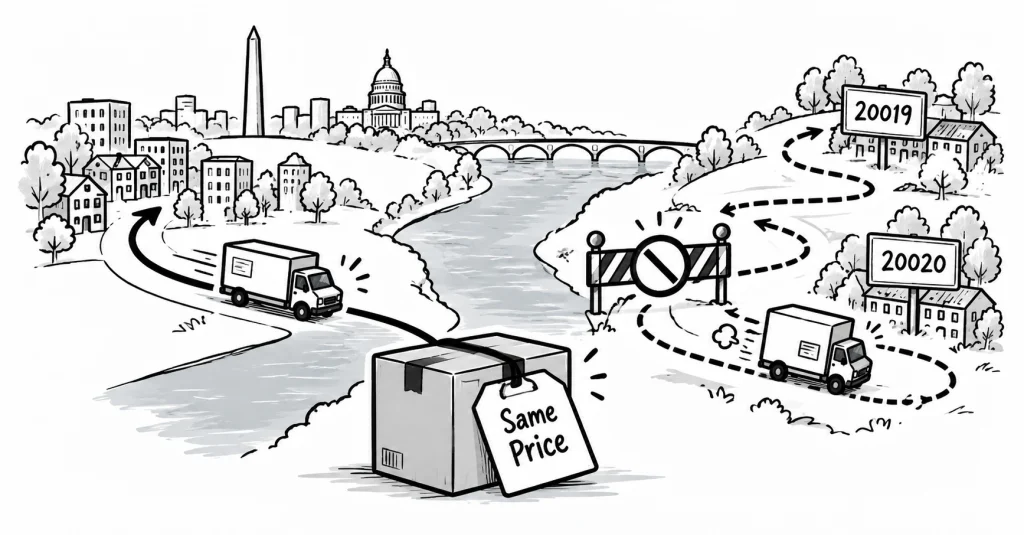
Amazon will pay $8.25 million to resolve a Washington, D.C., lawsuit alleging that the company charged full Prime membership fees while quietly excluding two predominantly Black ZIP codes from its own branded delivery network. The settlement covers ZIP codes 20019 and 20020 in Wards 7 and 8 east of the Anacostia River. According to the D.C. attorney general’s office, about 69,000 Prime members in those areas experienced slower service even though they paid the same price as members elsewhere in the city. Amazon will provide $7.25 million in refunds and pay another $1 million in penalties.
The Service Changed, But the Price Did Not
The District sued Amazon in 2024, alleging that the company had removed the two ZIP codes from its in-house Amazon-branded delivery network beginning in June 2022. Instead, packages were routed through third-party carriers such as UPS and the U.S. Postal Service. Those carriers were often slower than Amazon’s own network, according to the complaint.
The problem, according to the District, was not simply that Amazon changed how it delivered packages. Companies make operational changes routinely. The issue was that Prime customers were not clearly told that the main benefit they were paying for — faster delivery — could be materially different because of where they lived.
Prime has cost $14.99 a month or $139 a year since 2022. The attorney general’s office says affected members will receive refunds equal to nearly half of the membership fees they paid during the exclusion period. Amazon stopped excluding the ZIP codes from its full delivery service in April 2026.
Amazon has disputed the idea that its practices were discriminatory or deceptive. The company has said it adjusted routes because of safety concerns involving drivers in those neighborhoods. But the settlement still requires Amazon to provide clearer notice in the future if it makes similar delivery exclusions in the District.
Geography Became Part of the Product
Prime is sold as a standardized subscription. Customers pay the same membership price in exchange for a package of benefits that includes expedited delivery. The D.C. lawsuit argues that geography quietly changed the value of that membership.
That is especially consequential in Wards 7 and 8, where the neighborhoods involved are majority Black and where residents already face long-standing differences in retail access, transit options and neighborhood investment. The Washington Post reported that the lawsuit focused on residents east of the Anacostia River receiving slower deliveries than customers elsewhere in the city.
For a household that relies heavily on delivery because nearby retail options are limited, a one- or two-day difference is not necessarily trivial. It can affect access to household goods, medicine, school supplies or other items people might otherwise buy locally.
The Settlement Puts a Price on Unequal Service
The size of the refund is notable because it turns an abstract service disparity into a financial one. Nearly 69,000 members were affected, and the District says the exclusion lasted roughly four years. AFROTECH reported that customers in the two ZIP codes had placed millions of orders over the broader period examined in reporting around the dispute.
The settlement also creates a disclosure requirement. If Amazon excludes another D.C. ZIP code from its branded delivery service for safety reasons, it must notify existing customers, prospective customers entering an affected address and the attorney general’s office. That changes the issue from whether a company may alter service to whether it must clearly tell customers when the product they are buying is no longer being delivered in the same way.
For SSC, that is the more durable story. Subscription businesses increasingly promise standardized access: delivery, streaming, transportation, finance, software and other services that are marketed as uniform. But the actual experience can still depend heavily on ZIP code, infrastructure and neighborhood conditions.
The Amazon case shows what happens when that difference becomes large enough to trigger consumer-protection law. The settlement does not resolve every question about why service changed. It does establish something simpler: if customers are paying the same price, companies may face consequences when location quietly changes what they receive.