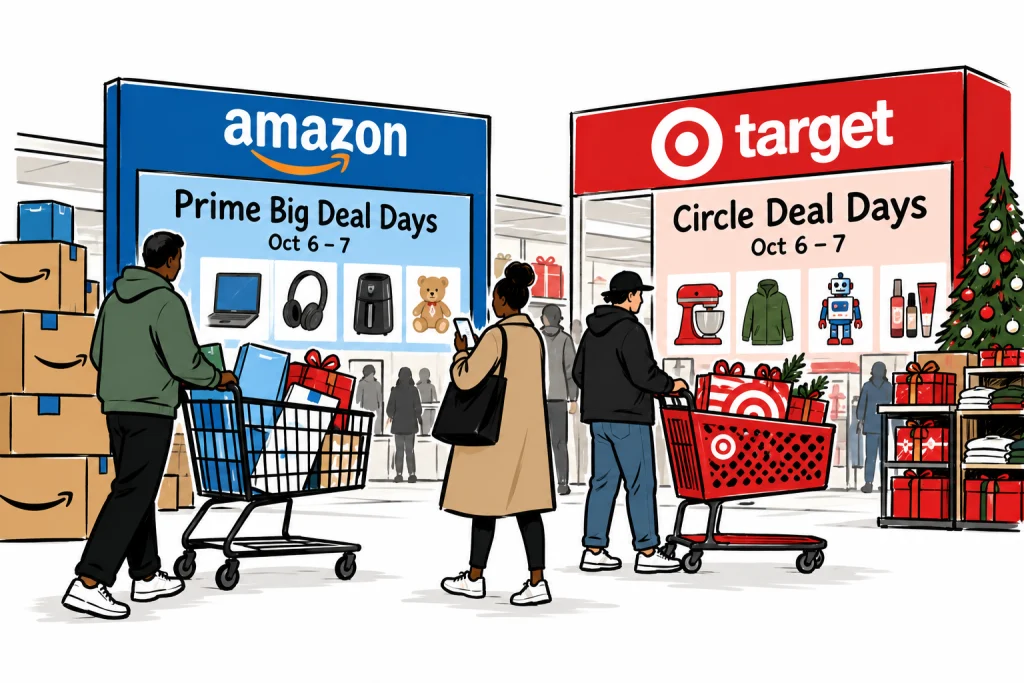
Amazon’s 48-hour Prime Big Deal Days runs October 6–7, putting one of the retailer’s biggest promotional events nearly two months ahead of Black Friday. The sale spans more than 35 product categories, from electronics and beauty to household essentials. For shoppers already planning holiday purchases, that creates an opportunity to compare prices earlier. For Amazon, it creates a chance to capture those purchases before competing retailers get them. Although the CNN Underscored article circulating ahead of the event says the sale starts “tomorrow,” Amazon’s official schedule places its opening on Tuesday, October 6.
Two Retailers, One Shopping Window
Amazon is positioning its fall event around both seasonal needs and early gift buying. Its 2026 deals announcement promotes discounts across electronics, fashion, beauty and toys, alongside fall and Halloween merchandise. That assortment gives shoppers several reasons to browse: replacing a household item, preparing for colder weather or checking someone off a holiday list. The business logic is straightforward. Combining everyday purchases with gifts gives a retailer more opportunities to win a share of the same household budget, even when customers arrive looking for only one product.
Target is competing during the same two-day window. Its Target Circle Deal Days runs October 6–7, with advertised savings of up to 40% across thousands of items, including clothing, beauty, toys and technology. The event is available through its free Target Circle loyalty program, while members of its paid Circle 360 tier received early access to select offers beginning October 5. That overlap gives consumers a useful comparison point: a discount at one retailer can be checked against a competing offer while both events are running. Advertised maximum savings, however, apply to selected merchandise rather than every item.
Bigger Spending Does Not Mean Bigger Buying Power
The sales arrive ahead of a holiday season expected to generate more spending, with higher prices accounting for a substantial portion of that increase. The Mastercard Economics Institute’s holiday forecast projects U.S. retail sales, excluding automobiles and gasoline, will rise 5.5% from a year earlier between November 1 and December 24. It estimates that inflation will contribute 2.8 percentage points of that growth—roughly half the projected increase. Those figures describe dollars spent, so they should not be read as an equivalent increase in the quantity of goods purchased. They also underscore why a larger holiday sales total can coexist with shoppers looking closely at prices.
Mastercard expects online holiday sales to grow 11%, compared with 3.6% for purchases in stores. Those are forecasts rather than results, but they help explain the stakes surrounding October’s competing promotions. Retailers are pursuing customers in a channel expected to grow quickly, and an early purchase leaves less money available for a later competitor. Mastercard also identifies the relatively late Thanksgiving calendar as a potential reason for earlier promotions. For households, spreading purchases across several weeks may make planning easier, although moving a purchase into October does not automatically reduce its cost.
The Price at Checkout Is the Test
Deal coverage adds another layer to the shopping rush. The supplied CNN Underscored article highlights early offers on Apple technology, outdoor equipment, skin care and kitchen products. Its disclosure says the publication may earn commissions when readers buy through its links. That information helps readers understand the commercial relationship behind the recommendations. The excerpt does not provide individual prices or price histories, however, so it does not establish which products are at their lowest prices of the year. Evaluating a particular offer still requires checking the exact model, competing prices, seller and applicable purchase terms.
The next two days will show how successfully Amazon and Target can turn early holiday interest into purchases. Consumers can benefit when a promotion lowers the cost of something already on their list, but an additional purchase still increases the total bill. A useful approach is to set a spending limit before browsing, compare identical products and account for any membership cost needed to access an offer. As October sales compete with the promotions still to come in November, the strongest measure of value will be how much shoppers spend to finish their planned purchases—not how many discounts they collect along the way.