
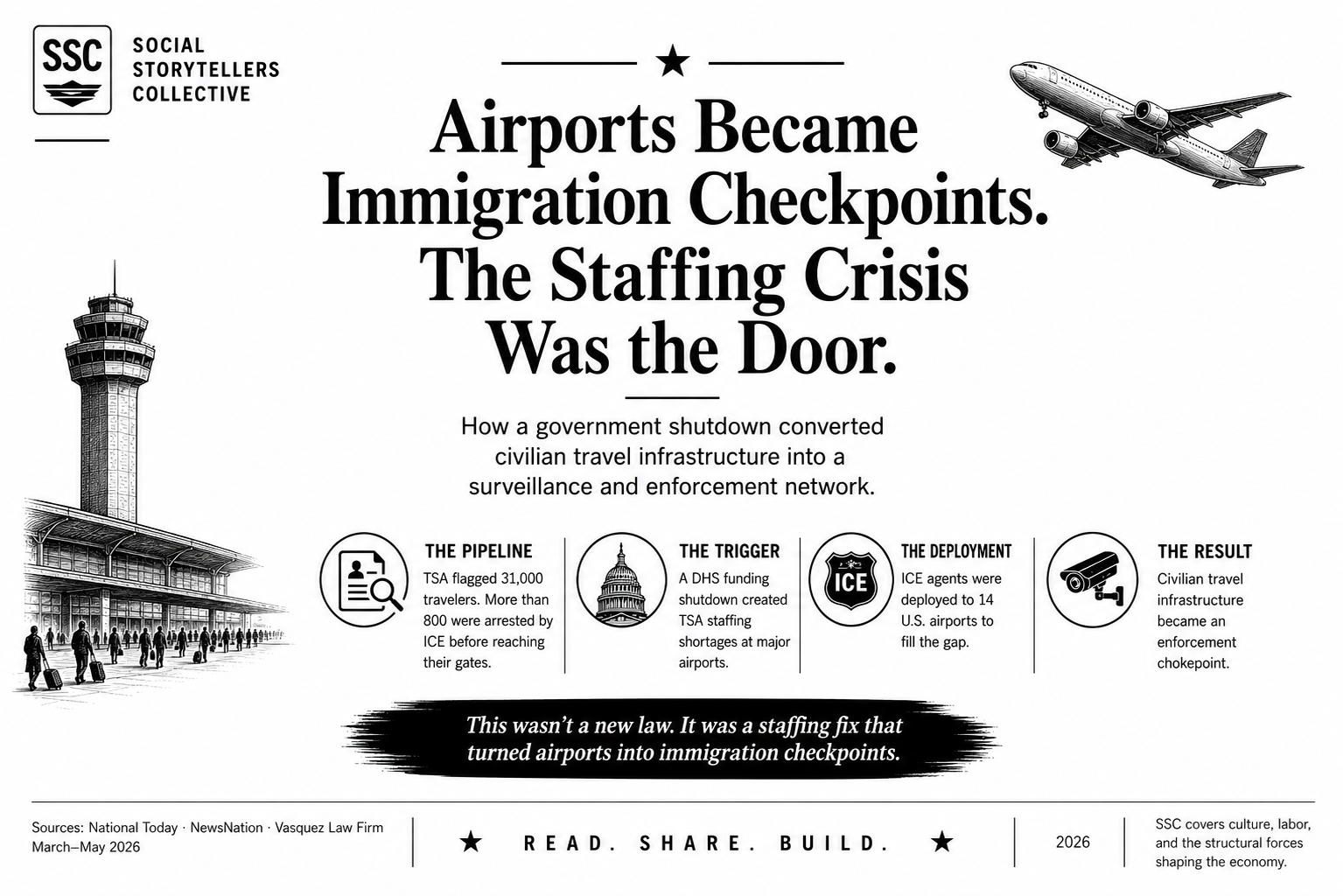
In March 2026, a Guatemalan mother and her 9-year-old daughter were detained by plainclothes ICE officers at San Francisco International Airport moments before boarding a domestic flight to Miami. They had no criminal history. They had lived in the Bay Area for years. What flagged them was data — traveler records that the Transportation Security Administration had already shared with Immigration and Customs Enforcement before they reached the gate. TSA tips to ICE led to the arrests of more than 800 people between January 2025 and the end of February 2026, after 31,000 travelers were flagged for potential immigration enforcement. The arrests didn’t happen in spite of the airport security system. They happened through it.
SSC has been covering the infrastructure conversion of civilian institutions into enforcement tools across multiple beats this year — and this story is the clearest example yet of how that conversion happens without legislation, without public announcement, and without the communities most affected having any warning it was coming. The sequence is the story: a funding fight produced a DHS shutdown, that shutdown generated a TSA staffing crisis, that crisis justified deploying ICE to airports, and ICE presence enabled real-time cross-referencing of traveler data against immigration databases that produced 800+ arrests. Critics, including Rep. John Garamendi, warned that the federal government has moved into an era in which it can have “total knowledge of every single individual” — pointing to parallel data-sharing arrangements involving IRS tax records and Medicaid and Medicare rolls being used to identify deportable immigrants. The airport is one node in a surveillance architecture that is being assembled piece by piece.
The sequence is the story. A funding fight between Congress and the White House over immigration enforcement spending produced a DHS shutdown. That shutdown generated a TSA staffing crisis. That crisis justified deploying ICEto airports. ICE presence at airports enabled real-time cross-referencing of traveler data against immigration databases. And that cross-referencing produced arrests — 800 of them — in a setting where most travelers have no reason to expect enforcement contact and no practical ability to avoid it. Critics, including Rep. John Garamendi, warned that the federal government has moved into an era in which it can have “total knowledge of every single individual” — pointing to parallel data-sharing arrangements involving IRS tax records and Medicaid and Medicare rolls being used to identify deportable immigrants. The airport is one node in a surveillance architecture that is being assembled piece by piece.
What this means practically for communities with large immigrant populations is that domestic air travel — a form of movement historically available to anyone with a ticket — now carries enforcement risk that didn’t exist before. That risk doesn’t distribute evenly. Families traveling to funerals, weddings, medical appointments, or job interviews now have to calculate their immigration exposure before they reach a gate. The controversy isn’t that TSA is running new immigration status checks on everyone at the checkpoint — it isn’t. It is that the airport security pipeline is being used as a chokepoint for immigration enforcement, and the public was not told this was happening. The architecture of the thing — how it was assembled, under what authority, disclosed how — is what makes it durable. It doesn’t require a new law to maintain. It just has to keep running.