
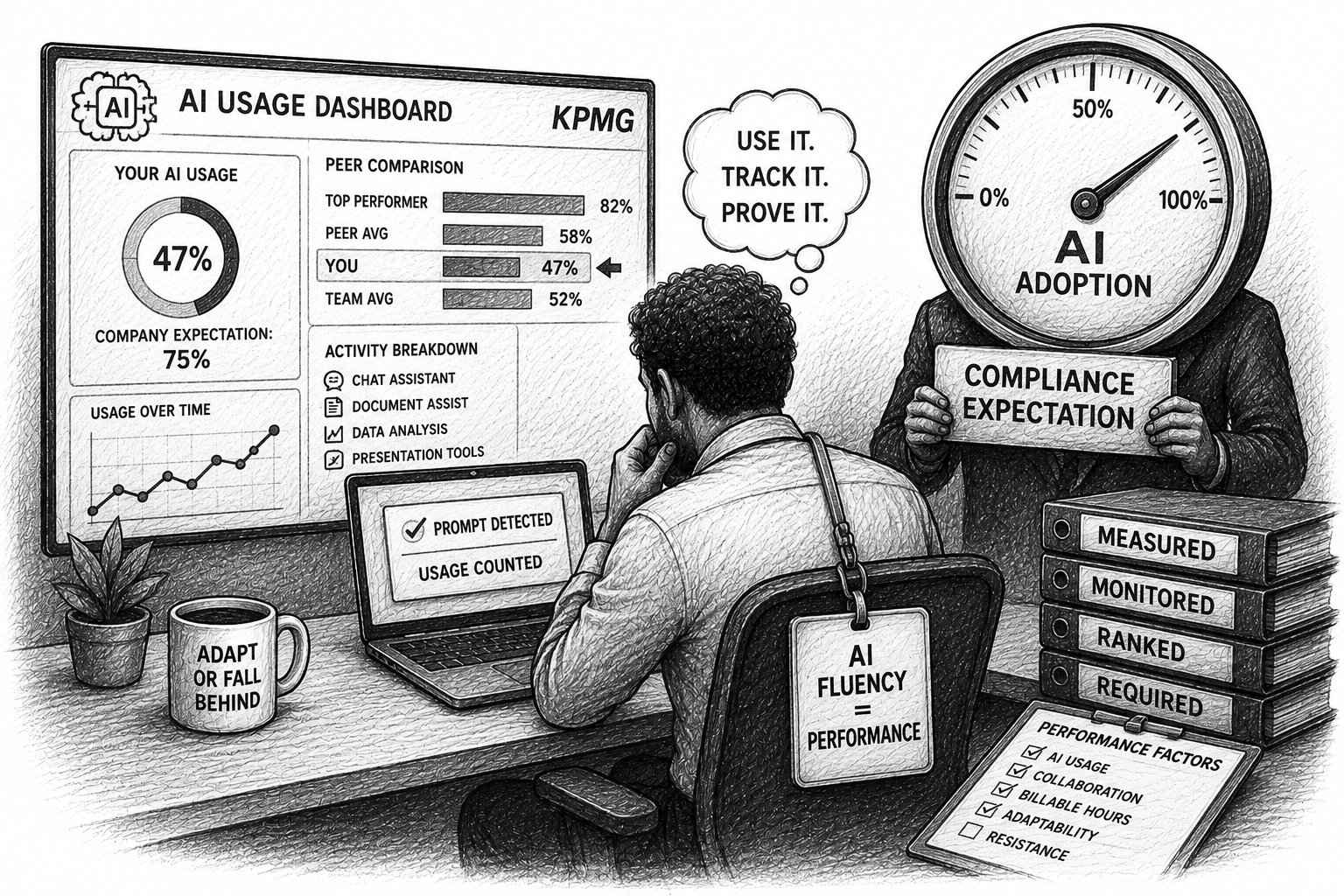
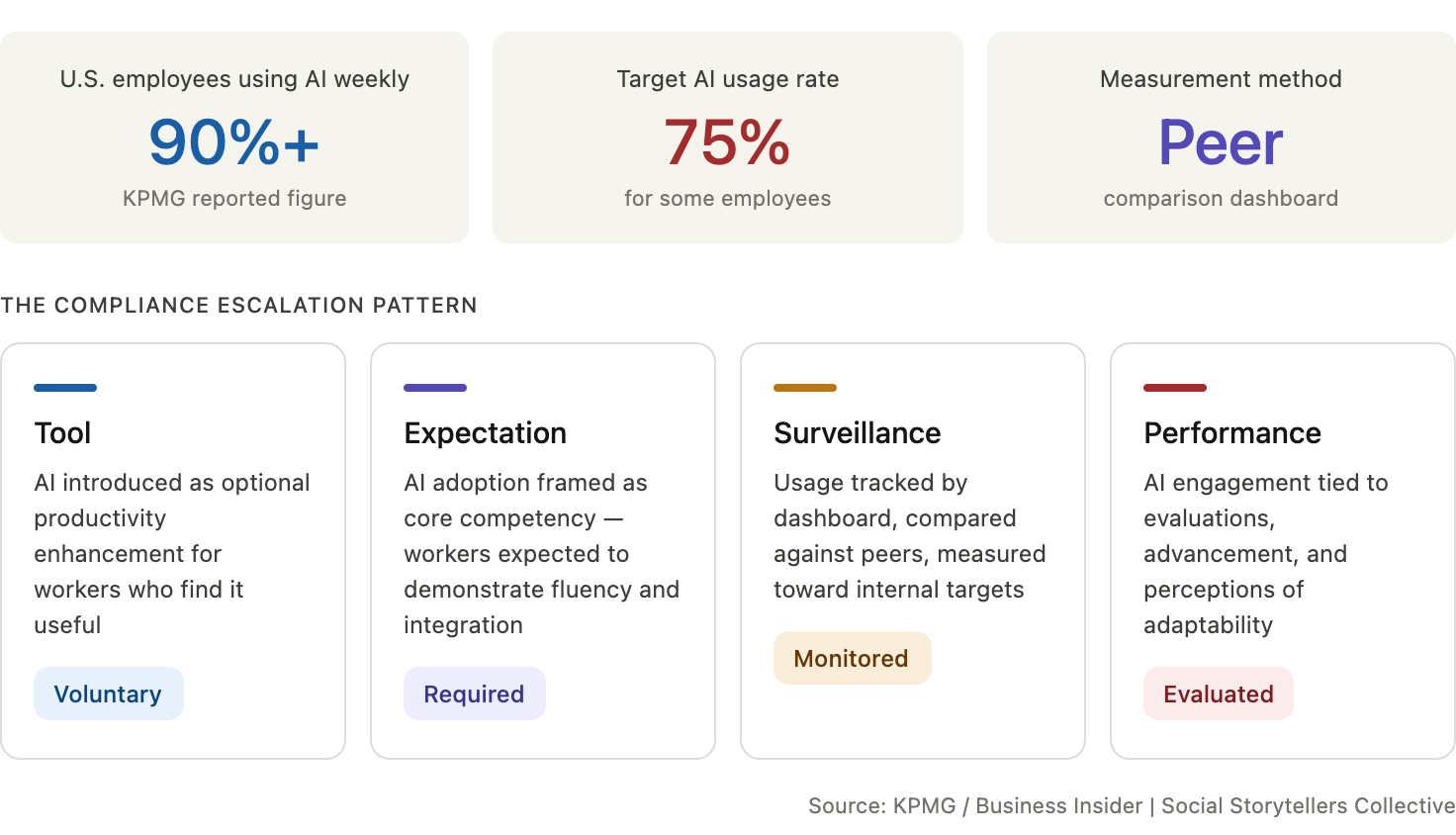
KPMG’s rollout of an internal AI-use tracking dashboard signals a new phase in how companies are integrating artificial intelligence into professional work. According to reporting from Business Insider, the dashboard monitors how frequently employees in KPMG’s U.S. advisory division are using AI tools, compares workers against peers, and measures progress toward internal usage expectations. The firm reportedly expects some workers to reach AI usage rates as high as 75%, with leadership framing adoption as a core competency rather than an optional productivity enhancement.
At first glance, the initiative appears aligned with broader corporate pressure to modernize workflows and accelerate efficiency. But the deeper shift is cultural and behavioral. AI is no longer being introduced simply as a tool employees can leverage if useful. It is becoming something workers are expected to visibly perform. Several employees interviewed noted that the system creates incentives to generate prompts simply to register activity, regardless of whether AI materially improves the work itself. In other words, the metric risks becoming detached from actual productivity and more connected to signaling institutional alignment.
That distinction matters because it reveals how quickly AI adoption is evolving into a workplace surveillance and compliance structure. Throughout modern labor history, management systems have repeatedly transformed behaviors into measurable indicators: email responsiveness, meeting participation, Slack activity, keystroke tracking, productivity dashboards, and now AI engagement. Once behavior becomes measurable, it becomes governable. And once it becomes governable, it often becomes tied — formally or informally — to advancement, evaluations, and perceptions of adaptability. KPMG’s dashboard is one expression of that pattern. Meta’s recently reported Model Capability Initiative is another — logging employee keystrokes, mouse movements, and general computer activity to train its AI models, turning everyday work behavior into training data. One company is measuring whether workers use AI enough. The other is using workers’ behavior to build the AI itself. The direction of both moves is the same: labor becomes legible to the institution in ways it never previously was, and that legibility changes the power dynamic before any formal policy is announced.
The pressure surrounding AI fluency is particularly important in white-collar professional environments where workers increasingly fear technological displacement. Employees are not just learning new systems; they are managing visibility inside an uncertain labor market. In that context, demonstrating AI usage becomes partially defensive. Workers want to avoid appearing resistant, outdated, or inefficient, even when the actual value of certain AI interactions remains unclear. The result is a workplace culture where engagement with technology becomes performative as much as functional.
The larger implication is that AI may reshape work culture before it fully reshapes work itself. The first transformation is not necessarily automation replacing labor outright. It is organizations redesigning expectations around how labor should be performed, documented, and measured. That changes professional identity, workplace anxiety, and power dynamics long before full displacement occurs.