
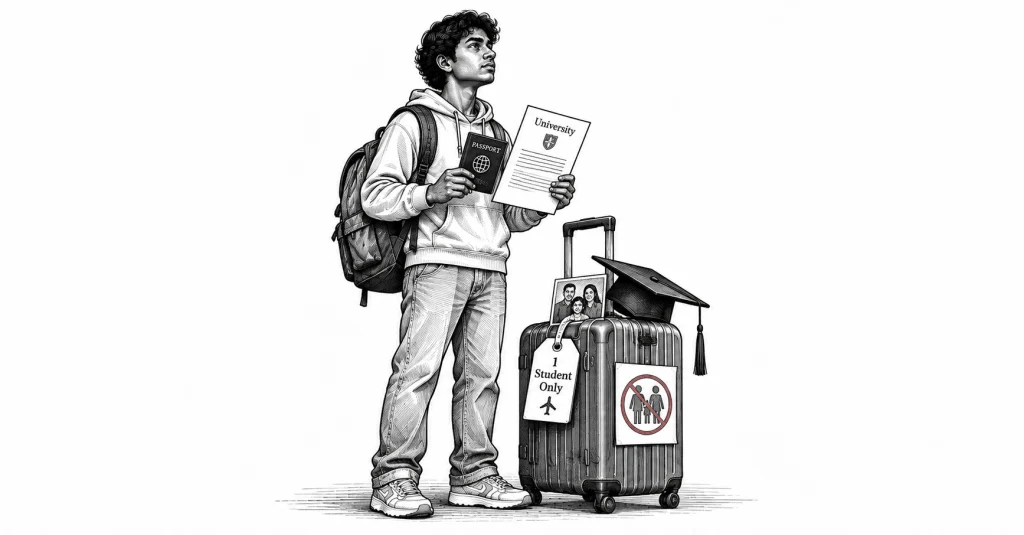
New limits on accompanying family members took effect October 2, with exemptions and protection for families already in Australia. The changes alter the practical decision to pursue an overseas education.
Australia wants to bring annual net overseas migration down from about 300,000 to roughly 225,000 by 2028, Reuters reported when Home Affairs Minister Tony Burke announced the reforms on September 17. One part of that plan took effect on October 2: limits on international students bringing partners and children. Assistant Minister for International Education Julian Hill confirmed the timing in a speech at the National Migration Conference, according to The PIE News. For prospective students outside the exemptions, the decision no longer turns only on whether a university offers admission. It also turns on whether they can pursue that education without a partner or children beside them.
The rule changes the household calculation
Dependant visas now remain available only to family members of doctoral candidates, recipients of Australian or foreign government scholarships, and students from ASEAN or Pacific Island nations. Even eligible families must be included in the student’s initial visa application. No family member can be added as a “subsequent entrant” after the visa is granted, and the Department of Home Affairs says that rule applies to everyone, including the exempt groups. The restrictions also extend to Temporary Graduate visa holders. Families already in Australia are protected through grandfathering, which Hill described as a way to avoid separating households that are already in the country. Because of these details, the policy cannot accurately be described as a blanket order splitting up families already living there. They also mean future applicants will face very different conditions depending on their course, nationality, funding and family circumstances.
Consider two hypothetical students admitted to comparable programs. One has no dependants and can weigh tuition, accommodation and travel as an individual. The other has a partner and a child and must also judge whether a household can be maintained across two countries. The rule may add little practical difficulty for the first student while changing the second student’s decision substantially. The exemption for doctoral candidates matters most to the people it covers. The Council of Australian Postgraduate Associations has noted that postgraduate research students bring about 61 dependants for every 100 students, four times the rate for coursework students. None of this establishes how many applicants will withdraw or choose another destination. It does identify a consequence worth reporting: a condition imposed through a visa can shape who is able to use an academic opportunity.
Migration control reaches into education planning
The government frames the reforms around visa integrity and the management of migration, and separate measures address students who move between courses and providers. The PIE reports an interim restriction on provider transfers during the first 12 months of a principal course. It also reports a dedicated transfer-visa stream due to begin July 1, 2027, which SBS says is expected to cost about half the original visa fee. Holders of working holiday, training, temporary employer and similar visas can no longer apply for a student visa from inside Australia. These rules have different timelines and should not be collapsed into one immediate requirement. The family restrictions govern who can accompany a student, while the transfer rules govern changes to the student’s educational pathway. Both affect planning, but through different decisions and procedures.
For institutions recruiting internationally, the practical challenge is to explain these conditions before an applicant commits money or reorganizes family life. An admission offer cannot answer every immigration question, so recruitment materials need to make clear what the institution can promise and which decisions rest with the government. That matters more when rules change between the start of a search and the intended start of study, and when the government is already refusing more applications. SBS reports that student visa refusals reached a record 35% in August. A useful follow-up would examine what applicants were told, when they were told it and whether they had enough information to make an informed choice.
The economic effect needs evidence
International education was worth A$53.6 billion to Australia, Reuters reported in September, so the consequences reach beyond individual applicants. The government linked lower migration to easing pressure on housing, while education-sector leaders warned about the potential damage to the industry. Both arguments need evidence over time. Lower student migration does not by itself show how much housing becomes available, and a restriction does not by itself show how large an enrollment or revenue decline will be. Applications, acceptances, actual arrivals and institutional finances will show how the policy works in practice.
The next phase of the story should follow prospective students alongside the national totals. A migration target can show whether fewer people arrive. It cannot show every educational decision that was abandoned, delayed or redirected along the way. Universities and officials will need to explain whether the reforms achieve their stated objectives and how they affect genuine applicants with families. For those students, the opportunity is no longer defined only by a degree, its price and its career prospects. It also depends on whether the household that supports the student can come along.
Sources: Reuters, “Australia cracks down on student and backpacker visas to curb migration,” September 17, 2026; The PIE News, “Australia’s student visa restrictions take effect, curbing dependants and onshore applications,” October 2, 2026; The PIE News, “Australia squeezes dependants as wider student migration questions emerge“; The PIE News, “Australia to restrict student dependants amid warnings of talent loss“; SBS News, “New student visa crackdown comes with extra cost for course-switchers,” October 2, 2026.