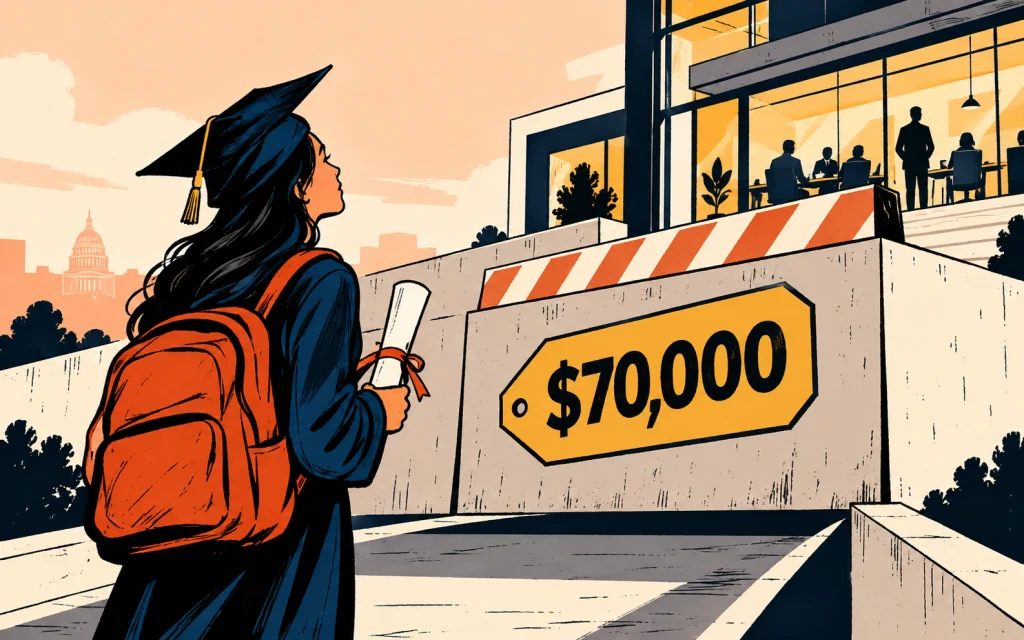
The administration’s proposal would put a new price on the bridge between an American degree and an American job — and universities may not be the only ones who end up paying.
International students already pay a premium to study in the United States. Under a new proposal from the Trump administration, the next step after graduation could become dramatically more expensive too. Business Insider reports that the administration has proposed requiring U.S. universities to pay a $70,000 fee when an international student works through Optional Practical Training, or OPT, with an additional $30,000 for later OPT periods. The Department of Homeland Security says the fees are intended to strengthen oversight and address fraud. The proposal is not final. But even before implementation, the size of the charge changes the economics of one of the country’s most important education-to-work pipelines.
OPT allows eligible international students to work in fields related to their degree, typically after completing their studies. For many students, it is the practical bridge between earning an American credential and gaining the U.S. work experience that employers expect. For universities, that bridge is part of the value proposition used to recruit international students. For employers, it is a source of trained graduates in science, technology, business and other fields. A $70,000 fee inserted into that chain would force institutions to decide which students, programs or employers are worth subsidizing.
Business Insider spoke with immigration attorneys who warned that universities could pass some or all of the cost to students. That possibility is especially consequential because international students are already more likely to pay full tuition and are often ineligible for the same public aid available to domestic students. The result could be a system in which the ability to obtain U.S. work experience depends not only on academic performance or employer demand, but also on whether a student or institution can absorb another five-figure charge.
The pressure would not stop with students. Universities that depend heavily on international enrollment could face a recruiting problem if the post-graduation pathway becomes less predictable or more expensive. International students contribute substantial tuition revenue to many institutions, and that money often supports broader academic operations. If fewer students decide a U.S. degree is worth the cost, schools could lose revenue at the same time they are being asked to pay more to help graduates remain in the labor market.
Employers would feel the effects further down the pipeline. Companies that hire international graduates often recruit from U.S. campuses precisely because those students have already been trained inside American institutions. If OPT participation falls, employers may have a smaller pool of graduates available for entry-level roles, particularly in fields where specialized skills are difficult to fill. The proposal could therefore restrict a workforce pipeline while the administration argues it is tightening oversight of it.
The policy also raises a broader access question. A fee this large does not simply discourage misuse; it can change who is able to participate at all. Wealthier universities may be able to subsidize selected students. Smaller institutions may not. Students from families with greater resources may be able to absorb new costs. Others may choose Canada, Europe, Australia or another destination where the path from degree to work is easier to price and understand.
The proposal is still just that: a proposal. Current students are being advised to continue planning, apply for OPT or STEM extensions early and monitor the rulemaking process. But the direction is already clear enough to matter. The United States has long sold international education as a combination of academic prestige and professional opportunity. If access to that opportunity comes with a $70,000 gate, the market will decide how many students still believe the promise is worth the price.