
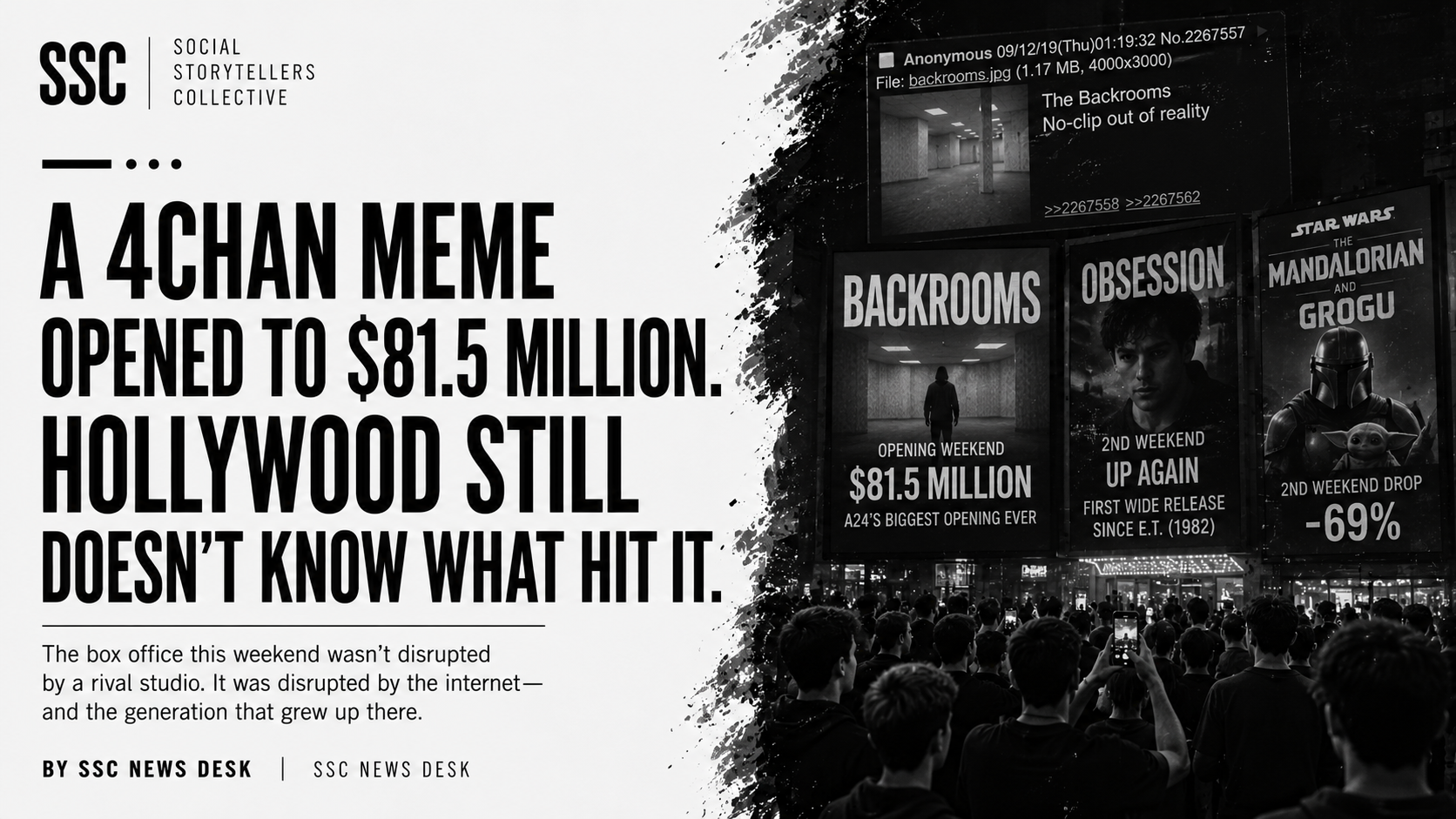
The two biggest movies in America this weekend were both directed by YouTubers in their twenties. Neither had a franchise behind it. Neither had a legacy IP, a recognizable brand, or a studio development deal that stretched back years. One of them started as a photograph posted on 4Chan.
Backrooms opened to a projected $81.5 million, marking A24’s biggest debut in the company’s history and the largest domestic opening of a horror film that isn’t based on a book or a sequel — not adjusted for inflation. The film was directed by a 20-year-old who built his audience online before he ever walked onto a studio lot. The second-place film, Obsession, is the first wide release since E.T. in 1982 to grow its ticket sales in both its second and third weekends. It was directed by a 26-year-old who also came up through the internet. Meanwhile, Star Wars: The Mandalorian and Grogu — backed by one of the most powerful entertainment brands ever assembled — dropped 69% in its second weekend against competition that the conventional wisdom said was basically meaningless.
Something is being confirmed here that the entertainment industry has been slow to absorb. Gen Z is not opposed to going to movies. They are opposed to going to movies that were not made for them — corporate-managed franchise products designed by committee to protect existing IP rather than create something new. What they will show up for is authenticity, novelty, and creators they already have a relationship with. The internet did not just change how people find culture. It changed who they trust to make it.
This is the part the box office analysis keeps underweighting. Backrooms did not succeed despite being low-budget and internet-native. It succeeded because of it. A24 understood that the film’s origin story — 4Chan photograph, YouTube series, 20-year-old director, no legacy studio infrastructure — was not a liability to manage. It was the whole marketing argument. The audience that showed up already knew the lore, already trusted the creator, and already felt ownership over the story before they bought a ticket. That is a fundamentally different relationship between audience and content than anything a franchise trailer can produce.
The distributional dimension of this shift matters and is going largely unexamined. The gatekeeping infrastructure of Hollywood — development deals, studio relationships, film school pipelines, the slow credentialing climb from assistant to director — has historically determined whose stories get told and whose creators get financed. YouTube does not eliminate that gatekeeping, but it creates a parallel track that the traditional system cannot control and, increasingly, cannot compete with. A 20-year-old with a camera, an internet audience, and a story rooted in a subculture that predates his career is now capable of opening a film larger than anything the Star Wars franchise produced this month. The door that was supposed to be locked just blew off its hinges.
What Hollywood is facing is not a bad quarter. It is a succession crisis — and the successors did not come from inside the building.