
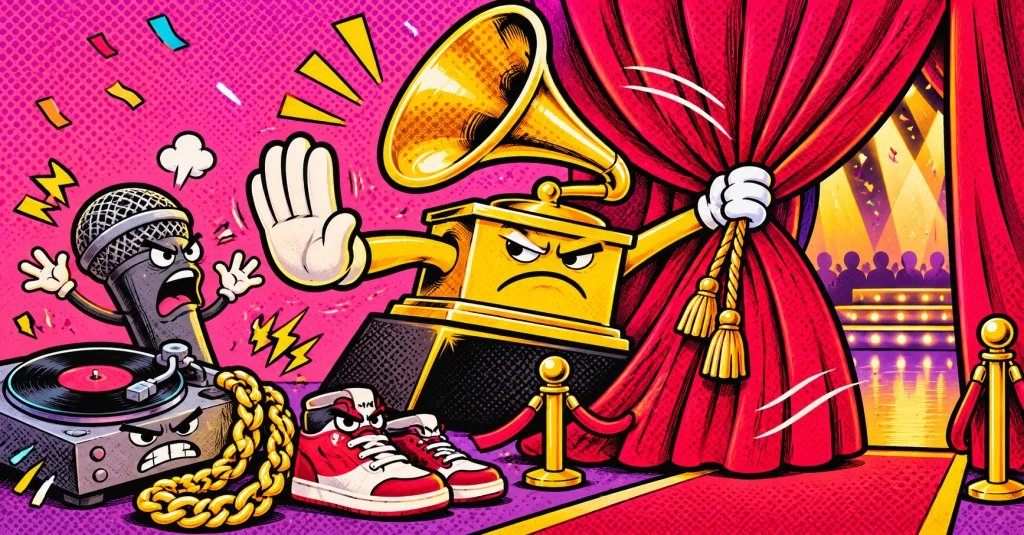
Zero rap nominees across Album, Record and Song of the Year isn’t a fluke of a slow year. It’s the Recording Academy’s oldest habit, finally out in the open.
Twenty-four slots. That’s how many nominations the Recording Academy handed out on November 16 across its three biggest categories: Album of the Year, Record of the Year and Song of the Year, eight apiece. Not one went to a rap artist or a rap song, Complex reported.
Twenty-four chances, and the most commercially and culturally dominant American genre of the past three decades couldn’t get through the door once.
The Academy and its defenders already have an explanation ready. It was a down year. The big names sat out. The market cooled. All of that is partly true. None of it excuses what happened.
The “weak year” alibi
Let’s take the defense seriously, because it isn’t baseless. Kendrick Lamar, Tyler, The Creator and Clipse, who filled the Album of the Year field a year ago, had no major projects eligible this cycle. Drake reportedly held back three 2026 albums. And the commercial numbers really did slip. In October 2025, the Hot 100 went without a rap song in its top 40 for the first time since 1990. Luminate’s midyear report showed R&B/hip-hop’s share of the Billboard 200 falling from 40% to 30%.
Riggs Morales told Billboard it was “a pretty weak year for standout [hip-hop] releases with storylines, with narratives,” adding, “It happens every few years.”
Read that quote again. Not weak music. Weak storylines. That’s the tell.
The Grammys aren’t supposed to reward narratives. They’re supposed to reward recordings. If a rap album needs a superstar, a feud or a cultural moment to be taken seriously in Album of the Year, while a pop or rock record only has to be good, then the problem isn’t the year. It’s the standard.
Rap gets its own room, and it’s expected to stay there
Look at what the Academy did nominate. Best Rap Album includes Busta Rhymes and J Dilla’s Dillagence II, Cardi B’s Am I the Drama?, Rapsody’s God Gotta Afro & Gold Hoops, Don Toliver’s Octane, Wale’s Everything Is a Lot. and Kanye West’s Bully – Deluxe.
So the voters found six rap albums worth honoring. They just didn’t find one worth putting next to Taylor Swift, Bruno Mars, Olivia Rodrigo or Phoebe Bridgers.
That pattern isn’t new. Complex points to the clearest example: West’s My Beautiful Dark Twisted Fantasy won Best Rap Album and never made the Album of the Year field. It is one of the most acclaimed albums of its era, and the Academy decided it belonged in the genre room.
This is what a shutout like this one actually reveals. Rap reaches the top categories when it’s too big to ignore, as it was for the past two years, when Lamar won Record and Song of the Year back to back with “Not Like Us” and “Luther.” When no one is forcing the issue, the default reasserts itself, and the default is a separate category.
Don Toliver is the proof
Don Toliver is the clearest test case. Billboard’s Album of the Year predictions singled out Octane as the rap album with the best shot at the category. It missed. Yet Toliver landed a Best New Artist nomination, which means voters noticed him, rated him, and still didn’t put his album among the year’s best.
That’s not a snub born of ignorance. It’s a judgment. And it’s the same judgment the Academy has made about rap for most of its history: good, sometimes great, but not quite Album of the Year great.
Who’s doing the choosing?
The Recording Academy has nearly 16,000 voters. Chris Anokute told Billboard before the nominations that if hip-hop were totally shut out, “then we have a big problem… then there’s definitely an issue with the complexity of who’s voting.”
Hip-hop was totally shut out. So the Academy owes an answer to the question Anokute raised. It spent years promising reform after past controversies over its voting and its treatment of Black artists. A ballot like this one is exactly where those reforms should be visible. Instead, the result looks like the Academy that passed over My Beautiful Dark Twisted Fantasy more than a decade ago.
The Academy may say the voting body has changed. If so, it should show its work: who these voters are, which genres they come from, and how many rap releases they actually listened to before filling 24 slots without one.
The cost of looking away
There’s a reason this matters beyond trophies. The Grammys still shape which records get remembered as the defining work of a year. When the top of the ballot erases a genre, it tells younger artists and audiences which kinds of music count as art and which count as product.
Rap built much of the modern music business. It doesn’t need the Recording Academy’s validation to survive. But the Academy needs rap’s credibility more than it likes to admit. Every time it retreats to the safe choice, it confirms what its critics have said for decades: that the institution follows hip-hop’s popularity but has never fully accepted its artistry.
Voting for the 69th Grammy Awards begins in December, and winners will be named February 7, 2027, in Los Angeles. Nothing that happens that night can fix these nominations. The Academy can only decide whether it will keep calling a pattern a slow year.