
For the first time in nearly a decade, Boston renters have breathing room.
Apartment availability in the city has surged to its highest level in years, with the Real-Time Availability Rate — the share of units that are either vacant now or coming available soon — climbing past 8% this spring, according to data from Boston Pads. That figure is 45% higher than it was at the same point last year, and it represents the first time availability has exceeded pre-pandemic levels since COVID reshaped the rental market in 2020.
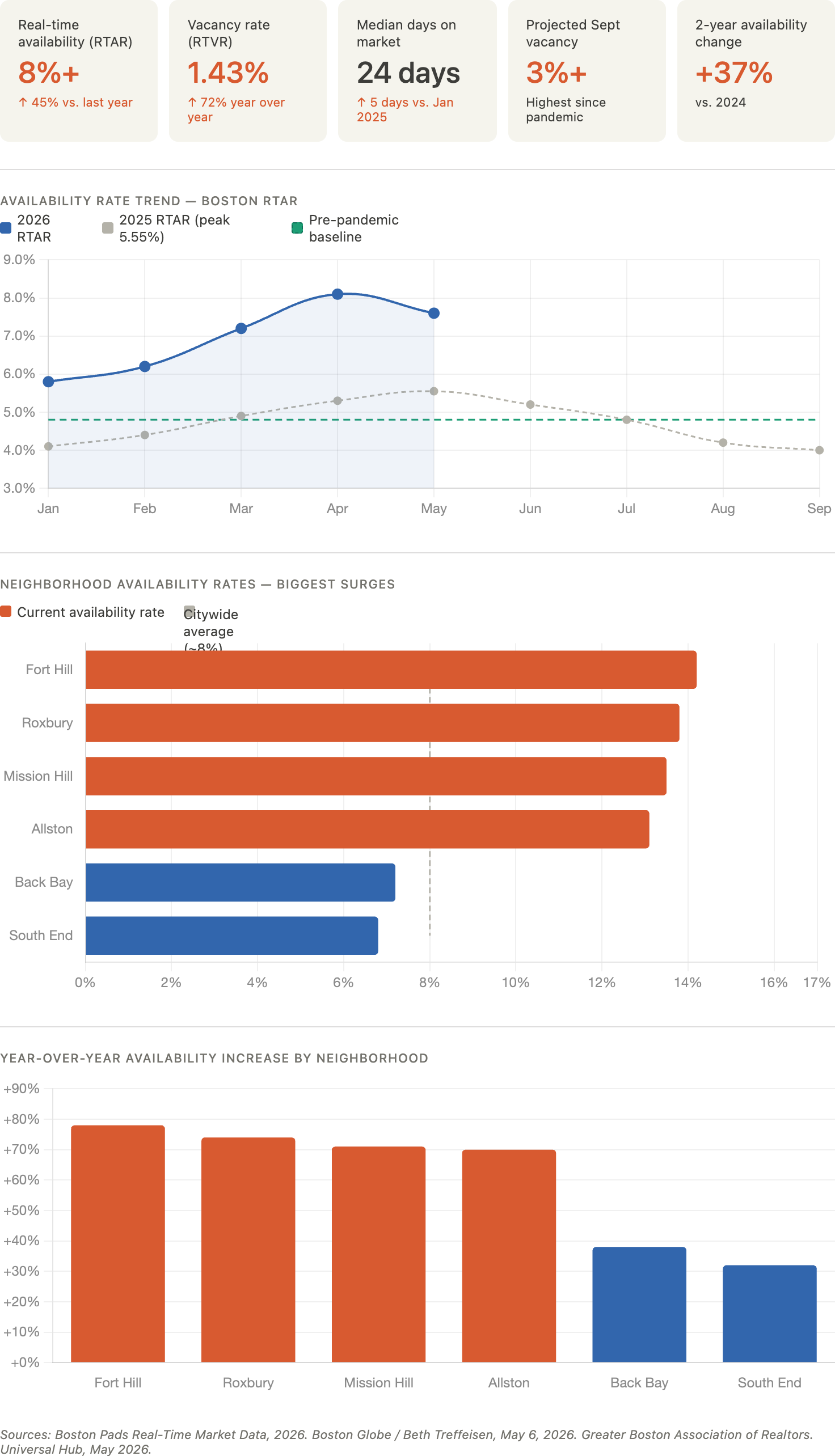
For a city that has functioned for years as one of the tightest rental markets in the country, this is a notable shift. Apartments that used to disappear within days are now sitting on the market for an average of 24 days — five days longer than in January 2025. Renters are taking more time. They are reading the fine print. They are choosing based on amenities rather than desperation.
“There’s more inventory than we’ve seen in probably 10 years,” Jamie Thompson, a real estate broker and president-elect of the Greater Boston Association of Realtors, told the Boston Globe. “It’s something that we’re not used to seeing.”
But where that inventory is concentrating — and why — tells a more complicated story than the headline suggests.
The neighborhoods carrying the weight
The availability surge is not evenly distributed across Boston. The biggest jumps are happening in Fort Hill, Roxbury, Mission Hill, and Allston, where availability rates have climbed above 13% with year-over-year increases of 70% or more, according to Boston Pads data.
These are not Boston’s wealthiest neighborhoods. They are historically Black and Latino communities that have absorbed the city’s housing pressure disproportionately for generations — the neighborhoods where residents stayed not because rents were manageable but because they had nowhere else affordable to go. The sudden appearance of options in these zip codes is worth examining carefully. Availability climbing in Roxbury and Mission Hill is not the same story as availability climbing in the Back Bay. One signals a market loosening. The other may signal something closer to displacement having already done its work — a neighborhood where longtime residents have already been pushed out, leaving units that the market is now struggling to refill at prices the remaining community cannot sustain.
That distinction matters because Boston’s rental market has never been neutral geography. The neighborhoods now showing the most availability are the same ones that bore the brunt of decades of underinvestment, redlining, and speculative development that steadily eroded affordable stock while pushing working-class Black and Latino residents further from the city’s economic core.
What’s driving the shift
Several forces are converging at once. New construction has been accelerating across Greater Boston after years of sluggish permitting — a response to sustained political pressure and state-level housing legislation designed to force municipalities to zone for more density. Units that were in the pipeline two and three years ago are now coming online at the same moment that demand is softening.
That demand softening has its own drivers. International student enrollment at Boston’s major universities — a reliable source of rental demand in neighborhoods like Allston and parts of Roxbury — has declined as Washington’s crackdown on foreign student visas begins filtering through university housing markets. Northeastern and Boston University, both historically heavy enrollers of international students, are feeling it. The ripple moves quickly in a city where student renters have long been a structural pillar of the housing ecosystem.
There is also a broader behavioral shift underway. Remote and hybrid work — now fully normalized across the knowledge economy — has loosened Boston’s geographic grip on workers who once needed to be walking distance from downtown. More people are moving to Lowell, Haverhill, and communities in southern New Hampshire and Rhode Island, trading commute time for cost. That outward migration reduces pressure on the urban core even as the city’s population continues growing modestly.
The national context
Boston is not alone in this moment. Across the country, rental markets that spent 2021 through 2024 operating at historic tightness are beginning to exhale. Sun Belt cities — Austin, Phoenix, Nashville, Charlotte — saw massive apartment construction booms in the post-pandemic years, and that supply is now landing in markets where demand has cooled. Vacancy rates in those metros have climbed sharply, and concessions — free months, waived fees, upgraded finishes — have returned after years of disappearing entirely.
The difference in Boston is scale and speed. This is not a Sun Belt oversupply story. Boston’s vacancy rate remains low by national standards — the Real-Time Vacancy Rate sits at 1.43%, even with its 72% year-over-year increase. What Boston is experiencing is less a market correction than a momentary loosening of a coil that has been wound very tight for a very long time.
That coil is still wound. Rents have not fallen. The median asking price for a Boston apartment has not moved meaningfully downward. What has changed is leverage — renters have slightly more of it than they did twelve months ago. In Boston, that is not a small thing.
What it means and what it doesn’t
The Boston Pads data tracker described the spring climb in availability with a specific image: “It’s going tick, tick, tick, tick, tick. It reminds me of going up Space Mountain or Jurassic Park. It’s still going up. But when does it start going down?”
The drop began in May as college students graduated and seasonal demand picked up. But availability remains historically elevated, and the vacancy rate is projected to hit its highest level since the pandemic by September.
For renters actively in the market right now — particularly young professionals, recent graduates, and working families — this is a genuine window. More options. Slower decisions. Less competition per unit. In a city where the opposite has been true for a decade, that matters.
But for the communities where this availability is most concentrated, the question is not whether the window is open. It is who gets to walk through it — and whether the rents behind it have already moved beyond the reach of the people who built those neighborhoods in the first place.
Sources: Boston Globe (Beth Treffeisen, May 6, 2026). Boston Pads 2026 Boston Apartment Rental Market Report. Greater Boston Association of Realtors. Universal Hub, May 2026.