
For centuries, Christianity has been the largest religion on Earth. According to new projections from Pew Research Center released Wednesday, that run is about to end: Muslims are expected to outnumber Christians worldwide by 2035.
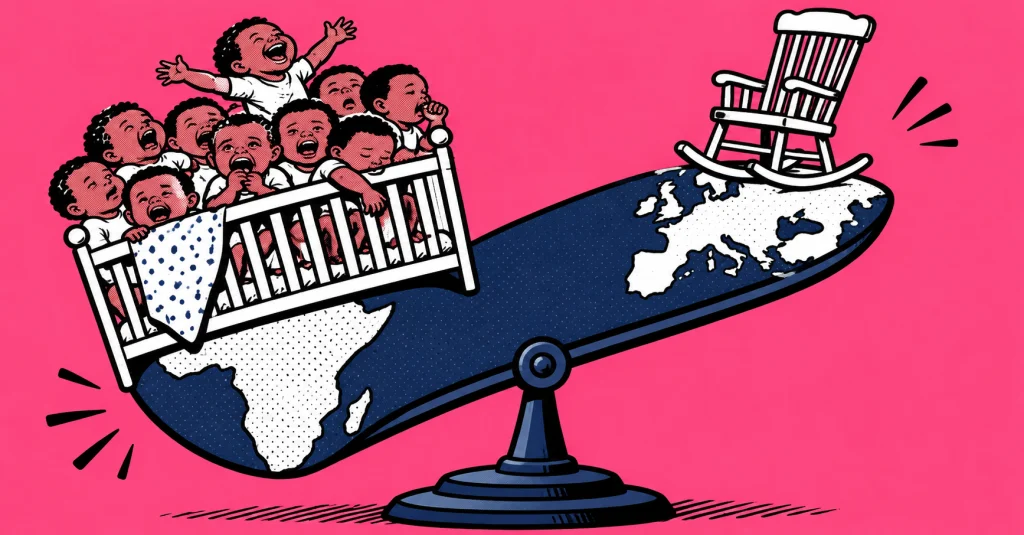
That headline will travel fast, and it will get bent along the way. Some readers will see a story about conversion, others a story about migration, and some will see a threat. Pew’s data tells a quieter and more interesting story. This shift is being driven mostly by babies, age and where in the world people happen to live, not by anyone changing their mind about God.
The numbers
If recent trends hold, there will be more than 3.6 billion Muslims and just under 3 billion Christians by 2070. Both groups are growing. The difference is speed: Muslims are projected to grow 80% over those 50 years, while Christians grow 30%, about the same as the world’s population as a whole (29%).
That gap reshapes the global picture. Muslims rise from 26% of humanity in 2020 to 36% in 2070, while Christians hold steady at about 29%. Hindus and Jews keep growing in number but shrink as a share of the world. Buddhists decline on both counts. People with no religious affiliation, often called “nones,” fall from 24% of the world to 17%.
It’s about births, not converts
Pew is blunt about this point: most new members of the major religions are babies born into them, not adults who convert. During 2020-2025, Muslim women averaged 3.1 children, compared with 2.0 for everyone else. Muslims are also the youngest major religious group, with a median age of 24 compared with 33 for non-Muslims, so more of them still have their childbearing years ahead.
Geography amplifies all of it. Most of the world’s population growth this century will happen in sub-Saharan Africa, where more than a quarter of humanity will live by 2070. Nearly everyone there is Christian or Muslim, so the region’s high fertility and rising life expectancy lift both faiths.
That is why Christianity’s share stays flat even as it shrinks in country after country. Pew projects the Christian share falling by at least 5 percentage points in 61 countries, yet 54% of the world’s Christians will live in sub-Saharan Africa by 2070, up from 31% in 2020. The Democratic Republic of the Congo is on track to pass the United States as the country with the most Christians. The center of gravity for the world’s largest faith is moving south, and many Americans have not noticed yet.
The China paradox
The strangest finding in the report concerns people with no religion. Most countries will have more “nones” in 2070 than they do today, yet the global number is projected to fall. Both things can be true because of China.
In 2020, China was home to two-thirds of the world’s religiously unaffiliated people. China’s population is expected to shrink sharply, so even with about nine in ten Chinese remaining unaffiliated, the country loses roughly 361 million “nones” by 2070. The rest of the world gains about 180 million, which falls far short of offsetting that loss.
It is a useful reminder that a global average can hide what is happening almost everywhere. Pew’s breakdown of the unaffiliated population shows secularization still spreading country by country, even as the worldwide share drops. Switching runs mostly one way: Pew expects 117 million more people to leave religion than to join one between 2020 and 2070, and most of those leaving are former Christians.
What it means for the United States
The U.S. is projected to lose its Christian majority by 2070, though Christians would remain its largest religious group. The unaffiliated share is expected to climb to about 41%. Jews, the country’s third-largest religious group in 2020, are projected to be outnumbered by both Muslims and Hindus.
Unlike the global story, the American shift is driven mostly by switching. Christians in the U.S. lose more people than they gain, and unaffiliated Americans skew younger, which gives them more room to grow. Canada and Germany are also on track to lose their Christian majorities, while France, the United Kingdom and South Korea are projected to become majority-unaffiliated.
That trend is not a straight line. SSC has reported that young Americans aren’t abandoning religion, even if many aren’t returning to church, and Pew itself notes that the U.S. unaffiliated share has leveled off. Faith also remains a fault line in politics. We’ve covered how religion still divides the American vote and how Abdul El-Sayed’s Senate race is testing how voters weigh faith.
Projections, not prophecy
The date keeps moving. Pew’s first projections in 2015 had Muslims and Christians roughly equal around 2070, with Muslims pulling ahead only after that. The new study moves the crossover up to 2035, and Pew’s methodology explains how the new model and data differ from the earlier work.
Pew is candid about its misses. Its last round predicted that “nones” would begin shrinking as a share of the world between 2010 and 2020, but they actually grew, from 23% to 24%. The model assumes today’s rates of switching and migration will continue, so it cannot anticipate a sudden wave of people leaving religion or a revival that brings people back. Pew acknowledges both possibilities, and the second one has some evidence behind it in the U.S., where the youngest adults are by some measures more religious than the generation before them.
How to read this headline
“Muslims will outnumber Christians” is accurate, but it is not a story about one faith overtaking another. It is a story about which parts of the world are young and growing and which are aging and shrinking. Europe’s population is projected to fall 17%, while sub-Saharan Africa’s surges. The religious map is following that demographic map.
It also lands in a climate where demographic change is easily turned into fear. SSC has documented how a Muslim Senate candidate is being called a terrorist, and numbers like these are easy material for that kind of rhetoric. The more accurate reading is less dramatic: the future of the world’s largest faiths will be written mostly in Lagos, Kinshasa and Karachi, by families making ordinary decisions about how many children to have.
Sources
- The Future of World Religions: Population Growth Projections, 2020-2070, Pew Research Center
- The Future of the Global Christian Population, Pew Research Center
- The Future of the Religiously Unaffiliated Population Around the World, Pew Research Center
- Methodology, Pew Research Center