
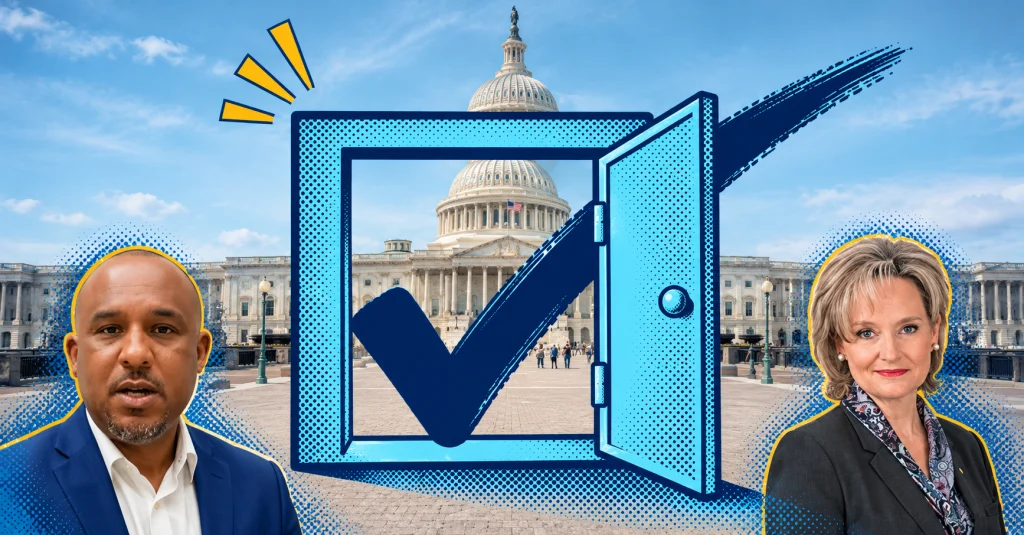
Scott Colom’s win is a verdict on a state’s history and on the politics of right now. Mississippi’s voters chose something new, and they meant it.
By Will Davison Jr. | November 11, 2026 | 5 min read
In April 2023, Sen. Cindy Hyde-Smith stopped Scott Colom from becoming a federal judge. Joe Biden had nominated the Columbus district attorney to the U.S. District Court for the Northern District of Mississippi. Her Republican colleague Roger Wicker signed off, and so did two former Republican governors, Haley Barbour and Phil Bryant. Hyde-Smith refused to return her “blue slip,” a Senate custom that lets a single home-state senator kill a district court nomination without a vote. She cited money a Soros-funded PAC had spent on his first DA race and a letter he signed supporting transgender Mississippians. On Wednesday, the Associated Press called Mississippi’s Senate race for Colom. The voters gave him a bigger job than the one she took from him, and they gave him hers.
The weapon she used has a history. As Mississippi Today documented in 2023, the blue slip became a single-senator veto under James Eastland, the Mississippi segregationist who chaired the Senate Judiciary Committee from 1956 to 1978 and used it to keep the federal bench safe for Jim Crow. Nearly 70 years later, a Mississippi senator used the same custom to keep the first Black district attorney of a majority-white Mississippi district off that bench. I don’t think the history makes her motive racial. I think it shows how long Mississippi’s power structure has relied on quiet procedural vetoes to decide who gets to hold power. On Tuesday, November 3, the voters overruled one.
Mississippi’s history with race isn’t distant. It’s the state where Medgar Evers, a World War II veteran who landed at Normandy, came home to register Black voters and was shot in his own driveway in Jackson in 1963. It took three decades to convict the man who killed him. A year after Evers was murdered, in June 1964, three young civil rights workers disappeared in Neshoba County during Freedom Summer, the campaign to register Black Mississippians to vote. James Chaney was a Black Mississippian from Meridian. Andrew Goodman and Michael Schwerner were white volunteers from New York. A sheriff’s deputy arrested them, released them after dark, and handed them to the Ku Klux Klan, which shot all three. Their bodies were found 44 days later, buried in an earthen dam. Mississippi wouldn’t bring a murder case, and it took federal civil rights charges in 1967 to convict any of the men involved. The man who organized the killings wasn’t convicted until 2005, 41 years later.
Colom ended his campaign in front of the Evers home. “He was killed for helping Mississippians vote,” he said in the ad. He could have said the same about Chaney, Goodman and Schwerner, and nobody needed it explained. It’s also the state where, in 2018, Hyde-Smith joked about attending a “public hanging” and still won. And it’s the state where, less than a week ago, three Black women at Ole Miss filmed classmates making monkey gestures outside their apartment door. One of those classmates now has a crowdfunding campaign raising money for her refusal to apologize. The past keeps showing up here because nobody ever made it leave.
It’s a national story, too. A generation of Black Americans came of political age in 2012, when Trayvon Martin was killed walking home in Sanford, Florida, with a bag of Skittles. His killer’s acquittal the next year taught them the difference between being protected by the law and being judged by it. Many of those people are now in their late twenties and thirties, and in Mississippi they voted. Turnout surged in the Delta and in majority-Black counties. Mississippi has the largest share of Black voters of any state, and SSC has argued that the state was never short on Black voters, only on political power. Colom turned that number into power, under some of the most restrictive voting rules in the country, with no early in-person voting and an affidavit-ballot process that kept the race uncalled for eight days.
Black turnout alone didn’t produce this result, and pretending otherwise would undersell what happened. Nearly every county in Mississippi moved left from 2024, when Donald Trump carried the state by almost 23 points. Colom won Republicans who were tired and white voters who were angry about grocery bills. Hyde-Smith did him a favor in February by telling people worried about beef prices that they had “so many proteins to choose from,” and his campaign turned that into the ad that defined the race. His campaign’s answer, “pick another senator instead,” became the race’s slogan. Her side responded by calling him the “Transgender Defender” and a Soros puppet. That’s the politics of this moment in one race. One candidate talked about what things cost. The other bet that division would still beat a family budget, and lost.
I’d call this election a referendum, and I don’t think it’s an overstatement. The past year has given people a lot of permission to act on their worst instincts, whether it’s a mocking gesture caught on a doorbell camera or a fundraiser that pays for it. Voters in the most conservative state in the country looked at that climate and rejected it by a few thousand votes. Democrats now have a Senate majority that runs through Mississippi. That’s a mandate, but it’s a fragile one, earned by people who were promised relief and who will notice if it doesn’t come.
Colom will be the first Black senator Mississippians have ever chosen themselves. Hiram Revels and Blanche Bruce were seated by a Reconstruction legislature, and the state spent the next century making sure it couldn’t happen again. It took about 150 years and a man a Mississippi senator decided wasn’t fit to be a judge. He now joins the Senate as her replacement. If he governs the way he campaigned, on cost of living and on who gets protected by the law, he won’t be the last.
Hero photos: The Contrarian / CC BY 4.0 (Colom); U.S. Senate (Hyde-Smith); Alexandra Tran / Unsplash (Capitol)