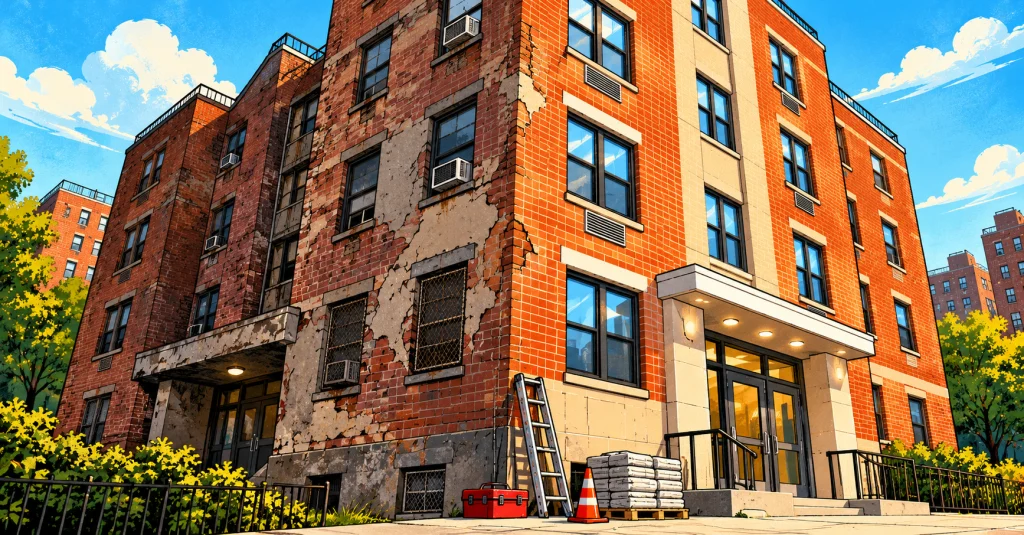
Nearly 3,000 Brooklyn residents are benefiting from renovated public housing after years of deteriorating conditions. But complaints about newly completed repairs and an $80 billion maintenance backlog raise questions about how America’s largest public housing system got here and whether private partnerships can deliver lasting change.
For residents of several Brooklyn public housing communities, a working heating system, a modern kitchen and a bathroom without deteriorating fixtures are finally part of everyday life. The New York City Housing Authority has completed a $636 million renovation covering 1,696 apartments across 87 buildings in East Brooklyn. Nearly 3,000 residents are benefiting from improvements that include new appliances, upgraded ventilation, enhanced security and renovated common areas. For some families, these changes arrived after decades without comprehensive modernization.
The renovations, completed at the Reid & Park Rock developments, represent one of the latest investments in New York City’s aging public housing system. The October 15 completion announcement was a milestone for the housing authority and its private development partners. But reporting published Monday by Gothamist also revealed an uncomfortable contradiction: Residents who waited years for repairs are already reporting problems with some of the newly installed materials. The celebration of a major public investment is unfolding alongside questions about construction quality, oversight and why basic housing improvements became such an expensive undertaking.
How a repair backlog became an $80 billion problem
The Brooklyn renovations are substantial, but they address only a small portion of the housing authority’s broader infrastructure needs. NYCHA estimates that its properties require approximately $80 billion in improvements, an extraordinary financial obligation accumulated as buildings age and necessary repairs become more expensive. Heather Beck, the agency’s chief real estate officer, told Gothamist that continued underinvestment has created a cycle in which deteriorating conditions require increasingly costly interventions.
Deferred maintenance rarely means a building simply remains unchanged until money becomes available. A small plumbing problem can become extensive water damage. An aging heating system can experience repeated failures before requiring complete replacement. Roof leaks can affect walls, electrical systems and interior finishes. As deterioration spreads, the eventual cost of restoring a property can far exceed what earlier preventive maintenance might have required. For residents, the consequences are not limited to government budgets. They are experienced through unreliable utilities, disrupted routines and prolonged exposure to inadequate living conditions.
The scale of the Brooklyn project illustrates the financial burden of catching up. According to NYCHA’s October 15 announcement, the $636 million investment covered apartment interiors, building facades, heating and ventilation systems, security infrastructure, accessibility improvements and community spaces. Divided across 1,696 apartments, the total represents approximately $375,000 per home, although that figure includes building-wide systems and shared improvements rather than apartment renovations alone. The investment is significant. So is the reality that residents spent years living with conditions that required such extensive intervention.
Private investment is changing how public housing gets repaired
The renovations were financed through NYCHA’s Permanent Affordability Commitment Together program, known as PACT. Under the arrangement, participating developments transition from traditional public housing funding to project-based Section 8 assistance, allowing development partners to assemble financing for major rehabilitation work. At Reid & Park Rock, the development partnership included Fairstead, BRP Companies, Urbane and the Local Development Corporation of East New York. Fairstead also assumed day-to-day property management responsibilities.
The program offers a way to address repairs that traditional public housing funding has been unable to cover. Rather than waiting for sufficient direct government appropriations, NYCHA uses a different federal subsidy structure to support financing and long-term property operations. Financing for the Brooklyn project closed in November 2023, setting in motion the renovations celebrated this month. For residents who have endured deteriorating buildings, the approach can deliver improvements that might otherwise remain years away.
But introducing private financial and management partners into public housing also changes the relationship between residents and the institutions responsible for their homes. NYCHA says it retains ownership of the properties and that participating residents continue to receive affordability protections. Under PACT’s published resident protections, rent generally remains calculated at 30% of adjusted household income, subject to specified exceptions. Residents retain lease-renewal protections, organizing rights, grievance procedures and the right to return if temporarily relocated during construction. These safeguards are important, but their effectiveness depends on whether residents can enforce them when disagreements arise over repairs, management decisions or housing conditions.
New apartments, familiar complaints
The completion of construction has not resolved every concern. Shamica Moore, president of the Ocean Hill-Brownsville tenants association, told Gothamist that residents have reported closet doors coming off their hinges, chipping paint, poorly fitted blinds, malfunctioning smoke alarms and flooring that has begun lifting. Moore, who has lived in the development for 15 years, also raised concerns about the level of oversight during construction and the need for inspections after contractors finish their work.
The disruption was significant even before the reported defects emerged. More than 40% of residents at Reid & Park Rock required temporary relocation during renovations, according to NYCHA. Moore told Gothamist that construction continued around her development for three years and raised health concerns for her son, who has asthma. The agency says residents are entitled to return to their homes after temporary moves, and the development’s management company has pledged to address problems that emerge following construction. NYCHA has also said it will monitor the properties, conduct site visits and work with its partners to resolve complaints.
Those commitments will be tested by what happens after the ribbon-cutting ceremonies end. A completed renovation does not necessarily mean every repair meets residents’ expectations or that newly installed systems will perform reliably over time. The reported defects do not establish that the entire project was poorly executed, but they create legitimate questions about inspection standards, contractor accountability and how quickly problems are corrected. For households that have already waited decades for improvements, another cycle of complaints, work orders and delayed repairs would undermine the promise of the investment.
Who gets to decide what successful redevelopment looks like?
The Brooklyn project includes an example of resident participation that could influence future redevelopment efforts. Tenant leaders selected Black Veterans for Social Justice to coordinate social services, marking the first completed PACT project in which residents selected their social services provider, according to NYCHA. The renovation also brought community-wide Wi-Fi, upgraded outdoor spaces and additional resident support services. Those investments recognize that public housing functions as a community, not simply a collection of apartments.
Still, resident participation during planning and construction is only one measure of accountability. Residents must also have meaningful ways to challenge management decisions, document recurring repair failures and obtain timely resolutions without jeopardizing their housing stability. As NYCHA considers bringing another 62,000 apartments into the PACT program, the experience at Reid & Park Rock offers an opportunity to evaluate whether the model delivers the long-term maintenance, resident protections and responsiveness it promises.
The $636 million investment has unquestionably changed the physical condition of thousands of Brooklyn residents’ homes. It demonstrates what concentrated financing and a coordinated rehabilitation effort can accomplish after years of unmet needs. But it also exposes the cost of allowing essential infrastructure to deteriorate before making comprehensive repairs. Residents should not have to wait decades for safe, functional housing, and public agencies should not measure success solely by the amount of money spent or the number of apartments renovated. The lasting measure will be whether these homes remain in good condition, whether management responds when something goes wrong and whether residents have the power to hold every institution involved accountable.