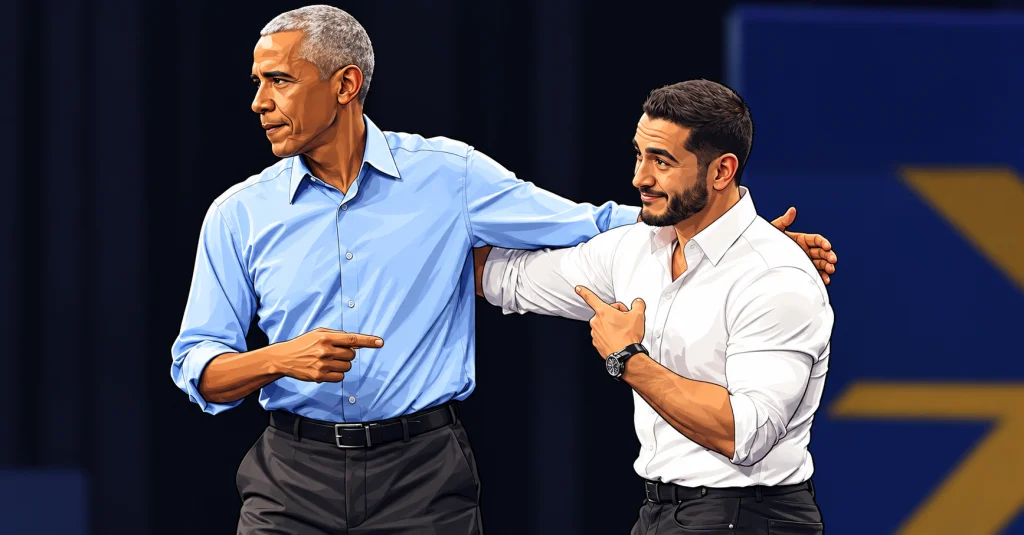
From the birther conspiracy against Barack Obama to the attacks on Michigan Senate nominee Abdul El-Sayed, racial and religious identity keep shaping American campaigns. The accusations change, but the message stays familiar: some candidates must prove their loyalty before voters will even consider their policies.
Barack Obama stood before a crowd at Detroit’s Cass Technical High School on Saturday and recalled a controversy that followed him long after he won the presidency. For years, Donald Trump promoted the false claim that Obama was not born in the United States, casting doubt on his citizenship and his eligibility to serve. Fifteen years after Obama released his long-form birth certificate, he was campaigning for another candidate facing questions about whether he truly belongs in American government: Abdul El-Sayed, Michigan’s Democratic nominee for the U.S. Senate, whose Muslim faith and Egyptian heritage have become central to the attacks against him.
Obama recognized the pattern. “We have seen this movie before,” he told the audience. “I starred in it.”
The next day, Trump took the stage in Port Huron, Michigan, and called El-Sayed a “jihadist” who was “on the side of the terrorists.” He invoked the September 11 attacks, compared stopping El-Sayed to the passengers who fought the hijackers on United Flight 93, and said El-Sayed would have to go through a metal detector before being allowed into the Senate. The sequence was an unusually direct illustration of Obama’s point: a former president who endured false claims about his national identity was defending a candidate facing accusations rooted in religious suspicion, and within a day those accusations grew louder.
El-Sayed was born in Rochester Hills, Michigan, and previously led the Detroit Health Department. He has repeatedly denied any ties to extremist groups and has called the attacks on his loyalty shameful. No credible evidence has shown that he belongs to the Muslim Brotherhood. The allegations have nonetheless become a defining feature of a race that could send the first Muslim senator to Washington.
The Birther Playbook
The comparison to Obama is more than a passing reference. Trump became one of the most prominent promoters of the birther conspiracy in 2011, questioning whether Obama had been born in Hawaii despite official records establishing his citizenship. Obama released his long-form birth certificate on April 27 of that year, but Trump kept raising doubts about its authenticity. In 2016, he finally acknowledged that Obama was born in the United States, while falsely claiming that Hillary Clinton’s campaign had started the controversy. The allegations were never supported by credible evidence, yet they consumed years of political attention that might otherwise have gone to Obama’s record in office.
Birtherism also worked on a cultural level. Obama, the nation’s first Black president, was repeatedly forced to defend a basic fact of his American identity. His name, his family background and his perceived religion all became vehicles for suspicion. The theory implied that his presidency was not just politically objectionable but potentially illegitimate. Its staying power showed how questions about race, ancestry and national belonging could be used to undermine a political figure without engaging with his policies at all.
That history gives the attacks on El-Sayed particular weight. No one claims he was born outside the United States or is constitutionally ineligible for office. Instead, his opponents have tied his Muslim identity to allegations of terrorism and divided loyalty. The specific claims differ, but the mechanism is the same: turn part of a candidate’s identity into a reason to doubt whether he can be trusted to represent Americans.
When Religion Becomes a Campaign Liability
El-Sayed’s religion was not always the main target. After his August primary win, a Washington Post analysis of political commentary found that criticism focused largely on socialism and progressive economic policy had shifted toward his faith and alleged extremist ties. Republican Sen. Tommy Tuberville of Alabama publicly called El-Sayed a terrorist, and activist Laura Loomer urged Republicans to cast him as a jihadist. The race has moved from a debate over his positions to a debate over his identity and loyalty.
Social Storytellers Collective examined this dynamic in an October 23 opinion column, “‘Are You for America?’ Is Not a Question Rogers Would Ask a Christian”. The column looked at how Republican nominee Mike Rogers questioned El-Sayed’s loyalty during a Senate debate, including allegations involving the Muslim Brotherhood. It separated legitimate questions about a candidate’s record from the broader suggestion that a Muslim American must prove his allegiance in ways other candidates never have to. Trump’s latest remarks sharpen that controversy and invite the comparison with the false claims about Obama’s citizenship and religion.
That distinction matters, because scrutiny of El-Sayed’s record is legitimate. In 2012, an Egyptian newspaper published a statement, reportedly signed by El-Sayed, that backed expanded powers for Mohamed Morsi, the Muslim Brotherhood figure who had been elected Egypt’s president. Questions about that statement, his associations and his views on foreign affairs are fair subjects for a campaign. But signing a statement does not, by itself, make someone a member of an extremist organization. Allegations of terrorism require credible evidence, not inferences drawn from a candidate’s religion, surname or ancestry.
A Familiar Question About Who Belongs
The rhetoric around El-Sayed also shapes how Islam is presented in American public life. American Muslims hold a wide range of political views and come from many ethnic backgrounds. Being Muslim does not signal support for any political organization or extremist movement. Yet campaign language that repeatedly links a Muslim candidate to terrorism reinforces the Islamophobic stereotype that Muslim Americans are inherently suspect or less loyal. In that climate, the burden shifts: instead of accusers having to prove their claims, Muslim candidates are left to disprove them again and again.
The backlash to Trump’s remarks has not come only from Democrats. Bishara Bahbah, a founder of Arab Americans for Trump, the group that courted Arab American voters for Trump in 2024 and has since renamed itself Arab Americans for Peace, called the president’s comments racist and said they crossed a red line. His criticism stands out because he once worked to build support for Trump in a community now watching a prominent Muslim candidate portrayed as a security threat. Objections to religiously charged campaign rhetoric do not always fall along party lines.
There is also an important distinction between race and religion. Muslims are not a single racial group, and criticizing a religious or political belief is not automatically racial discrimination. But attacks that combine religious suspicion with a candidate’s ancestry, name or presumed foreign loyalties can become racialized. In El-Sayed’s case, allegations of extremism have been bound up with references to his Egyptian heritage and questions about his allegiance to the United States. That is why critics call the rhetoric Islamophobic rather than ordinary opposition research.
The Political Cost of Making Identity the Story
Michigan voters are choosing between candidates with different approaches to health care, taxes, the economy and the role of the federal government. They are entitled to weigh those differences, along with each candidate’s record, associations and judgment. Rogers has defended his scrutiny of El-Sayed as a national security concern, drawing on his years as an FBI agent and as chairman of the House Intelligence Committee. He has also said he has never called El-Sayed a terrorist. Those distinctions deserve acknowledgment, even as his accusations still require evidence.
The concern is what happens when questions about identity crowd out questions about governing. A campaign can become consumed by whether a candidate is American enough, trustworthy enough or loyal enough because of his faith or ancestry. The debate shifts from what a person would do in office to whether that person belongs in the institution at all. For voters who hear these allegations over and over, the suspicion can become part of the candidate’s public identity, whether or not the claims hold up.
An Old Test of Belonging
American political history is full of candidates who faced questions about religion, ethnicity and national loyalty. John F. Kennedy confronted suspicion about his Catholic faith in 1960, assuring voters that the Vatican would not direct his decisions as president. Decades later, rumors that Obama was secretly Muslim circulated alongside the false claims about his citizenship. In 2008, former Secretary of State Colin Powell challenged that rhetoric directly, asking why being Muslim should be treated as disqualifying in the first place. These controversies keep returning, even though the Constitution bars religious tests for public office.
The Obama and El-Sayed episodes share something more specific: Trump’s central role in advancing both sets of accusations. In one case, a president’s citizenship was questioned despite documentary proof. In the other, an American-born Muslim candidate has been linked to extremism without evidence for the most serious allegations. Both show how suspicion about identity can become a campaign narrative that outlasts the facts.
The November 3 election will decide who represents Michigan in the Senate, but the questions raised by this race reach beyond one seat. Americans are entitled to scrutinize the people seeking public office, including their decisions, associations and policies. They are also entitled to expect that serious accusations come with facts. When race, religion or ancestry stands in for that evidence, the argument is no longer about what a candidate would do in office. It becomes an argument about who is presumed to belong there in the first place.