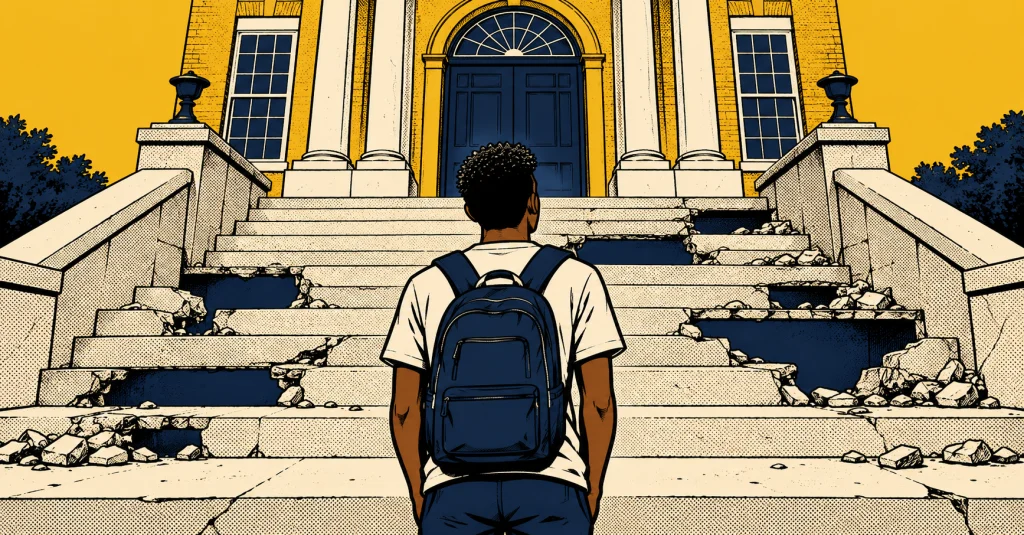
Chicago Public Schools has spent years improving graduation and college enrollment rates. New research shows that getting students through the next stage of their education remains a much harder problem, particularly for young Black and Latino men.
Chicago Public Schools has something worth celebrating. More students are finishing high school, more are earning college credits before graduation, and more are continuing their education after receiving their diplomas. The district announced last week that 83.4% of students in the class of 2026 graduated within four years, a substantial improvement over the early 2000s, when fewer than half did. But new research released Friday introduces a difficult reality. As Emmanuel Camarillo reported for WBEZ and the Chicago Sun-Times, Chicago has become considerably better at getting students into college than getting them through it.
The numbers deserve a closer look. According to the University of Chicago’s To&Through Project and Consortium on School Research, only 48% of Chicago Public Schools graduates from the class of 2019 who immediately enrolled in college completed a degree or workforce certificate within six years. Nationally, the comparable figure was 64%. Among Chicago graduates who entered four-year institutions, completion reached 56%. For those who started at two-year colleges, the rate was just 32%. These are different groups of students, but their outcomes reveal a common problem: the path from high school graduation to a college credential remains uncertain, even after students clear the admissions process.
Chicago’s progress should not be minimized. The district has spent years expanding access to advanced coursework, career certifications and college preparation. According to Chicago Public Schools’ October 21 announcement, more than 57% of the class of 2026 earned college credits or career credentials before graduation. Meanwhile, 67% of the class of 2025 immediately enrolled in college, up from 58% a decade earlier. These improvements represent years of work by students, families, educators and school administrators. They also create a new responsibility for the institutions receiving those students.
College enrollment transfers students into a system with different financial demands and fewer built-in safeguards. High schools organize the school day, track attendance and maintain regular contact with families. Colleges generally expect students to manage schedules, financial aid, registration and academic difficulties with considerably greater independence. Students who work to pay tuition or support their households may have less time for coursework. Those who encounter an unexpected expense can face choices between remaining enrolled and meeting immediate financial obligations. These pressures are especially consequential when institutions lack the advising and emergency assistance needed to prevent temporary setbacks from becoming permanent departures.
The disparities in Chicago’s findings make the challenge harder to dismiss. Fewer than one-third of young Black and Latino men from the district’s 2019 graduating class earned bachelor’s degrees within six years. Completion rates were higher among several other student groups, including young Latina women. The research establishes unequal outcomes, although the figures alone cannot determine how much each factor, including income, academic preparation, institutional support or college selection, contributed. What they establish is that opening the college door has not produced equal chances of reaching graduation.
Dominique McKoy, executive director of the To&Through Project, told WBEZ that the findings reinforce the need for initiatives such as the district’s Black Student Success Plan. His comments point toward a broader responsibility that extends beyond Chicago Public Schools. Colleges control course availability, academic advising, financial-aid administration and many of the policies that determine whether a struggling student can continue. High schools can prepare students for that environment, but they cannot control what happens after enrollment. Improving completion requires cooperation between institutions that have traditionally measured success at different points.
The timing matters because the students measured in the report entered college in 2019, shortly before the pandemic disrupted campuses, employment and household finances. Their experiences cannot be treated as a perfect forecast for the class of 2026. Still, completion rates have changed relatively little over several years, suggesting that the difficulties predate the pandemic. Chicago’s next generation of graduates may enter college with stronger preparation and more credits, but those advantages will have limited value if the institutions they attend cannot help them finish.
For years, school districts have been judged by how many students receive diplomas and continue to college. Chicago’s progress shows what sustained attention to those measures can accomplish. The next phase will require tracking what happens to students after they leave high school, identifying where they fall behind and directing resources toward the barriers that prevent completion. Otherwise, the city could continue celebrating record graduation rates while thousands of former students discover that access to higher education never guaranteed access to the opportunities a degree was supposed to provide.