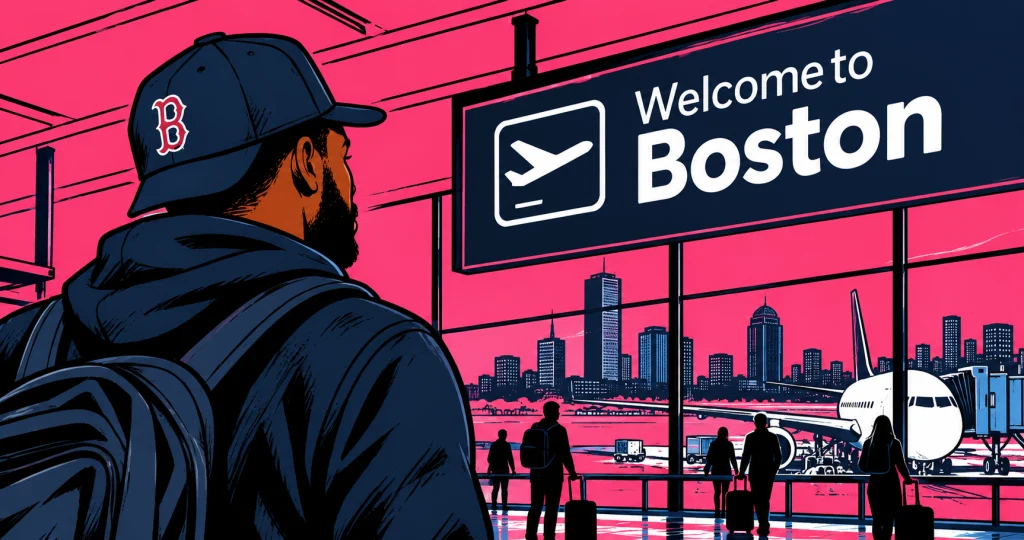
Boston Logan International Airport wants a new voice to welcome millions of travelers. Thousands of Massachusetts residents auditioned, eight finalists remain, and the public gets the final say. But the competition comes as researchers warn that the city’s most recognizable accent is becoming less common.
There are plenty of ways to announce that you’ve arrived in Boston. You could point out the skyline, mention Fenway Park or remind travelers that Dunkin’ is practically a regional institution. But Logan International Airport has another idea. It wants arriving passengers to hear Boston before they even leave the terminal, preferably from someone whose voice makes it unmistakably clear where they’ve landed.
Nearly 6,000 Massachusetts residents submitted auditions for the airport’s new official welcome voice. The contest, organized by the Massachusetts Port Authority, has narrowed the field to eight finalists, and public voting begins Saturday, October 24. The winner will eventually deliver announcements heard by travelers passing through an airport that serves approximately 43 million passengers annually. The assignment sounds simple enough: welcome people to Boston. The challenge is finding someone who sounds like Boston while doing it.
For a city whose accent has inspired countless movie performances, comedy sketches and exaggerated attempts to pronounce Harvard Yard, the competition has become a celebration of local identity. But it also arrives during an unusual moment for the region. Linguists have found that some of the speech patterns associated with the traditional Boston accent are fading, particularly among younger residents. Boston is holding a contest to celebrate a way of speaking that may be growing less common in the city itself.
Eight Finalists, Thousands of Accents
The finalists come from different communities, backgrounds and professions. Among them are a Boston Public Schools teacher, a law student, a singer with a family connection to Fenway Park, and a boxer who also works as a bartender on Cape Cod. Their voices reflect different experiences of growing up in Greater Boston, rather than one standardized version of the city’s familiar accent.
Massport announced the finalists on October 19, with Gov. Maura Healey and Massport CEO Rich Davey joining the announcement on Boston radio station KISS 108. A selection group had reviewed thousands of submissions before choosing the final eight.
One finalist, Kristin Ingala, told WHDH that her accent has sometimes caused people to underestimate her education. Rather than change how she speaks, she has embraced it as part of her identity. Her family history and affection for New England are central to why she wants the role.
Another finalist, Samantha Edwards, described Boston residents as unapologetic about their accents and emphasized the city’s diversity. That perspective matters because the version of the Boston accent most familiar through Hollywood is only one part of how people in the region actually speak.
Public voting runs from October 24 through October 28 at VoiceofLogan.com. The winner is scheduled to be announced November 5.
The Accent Hollywood Loves to Exaggerate
The Boston accent is among the most recognizable regional speech patterns in the United States. Its best-known feature is the dropped or softened r sound in certain positions, producing pronunciations that have become a staple of popular culture.
Movies including Good Will Hunting, The Departed and The Town have helped establish an instantly recognizable cinematic version of working-class Boston. Actors frequently rely on the dialect to communicate toughness, familiarity with local culture or a character’s social background before much else is revealed.
But authentic Boston speech is more complicated than the familiar movie version. Pronunciation varies across neighborhoods, generations, ethnic communities and social groups. Not everyone raised in Boston speaks with the traditional accent, and someone who lacks it is no less connected to the city.
That complexity creates an interesting challenge for Massport. An airport serves as a city’s public introduction, welcoming visitors from around the country and the world. Its announcements need to be understandable, but officials also want the voice to communicate something distinctive about the place.
The search is therefore not simply for the person who can drop the most r sounds. The winning voice must represent Boston without reducing it to a caricature.
The Accent Is Changing as Boston Changes
Earlier this year, The Boston Globe examined whether the city’s traditional accent was disappearing. The reporting featured Dartmouth College linguist James Stanford, who began a 10-year research project in 2010 examining speech patterns among 993 New England residents, including extensive interviews in South Boston.
The research found that several traditional features of the accent, particularly non-rhotic pronunciation, were becoming less common among younger generations. Age, socioeconomic background and ethnicity were associated with differences in pronunciation.
That does not mean everyone in Boston will eventually sound identical. Accents evolve, and regional speech can retain characteristic vowel sounds and other features even as particular pronunciations decline.
The social changes are also relevant. Boston has experienced decades of demographic change, immigration, neighborhood redevelopment and population movement. Families who once lived in heavily working-class communities have relocated, while new residents have brought different languages and speech patterns into the city.
For some longtime Bostonians, the fading accent represents more than a change in pronunciation. It evokes the disappearance of familiar neighborhood relationships and the culture of communities where generations of families lived close to one another.
That gives the Voice of Logan contest unexpected significance. The airport is celebrating local speech at a time when some residents are asking whether an important part of their regional identity is being lost.
The Internet Has Given Regional Voices a New Audience
Social media has complicated predictions about the disappearance of regional accents. While some traditional speech patterns may be weakening locally, platforms such as TikTok and Instagram have made distinctive voices newly visible to national audiences.
Earlier this year, Romano Duncan became an online sensation after his girlfriend, Kacey Levesque, recorded him participating in a word game featuring terms such as bear, pear, chair and hair. Duncan’s thick Boston pronunciation turned an ordinary living-room challenge into a viral video.
Another unexpected internet personality emerged in Boston Globe reporter Emily Sweeney, whose unmistakable local accent attracted widespread attention after she appeared in a video report about a home invasion in Beverly, Massachusetts.
Sweeney, a longtime journalist, became popular partly because her delivery sounded different from the standardized voices audiences often associate with professional news reporting. Her accent and casual presentation gave viewers a sense that they were hearing directly from someone who knew the community.
Her success also raised an interesting issue for journalism: audiences may connect more readily with voices that sound authentic to their communities than with speakers who conform to traditional broadcasting conventions.
Regional accents have historically exposed speakers to judgments about class, education and professionalism. Yet those same characteristics can now attract audiences who value individuality and a sense of place.
What Does Boston Sound Like Now?
For Massport, the contest offers a relatively simple public engagement opportunity. Instead of hiring a conventional announcer, the airport has invited residents to participate in choosing a voice associated with one of the region’s most prominent public institutions.
For residents, it offers something more personal. A familiar accent that some people have been encouraged to soften or abandon is being celebrated as a civic asset.
The competition also makes room for a broader conversation about whose voices represent American cities. Boston is not linguistically uniform, and its identity includes communities whose speech sounds very different from the Hollywood stereotype. Choosing an official airport voice cannot capture all that diversity, but it can prompt people to think about what authenticity actually means.
The winning contestant will eventually have a relatively straightforward responsibility. Travelers arriving in Boston will hear a welcome, perhaps followed by directions, safety reminders or other announcements.
Some passengers will notice the accent immediately. Others may hear nothing particularly unusual. For residents who grew up with that way of speaking, the voice may simply sound familiar.
And that may be the most meaningful outcome of the entire contest.
For decades, people have imitated the Boston accent for laughs, tried to perfect it for movie roles or worked to remove it from their professional speech.
Now an airport is asking someone to bring it to work.
And millions of passengers will be listening.