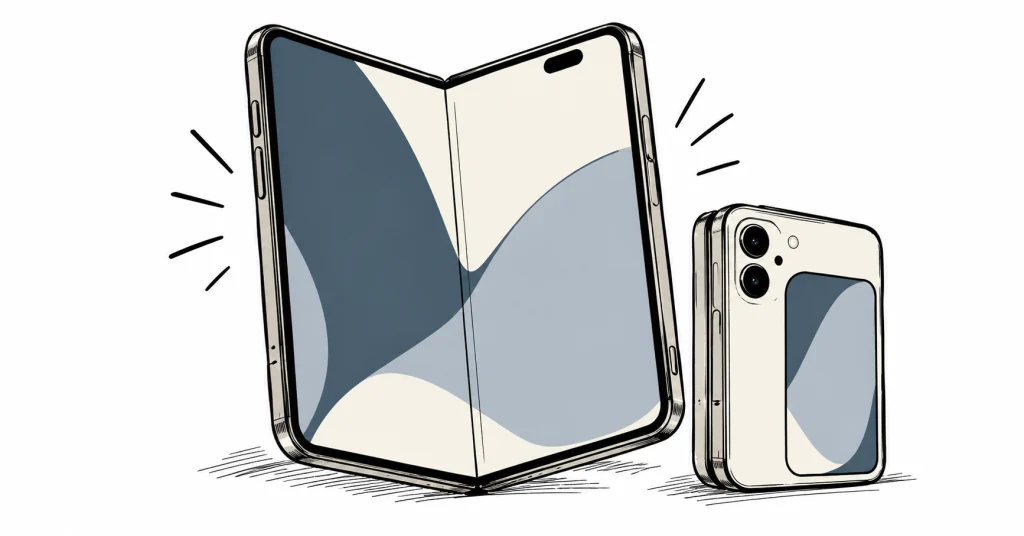
The iPhone Duo sold through its initial preorder allocations within minutes, and some customers now face delivery dates in 2027. Apple’s biggest new smartphone experiment in years is off to a strong start, but limited inventory complicates the picture.
Apple’s first foldable iPhone officially arrived in stores Friday, and some customers who hoped to bring one home are discovering they may have to wait until next year. The iPhone Duo, which starts at $1,999, has attracted substantial interest despite its premium price, with initial preorder inventory disappearing within minutes and estimated shipping dates stretching into January 2027. Lines formed outside Apple Stores from New York to Shanghai, marking a consequential debut for a company entering a smartphone category its competitors have occupied for years.
The demand was visible before Friday’s launch. When Apple opened preorders October 16, delivery estimates quickly slipped beyond the official release date. Within approximately 30 minutes, all configurations were showing January delivery estimates, according to 9to5Mac. Apple said retail stores would receive limited quantities for walk-in shoppers, but some locations exhausted that inventory within hours. The company has not disclosed the total number of devices ordered or sold, making it difficult to determine exactly how much of the shortage reflects exceptional demand and how much reflects constrained production.
That uncertainty has not discouraged early enthusiasm. Reuters reported that Apple restricted purchases to two devices per customer and limited in-store availability in several markets. In the United States, online orders carried an average shipping delay of 92 days earlier this week, according to data provider Navi cited by The Wall Street Journal. That is substantially longer than the delays recorded for several recent iPhone launches. The result is an unusual commercial moment: Apple’s most expensive mainstream smartphone is attracting considerable attention, yet many interested customers cannot obtain one immediately.
Apple Finally Enters a Market It Didn’t Create
Samsung, Huawei and other smartphone manufacturers have spent years introducing foldable devices, experimenting with larger interior displays, improved hinges and different approaches to multitasking. Apple waited until September 9 to unveil its first model, choosing a book-style design that opens into a 7.6-inch display. When closed, the Duo operates through a 5.4-inch exterior screen, giving users a more compact device for everyday tasks.
The phone runs on Apple’s A20 Pro chip and uses iOS 27, adapted for its dual-screen design. Users can work with two applications side by side, view larger documents, watch videos and perform tasks that traditionally require switching between a phone and tablet. Apple is also promoting the device’s precision hinge, titanium construction and large display as evidence that its approach can make foldable smartphones more practical for everyday consumers.
Those features help explain the interest, but they do not settle whether people need a folding phone. Most smartphone users already own devices capable of handling messaging, navigation, photography, entertainment and professional communication. Apple is asking customers to pay a substantial premium for a different physical experience rather than an entirely new category of functionality. At $1,999 before accessories, the Duo costs considerably more than a standard iPhone and competes with the combined cost of some smartphones and tablets.
For consumers, the appeal may come down to convenience. A folding device could eliminate the need to carry a second screen, especially for people who frequently read documents, manage multiple applications or work while traveling. But that advantage depends on whether the software experience is sufficiently refined to justify the additional expense and possible compromises.
Strong Demand Does Not Tell the Entire Story
The early sellouts have generated considerable excitement among analysts, investors and Apple customers. Wall Street analyst Dan Ives described initial preorder demand as substantially stronger than available supply, while projecting that Apple could sell approximately 10 million Duo devices over the next few quarters and as many as 25 million during 2027. Those figures are analyst forecasts, not confirmed Apple sales.
The difference matters because companies can exhaust a relatively small initial inventory without demonstrating that a product will sustain mass-market demand. Manufacturing a foldable smartphone introduces challenges involving flexible displays, hinge tolerances and component production. Reports before the launch indicated Apple was producing the Duo in considerably smaller volumes than a conventional iPhone. Without official production or sales figures, long delivery delays cannot establish precisely how popular the device will become once inventory improves.
Nevertheless, the market implications could be significant. Research firm IDC expects Apple to capture approximately 44% of the global foldable smartphone market by value and 31% by unit volume in 2026, according to Reuters. The forecast reflects the company’s potential to reshape consumer interest in a product category that has remained relatively small despite years of development by competitors.
Apple’s arrival could also encourage software developers to invest more heavily in applications designed specifically for larger folding screens. That matters because hardware innovation is useful only when people can take advantage of it. A larger display may be visually impressive, but applications that do not adapt properly can reduce the value of the experience.
The Reviews Reveal a First-Generation Compromise
Early reviewers have praised the Duo’s interior display, hinge design and overall construction, but they have also identified shortcomings. Some have criticized the relatively cramped exterior screen, the absence of a telephoto camera and limitations involving applications that have not been fully optimized for the folding format.
Those concerns introduce a familiar problem with first-generation technology. Early adopters may be willing to pay a premium and tolerate imperfections because they value having something new. The broader consumer market generally expects a more refined experience, particularly when a device costs nearly $2,000.
Apple must also convince customers that folding the phone offers a meaningful improvement over the familiar smartphone design. Opening a larger screen can make certain activities easier, but it also adds another physical step to interactions that users have spent years completing on conventional devices. Whether that becomes second nature or remains an inconvenience will help determine the Duo’s long-term appeal.
Durability will receive particular scrutiny. Flexible displays and moving hinges create wear considerations that do not exist in the same way on traditional slab-style phones. Apple has emphasized engineering advances intended to make the Duo reliable, but long-term performance will become clearer only after consumers have used the devices for months or years.
A Major Test for Apple’s New Leadership
The release also carries significance for Apple’s leadership. John Ternus, who became chief executive in September after overseeing the company’s hardware engineering, introduced the Duo as a major new chapter for the iPhone. Its launch is one of the most visible early tests of his leadership and Apple’s ability to expand beyond established smartphone formats.
The company is entering the category from a position of considerable strength. Apple maintains an extensive global retail network, a large installed customer base and an ecosystem of products and services that encourage existing users to remain with the brand. Those advantages could make it easier to introduce foldable technology to consumers who have been reluctant to adopt competing products.
But Apple is also arriving late. Samsung and Huawei have already spent years refining their folding devices, learning from durability problems and experimenting with different screen configurations. Apple’s challenge is not merely to demonstrate that it can produce a foldable smartphone. It must persuade consumers that waiting for its version was worthwhile.
The commercial opportunity reaches beyond a single device. If premium foldables become more widely adopted, they could help manufacturers increase average selling prices in a mature smartphone market where consumers are keeping devices longer. Apple could also generate additional demand for accessories, insurance, financing arrangements and other services associated with higher-priced hardware.
The Real Test Begins After the Lines Disappear
Friday’s launch confirms that Apple’s first foldable phone has attracted substantial early interest. Customers have lined up, initial allocations have sold out and shipping delays now extend months beyond the release date. For a product carrying a $1,999 starting price, that is a notable reception.
But the first weekend cannot answer the larger questions about sustained demand. Apple will need to increase production, deliver devices to customers who have already ordered them and demonstrate that the folding design offers enough everyday value to attract buyers beyond enthusiasts and early adopters.
The early response suggests consumers are willing to spend considerably more for a different kind of iPhone. Whether millions will continue making that decision after the launch excitement fades remains uncertain.
Apple did not invent the foldable smartphone, and it is not the first company to prove that a phone can open into a larger screen. Its opportunity is to make the format familiar, desirable and commercially significant to a much broader audience.
For now, the company has succeeded in generating something increasingly difficult to achieve in the mature smartphone business: a new iPhone that people are willing to wait months to own.