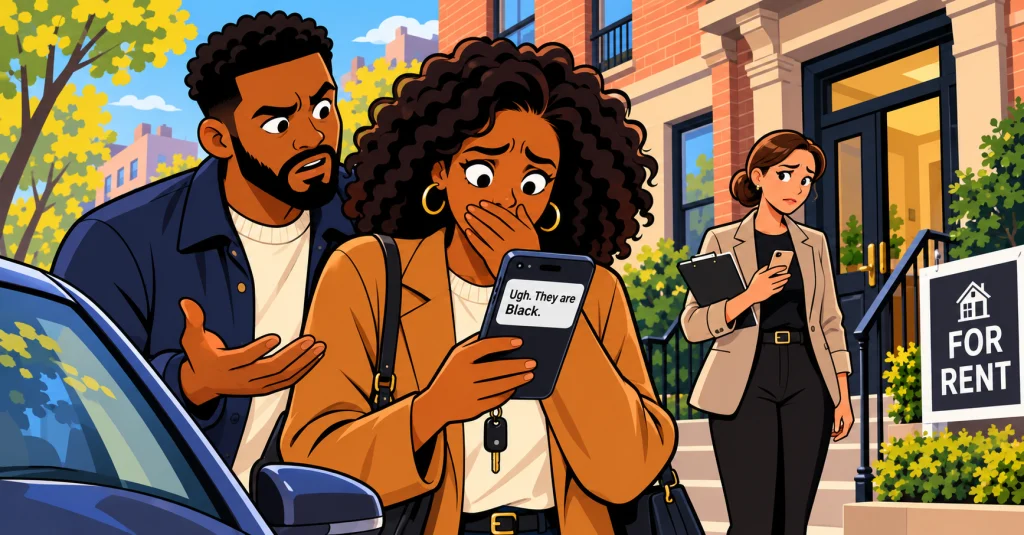
An apartment showing in Queens ended before it began when a real estate agent allegedly sent a racist message to prospective tenants. Now a Black couple is suing, raising questions about the decisions renters never see being made behind closed doors.
Lisa Renee Olaso and her fiancé, Cyril Christopher, had driven from Delaware to Queens in June to see an apartment that could become their new home. Olaso had accepted a job in New York, and the couple was preparing to relocate. They arrived at the rental property in Flushing expecting to meet a real estate agent, tour the apartment and decide whether it was right for them. Instead, as they stepped out of their vehicle, a message appeared on Olaso’s phone: “Ugh. They are Black.”
The message allegedly came from the Douglas Elliman real estate agent scheduled to show them the property. Olaso believes it was intended for the homeowner but mistakenly sent to her instead. The encounter has now resulted in a housing discrimination lawsuit against the brokerage, the agent and several individuals identified as property owners. As ABC7 New York reported October 22, the couple never made it inside the apartment. Their experience offers an unusually direct look at how racial judgments can enter a rental transaction before an applicant has been evaluated on income, rental history or any other legitimate qualification.
Olaso told reporters that the agent apparently observed them from a distance before sending the message. She immediately told Christopher to return to their vehicle. When the agent approached, Olaso confronted her about the text. According to Olaso, the agent apologized and attempted to explain the comment by referring to previous Black tenants in the neighborhood who she claimed had caused problems. The explanation did not involve anything the couple had done. They were simply prospective tenants arriving for a scheduled appointment, yet their suitability appeared to have been judged through assumptions about unrelated people who shared their race.
Christopher described the experience as being judged before anyone had gotten to know them. Olaso said the apology did little to ease the pain of what happened during a relocation that should have been an exciting transition. The couple eventually found housing in Commack, on Long Island, but decided to pursue legal action. Their attorney, Kenneth Mollins, has argued that the message may have reflected more than one agent’s private opinion.
The lawsuit names Douglas Elliman Realty, agent Helen Tzelios and several people associated with ownership of the property. It alleges violations of federal, New York State and New York City housing discrimination laws. Mollins has questioned whether the homeowner had prior knowledge of or involvement in the alleged discriminatory communication, suggesting that the message may have been sent within an existing conversation about prospective tenants. That theory has not been established in court, and the allegations against the individual defendants remain unresolved.
Douglas Elliman said the agent no longer works for the company and stated that it has a zero-tolerance policy for discrimination. NBC New York reported that the agent did not respond to its request for comment and that attempts to obtain responses from people associated with the property were unsuccessful. The company’s statement addresses its employment relationship with the agent but does not establish what happened throughout the rental transaction or resolve the claims against the other defendants.
What makes the episode particularly revealing is the accidental delivery of the message. Had it reached only its intended recipient, Olaso and Christopher might never have known their race had become a subject of discussion. They could have been told that the apartment was unavailable, that another applicant had been selected or that the owner had decided not to proceed. Those explanations can be entirely legitimate in an ordinary rental search. They can also be difficult to challenge when an applicant has no way to determine whether the same standards were applied to everyone.
That uncertainty is one of the enduring challenges of fair-housing enforcement. Discrimination does not always involve an explicit refusal to rent to someone because of race. It can appear through canceled showings, selective information, different screening requirements or subtle efforts to discourage an applicant from pursuing a property. A renter may never learn about an available unit or may be directed toward a different neighborhood without understanding why. Unlike the couple in Queens, most applicants do not receive a message revealing what someone involved in the transaction was thinking.
Federal fair-housing law prohibits racial discrimination in housing transactions, while New York State and New York City provide additional protections. Those requirements extend beyond the final decision to approve or reject an application. New York City’s Commission on Human Rights explains that landlords, property owners, brokers and agents can be held responsible for discriminatory treatment. Housing providers may establish legitimate financial and rental qualifications, but those standards must be applied consistently rather than influenced by an applicant’s race or another protected characteristic.
The costs of unequal treatment can extend beyond a missed apartment. Someone relocating for employment may have already invested in travel, taken time away from work or arranged a moving schedule around a limited number of available properties. Losing access to a suitable home can mean another search, additional expenses, a longer commute or a different neighborhood. In a competitive rental market, applicants may have little opportunity to investigate why a showing was canceled or an application never progressed.
There is also a personal consequence that cannot be captured through rental prices or moving expenses. Olaso and Christopher were preparing to establish themselves in a new community. Instead, they encountered a message that appeared to reduce their suitability as tenants to their race. The agent’s alleged explanation involving previous Black renters made the interaction more troubling because it suggested the couple could be evaluated according to stereotypes rather than their own circumstances.
The incident illustrates why fair-housing protections matter even when someone eventually finds another place to live. The couple’s move to Commack resolved their immediate housing need, but it did not answer whether they received fair treatment during their search in Queens. The lawsuit now places the conduct of the agent, the responsibilities of the brokerage and the possible involvement of property owners before the legal system. A court will have to determine what occurred, who bears responsibility and whether the conduct violated applicable laws.
Olaso and Christopher have said their motivation for pursuing legal action is not primarily financial. They want others to understand what happened and hope their experience prevents similar treatment. Their case concerns one scheduled apartment showing, but it raises a question relevant to rental markets far beyond Queens: how often do prospective tenants lose access to housing opportunities without ever knowing the reason?
For Olaso, an apparent texting mistake made a private racial judgment visible. Other renters may encounter unexplained rejections, canceled appointments or shifting requirements without comparable evidence of what happened behind the scenes. They may have the income, references and rental history necessary to qualify for a property yet never receive the opportunity to demonstrate it.
The apartment in Flushing was supposed to be a possibility for the couple’s next chapter. Instead, the alleged message stopped the showing before it began. Whatever the lawsuit ultimately establishes, the encounter brings attention to a fundamental issue in housing access: renters are expected to demonstrate that they qualify for a home, while the people controlling those opportunities are not always required to explain how every decision was made.