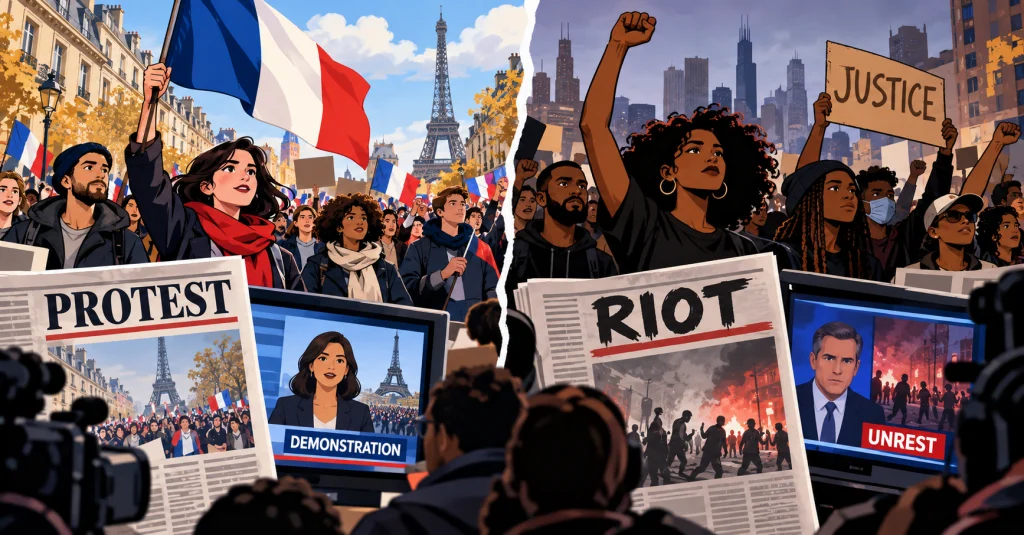
France’s student-led demonstrations have turned violent in places, yet coverage has kept their grievances in view. That raises an old question about American journalism: whether race shapes which protests are explained and which are simply described as disorder.
Thousands of demonstrators gathered peacefully in Paris on Thursday after a French court overturned a police ban on their march. The calm followed weeks of turmoil. What began in mid-September as secondary school students in the Paris suburbs demanding better school conditions has grown into a broader revolt over the cost of living and government policy, and parts of it have turned destructive: burned cars, smashed storefronts, looting in Paris and Marseille, and clashes with police. After an Oct. 17 march descended into violence, French courts began handing down fast-track sentences, and authorities across the country have restricted demonstrations and deployed additional security forces.
France is facing a familiar democratic dilemma: how to protect the right to protest while responding to real disorder. The Associated Press reported Oct. 22 that a Paris administrative court lifted the ban despite government warnings of renewed violence. Officials defended other restrictions as necessary to protect residents, businesses and public infrastructure; protesters and civil liberties advocates questioned the limits on political expression. Much of the coverage has carried both threads at once: the destruction, and the grievances behind it.
That pairing invites a comparison with how protests are often described in the United States, particularly when Black Americans demonstrate against police violence and racial injustice.
What the research shows
The comparison comes with a caveat. Current French coverage and past American coverage involve different outlets, eras and movements, and showing that Paris is receiving more sympathetic treatment would require a systematic study of comparable headlines, images and broadcasts. No such study yet exists for these protests. What research has established is that racial bias in protest coverage in the U.S. is real and measurable.
In a 2023 study in the Journal of Race, Ethnicity, and Politics, political scientists LaGina Gause, Steven T. Moore and Mara Cecilia Ostfeld found that television news described protests involving people of color in language tied to anger and fear more often than comparable protests by mostly White participants.
Danielle K. Kilgo and Summer Harlow, in a 2019 study of U.S. newspaper coverage, found that protests against anti-Black racism received more delegitimizing treatment than protests over health, the environment or immigrant rights. They describe the result as a hierarchy of social struggle: not every grievance enters the news with the same presumption of legitimacy.
And framing changes minds. A 2021 study by Danielle K. Brown and Rachel R. Mourão found that coverage emphasizing legitimate political debate increased support for protesters, while coverage centered on riots and confrontation increased criticism of them and reduced identification with their cause.
Ferguson and Minneapolis
The pattern is visible in recent history. After a Ferguson, Missouri, police officer killed Michael Brown in 2014, coverage often led with burning buildings, damaged cars and arrests. Those were real events that demanded reporting. But the emphasis could crowd out what brought residents into the streets: aggressive policing, predatory municipal fines and fees, and the treatment of Black residents. The national debate swung between whether protesters had legitimate complaints and whether their methods deserved condemnation, as if the two questions could not be answered separately.
The 2020 protests after George Floyd’s murder in Minneapolis drew millions of people, and the vast majority of demonstrations were peaceful, even as some cities saw arson, looting and clashes with police. In some political and media narratives the violence became the story, overshadowing demands for police accountability. Other outlets centered civil rights, reform proposals and affected communities. Coverage was not uniform, which is exactly why comparing outlets matters.
Why France is a useful mirror
France makes a revealing comparison because protest is woven into its national identity. General strikes, blockades and street confrontations over labor and public policy are a routine part of French political life, from the Yellow Vest movement to the pension reform protests. French police have answered with force and arrests, some coverage has dwelt heavily on disorder, and France has its own history of racialized portrayals of unrest, particularly of protests in its suburbs. European protesters are not automatically portrayed sympathetically.
Still, when American readers encounter French protests, the story frequently arrives with context attached: labor rights, austerity, a national tradition of dissent. The disruption is reported, but the political origins stay in the frame. The research above suggests that Black American protests have not consistently received the same treatment, with the danger of the crowd often leading and the demands arriving later, if at all.
A consistent standard
None of this means journalists should make every protest look peaceful or justified. When people are hurt, businesses are destroyed or police use force, those facts should be reported precisely. A protest can have legitimate aims and still include criminal acts; police can have a real duty to keep order and still deserve scrutiny for how they use it. The obligation is consistency. When most participants are peaceful, that is news. When demonstrators are responding to documented institutional failures, those failures should not vanish from the story the moment a confrontation begins.
These judgments rarely appear as explicit commentary. They live in headlines, opening paragraphs, photo selection, choice of sources and the order in which facts appear. Who gets to be angry about injustice without the anger itself becoming the threat? Whose disruption is read as part of a political tradition, and whose as evidence of social breakdown?
France is bracing for more demonstrations, and the violence surrounding them deserves serious coverage, as do the conditions driving them. The same standard should apply in Ferguson, Minneapolis, Atlanta, Chicago or any American city where residents take to the streets. A protest should not gain legitimacy because it happens in Paris, or lose it because it happens in a Black American neighborhood. Its demands, conduct and consequences should be judged on their merits, and journalism should give readers what they need to make that judgment rather than letting selective language make it for them.