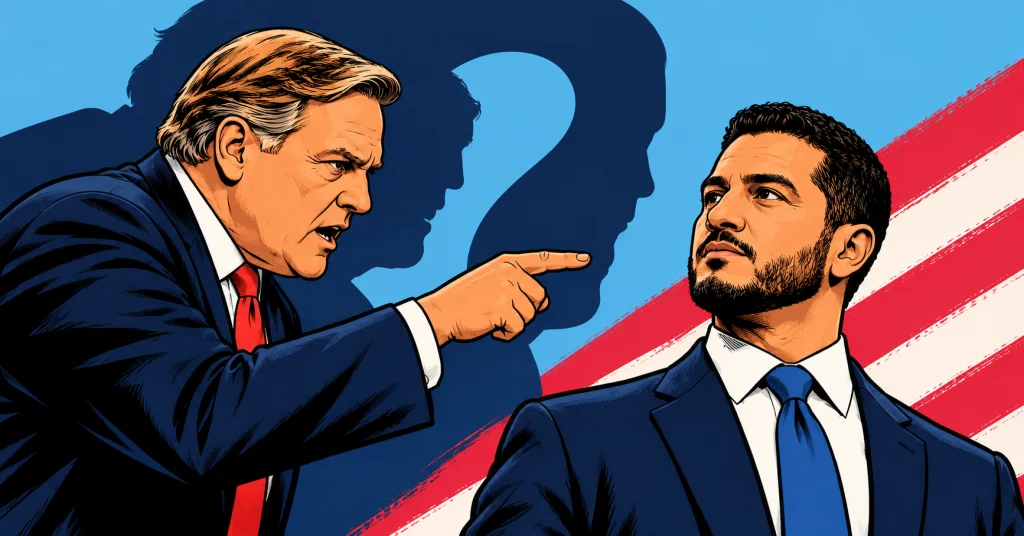
Mike Rogers says his attacks on Abdul El-Sayed are about judgment and national security. Wednesday’s debate showed they’re about something else.
There was a moment in Wednesday night’s Michigan Senate debate when the race stopped being about policy. Mike Rogers, the Republican nominee and a former chairman of the House Intelligence Committee, accused his Democratic opponent of being bought off by the Muslim Brotherhood and of taking money from donors who support Hamas and Hezbollah. Then he asked Abdul El-Sayed, a Michigan-born physician who would be the first Muslim in the U.S. Senate, whether he was for America or for terrorist groups overseas.
El-Sayed’s answer was measured. He told Rogers it was beneath him to question his loyalty to the Constitution. He was right, and Michigan voters should treat that question as what it is: a loyalty test that a Christian candidate in America would never be asked to pass, and one that Jewish Americans will recognize from the dual-loyalty smears long aimed at them.
Scrutiny and suspicion
Let me be fair to Rogers about the record, because the record is not empty. In 2012, El-Sayed signed an open letter with other Egyptian American community figures supporting Mohamed Morsi, the Muslim Brotherhood leader who had just been elected Egypt’s president, and urging him to purge the media and the police. That is a real document with his name on it, and he has not publicly explained it. A Senate candidate should have to answer for what he signs. If Rogers had spent his time on the debate stage asking about that letter and what it says about El-Sayed’s judgment, I would have no complaint.
That is not what he did. Much of the case against El-Sayed rests on his family. His maternal half-sister wrote on social media in 2012 and 2013 that their mother was active in the Brotherhood as a college student in Egypt in the early 1970s. El-Sayed says he was 3 when his parents divorced, was raised by his father and stepmother, and did not see his mother for years. Rogers has also pointed to his mother’s past job at a charity the Treasury Department later sanctioned, and to donors who signed the same 2012 letter.
None of that is evidence of what El-Sayed believes now, or of where his loyalty lies. We do not judge candidates by what their mothers did in college half a century ago, on another continent, before he was born. And we stopped asking Catholic candidates whether they answer to the Vatican a long time ago. The question Rogers asked on Wednesday was not “Why did you sign that letter?” It was whether a Muslim man born in Michigan is really on America’s side. That is the line between scrutiny and suspicion, and Rogers stepped over it on live television.
An old playbook
El-Sayed has been comparing himself to John F. Kennedy, and the comparison fits. In 1960, Kennedy went to Houston to tell a room of Protestant ministers that he would not take orders from the pope. He had to give that speech because enough Americans believed a Catholic president might be loyal to Rome first. Today that suspicion sounds absurd. It did not sound absurd then.
Muslim Americans in politics have been asked versions of the same question for 20 years. When Keith Ellison of Minnesota, the first Muslim elected to Congress, chose to be sworn in on Thomas Jefferson’s copy of the Quran in 2007, a Republican congressman warned that more Muslims would follow unless immigration was tightened. In 2008, the rumor that Barack Obama was secretly Muslim was treated as a smear on its own terms. It took Colin Powell, a Republican, to say on national television that the better answer was to ask what would be wrong if he were.
El-Sayed has heard this before, too. When he ran for governor in 2018, a Republican candidate, Patrick Colbeck, claimed he had ties to the Muslim Brotherhood through the Muslim Students Association at the University of Michigan. Eight years later, the evidence has changed shape but the accusation hasn’t. It has moved from the fringe of a primary to the center of a Senate race, and up to the president, who has called El-Sayed “100% Muslim Brotherhood.”
The best case for Rogers
Rogers’ defenders have an argument, and it deserves a real answer. The Muslim Brotherhood isn’t a church or a mosque. It is a political movement, one the Trump administration designated a terrorist organization last year. Rogers spent his career in the FBI and on the Intelligence Committee, and he says this is about judgment and national security, not faith. On “Meet the Press,” El-Sayed flatly denied that his family had any ties to the group, and his half-sister’s own posts appear to say otherwise. He still hasn’t explained the 2012 letter. Voters, Rogers argues, are entitled to know who a Senate candidate is.
They are. And El-Sayed would be better off answering the letter question directly instead of letting it hang. But notice what an honest version of Rogers’ argument would look like: specific questions about specific things El-Sayed did, asked of him and answered by him. What Rogers delivered was a list of associations, some of them his mother’s, some of them donors who wrote him checks, rolled into the question of whether he is for America. When a Christian candidate takes money from a donor with ugly views, the attack ad says he has bad judgment. It doesn’t ask whether he is secretly working for a foreign power.
That difference isn’t a technicality. It is the whole point. Rogers can’t control what every voter hears when he frames a Muslim man’s candidacy as a loyalty question. But he should know how it sounds. The Washington Post-Schar School poll last month found that 45% of likely Michigan voters wouldn’t consider voting for a Muslim for president. A man who spent his career studying how messages land should understand which fear that question speaks to.
The question that matters
You can vote against Abdul El-Sayed for plenty of reasons. You can think Medicare for All would wreck the budget, that his views on Israel are wrong, that his comments after the Temple Israel attack were disqualifying, or that Rogers’ experience makes him the safer choice. Those are arguments about a candidate. Reasonable people in Michigan are having them right now.
What shouldn’t be on the table is whether a Muslim American can be trusted to serve his own country. Kennedy settled that question for Catholics in a hotel ballroom in Houston 66 years ago. Michigan voters will have a chance to settle it again on Nov. 3, whichever candidate they choose. The test isn’t who wins. It’s whether the next Muslim candidate who runs for the Senate gets asked about his policies or about his loyalty.
On Wednesday night, Mike Rogers made his choice. Voters get to make theirs.