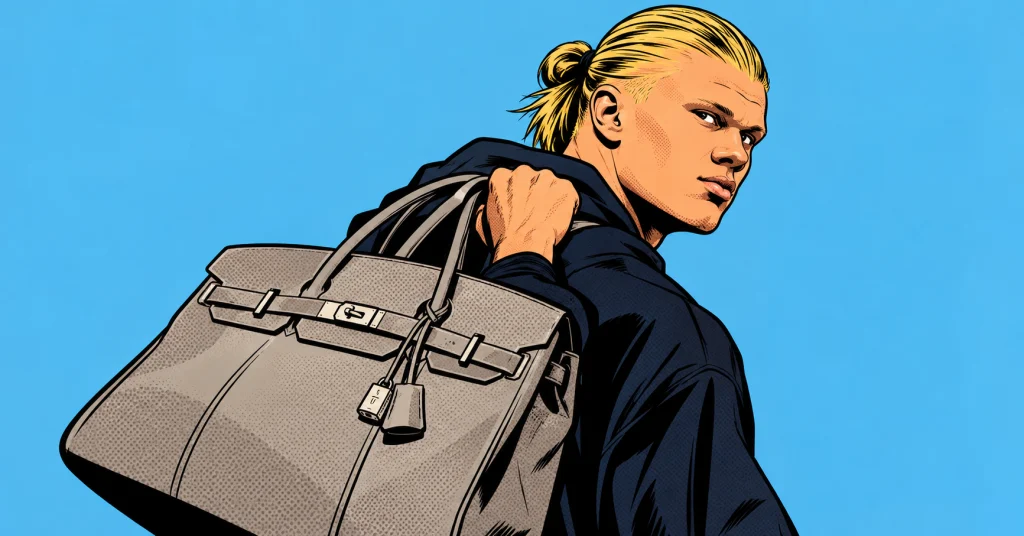
NBA tunnels made designer bags part of men’s style. Pharrell put the Speedy on LeBron’s shoulder. Now a 6-foot-4 Norwegian striker is carrying the most talked-about Hermès collection in sports.
Erling Haaland stepped off Norway’s team plane in Oslo on July 13 holding two things. In one hand was a taxidermied raccoon clutching a liquor bottle, bought for about $750 at a western store in Dallas. On his shoulder was a Dolce & Gabbana Sicily tote that had walked the brand’s spring 2027 menswear runway in Milan only weeks earlier. “It followed me home,” he posted about the raccoon.
The raccoon got the laughs. The bag fit a pattern. Over the summer of the 2026 World Cup, Haaland’s luggage drew almost as much attention as his finishing. Fashion trackers counted at least seven Hermès bags he had carried in public, most of them rare, oversized travel pieces, with an estimated combined resale value above $317,000, Page Six reported. One analysis by The National put his full visible collection, including Louis Vuitton, Chanel and Goyard pieces, closer to $860,000.
Haaland didn’t introduce men to designer bags. Basketball players, rappers and a Louis Vuitton creative director got there first. So, in his own way, did my best friend Travis. But no athlete has made the case quite as loudly, or with quite as much leather.
Not your average Birkin
Most people looking at Haaland’s bags see Birkins. Most of them are actually Hermès Haut à Courroies, or HACs, the tall equestrian travel bag the house made long before the Birkin existed. The HAC was built to carry riding gear. At Haaland’s size, it reads like a normal bag instead of an accessory.
The crown of the collection is a black Multipocket HAC 50 covered in exterior utility pockets, which has sold for about $69,500 on the resale market. Close behind are a moss-colored Toile Cargo HAC 40, estimated at around $50,000, and a HAC Rock in black. The one that made fashion writers stop scrolling was the Endless Road HAC 50, a bone-colored bag patchworked with blue-gray mountains and a winding highway, valued at roughly $45,500. He carried it off the plane when Norway arrived in the U.S. for the tournament.
Those numbers are secondary-market estimates, not what he paid. They also understate the real difficulty: bags like these rarely show up in a Hermès boutique at all. Beyond Hermès, Haaland has been photographed with quilted Chanels, landscape-printed Louis Vuitton duffels and a Goyard toiletry case, and he was spotted with a smaller black Birkin before a match in Madrid on March 11.
The attention paid off for the brands. Launchmetrics, which tracks the media value generated by mentions and images, estimated that Haaland generated $8.8 million in value for Hermès during the World Cup. He gained roughly 12 million Instagram followers over the same stretch. Norway went out in the quarterfinals, losing 2-1 to England in extra time in Miami. Haaland still left the tournament as one of its biggest style stories.
The tunnel got there first
The modern athlete’s runway started as a rule meant to tame it. In 2005, NBA commissioner David Stern introduced a league dress code that banned chains, jerseys, headphones and much of the clothing tied to hip-hop from team business. Critics, including some players, said it targeted Black culture. Within a decade, they had turned the walk from the bus to the locker room into a weekly fashion show, with photographers stationed in the tunnel and brands paying close attention.
Russell Westbrook pushed it furthest early on, with experimental silhouettes and accessories that ignored every old idea of how a point guard should dress. LeBron James made the arrival into an event. Today the standard-bearer is Shai Gilgeous-Alexander, the Thunder’s two-time MVP, who has worn fur, shearling bags and, before Game 1 of this year’s conference finals, an all-white look finished with a white Chanel mini bag. Nobody in the tunnel blinked.
I’ve watched athletes walk those tunnels for years, and the biggest lesson has nothing to do with labels: money can’t buy taste. Plenty of the richest men in sports have shown up looking like they bought the whole store at once, at least until a stylist stepped in. The ones who get it right do something bigger than look good. They’ve blurred the old lines around what a man is supposed to wear, and a lot of fans have redrawn those lines right along with them.
The NFL followed, more slowly. Odell Beckham Jr. showed that a star receiver could lean all the way into designer fashion without it costing him anything on Sundays, and pregame arrivals across the league now look a lot like basketball’s. Soccer has caught up: Virgil van Dijk has carried a Chanel bag from Matthieu Blazy’s debut collection, and Jude Bellingham, a Louis Vuitton ambassador, has made the house’s monogram part of his travel uniform. Haaland arrived in a sport that was already primed for him.
Pharrell’s Speedy
If the tunnel created the audience, Pharrell Williams gave it a product. Louis Vuitton named him men’s creative director in 2023, and his debut show that June on Paris’s Pont Neuf introduced the Speedy P9, named for the bridge. It took one of the house’s most recognizable handbags, a design dating to the 1930s, rebuilt it in soft, waxy calfskin and released it in loud colors: yellow, red, green, blue. He didn’t invent a men’s bag. He put an existing one in a men’s collection and dared people to object.
The first campaign made the point clear. Rihanna fronted it, carrying Speedys, which tied the bag to its long history with women instead of pretending it was something new. Then LeBron James, the campaign’s next face, walked into Denver’s Ball Arena for the Lakers’ October 2023 season opener with a green Speedy across his chest, part of a Louis Vuitton look reported to cost about $28,000. His first LV billboards had gone up in New York that same day.
By April 2026, the house built an entire campaign around men and the bag. Called In My Bag and photographed by Thomas Lagrange, it opened each ambassador’s Speedy P9 to show what was inside. LeBron’s yellow bag held shaving cream, a cap and golf balls. Future’s cobalt blue one had a tennis racquet, a gold chain, gummy candies and a spare pair of sneakers. Victor Wembanyama’s turquoise bag, with an alien charm on the handle, held a mini basketball, playing cards, a lucky spur and wired headphones. Jude Bellingham, Jeremy Allen White and Jackson Wang filled out the cast.
The pitch was quiet and very effective. A Speedy wasn’t a statement anymore. It was where you kept your keys.
Retiring the murse
For a long time, the joke wrote itself. In a 1998 episode of Seinfeld, Jerry insists his new shoulder bag isn’t a purse but a “European carryall,” and spends the episode being mocked for it. A year later, Friends gave Joey a leather satchel and built a whole episode around how ridiculous he looked. By the 2000s, the culture had a word ready for any man carrying anything smaller than a briefcase: “murse,” man plus purse, delivered with a smirk.
Travis never cared about any of that. About 15 years ago, when a man with a shoulder bag was still a punchline, he carried a small crossbody everywhere, just big enough for his wallet, phone and cash. He was a doctor, and he treated the bag the way he treated everything else: as a practical choice that was nobody else’s business. Over time it grew. When we traveled together, his carry-on was a Gucci or Louis Vuitton duffel, slid into the overhead bin like the most normal thing in the world. Nobody else I knew dressed like that. I admired how he wore what he wanted and never once apologized for it, years before athletes made it look easy.
The word did a specific job. It said a bag was naturally a woman’s thing, and that a man holding one needed a special label to explain himself. That framing has aged badly. Men carry the same things everyone else does: phones, wallets, keys, sunglasses, earbuds, a charger. Pockets fill up, and a backpack is too much for dinner. A small leather shoulder bag solves a practical problem and adds something to an outfit while it’s at it.
Even “man bag,” the polite successor, is starting to feel unnecessary. It helps a retailer sort inventory, but it still implies the object needs a gender before anyone can carry it. Haaland’s HACs were designed to carry riding gear. The Speedy on LeBron’s shoulder had already been on Rihanna’s in Pharrell’s first campaign. A bag is a bag, and the people carrying them increasingly act like it.
Why luxury needs men
The industry’s enthusiasm isn’t only cultural. Luxury handbags have hit a wall. In a July column for Bloomberg Opinion, Andrea Felsted noted that the number of premium bags sold has been falling since 2022, even as average prices climbed about 60% since 2019. Shoppers are buying fewer bags for more money, and that math only goes so far.
Men are the obvious way out. They made up only about a quarter of the global luxury handbag market in 2025, according to Bain & Co. To the industry, that’s room to grow. Felsted’s argument was that footballers like Haaland, Van Dijk and Bellingham had moved the man bag from mocked to coveted at exactly the right time, and the column’s numbers backed her up: searches for Haaland’s bags peaked the day Norway played England, and searches for larger Birkins on resale sites climbed after the World Cup began.
The brands are already stocked for it. Walk through a luxury department store and the men’s floor now carries shoulder bags, crossbodies, minis and totes from Gucci, Prada, Dior, Bottega Veneta and Saint Laurent, alongside Hermès and Louis Vuitton. Bottega’s oversized Andiamo became a signature for actor Jacob Elordi. Lower down the price ladder, Coach and Telfar have made a stylish bag something a college student can afford.
The $70,000 question
There’s an obvious catch. Haaland’s collection is the extreme end of a trend most people will join for a fraction of the price, and the luxury industry’s eagerness to sell $50,000 bags to men isn’t the same thing as men feeling free to carry one. A canvas tote, a secondhand leather satchel or a $200 crossbody does the same job. The shift that matters is that a man can carry any of them now without a joke attached.
For the record, I’m not buying one either. I’m a backpack guy, and the closest I’ll ever get to a luxury bag is a monogrammed Tumi carry-on. But I don’t need a Hermès to understand what Travis figured out 15 years ago. The bag was never really the point. Carrying it without asking anyone’s permission was.
There’s also something fitting about who is carrying the biggest bags. Haaland is one of the most physically imposing players in the world, a striker whose whole game is force. He doesn’t style his Hermès to look tougher, and he doesn’t explain it. He carries the bag off the plane, sometimes with a raccoon in the other hand, and lets everyone else do the talking.
He didn’t start this, and he won’t finish it. But the next 12-year-old who sees him walk through an airport with a $70,000 Hermès on his shoulder probably won’t think to call it a murse.