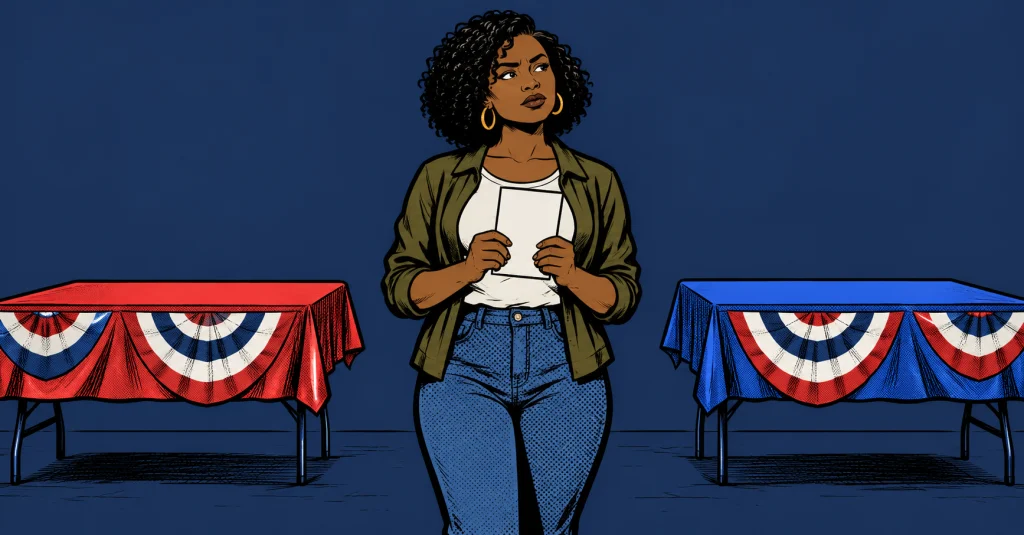
Every election cycle, political campaigns spend millions of dollars trying to identify the voters who could determine the outcome. They purchase advertising, organize rallies, recruit volunteers and commission research to understand which communities might help deliver a victory. Yet in Ohio, one of the most consequential political constituencies has remained largely disconnected from the electoral process: hundreds of thousands of eligible Black voters who are not casting ballots.
A report by the Ohio Legislative Black Caucus Foundation found that approximately 603,000 eligible Black Ohioans did not vote in the 2022 midterm elections. That is more than the population of Cleveland. During that election, Republican JD Vance defeated Democrat Tim Ryan in the U.S. Senate race by approximately 253,000 votes. The numbers do not mean those absent voters would have supported Ryan, but they illustrate the enormous political influence of a community whose participation has not matched its potential electoral weight.
The findings raise an uncomfortable issue for political parties, particularly Democrats, who have historically depended on strong Black voter support. When hundreds of thousands of people repeatedly decline to participate, is the problem simply voter disengagement, or have political organizations failed to build relationships that make participation feel worthwhile?
The Voters Nobody Is Reaching
The Ohio Legislative Black Caucus Foundation’s research challenges the assumption that people who skip elections are necessarily uninterested in politics. Its president and CEO, Shayla Davis, told Ohio public radio that the findings pointed toward people who were not being sufficiently engaged rather than people who did not care about their communities.
That interpretation changes the conversation. A person struggling to pay rent, manage medical bills or maintain stable employment may have strong opinions about government policy without believing that either political party understands their circumstances. Voting requires time, attention and confidence that participation matters. When campaigns primarily appear during election season, those relationships can begin to feel more like requests for political support than sustained investments in the communities being courted.
The foundation’s research also found that the overwhelming majority of these nonvoters were concentrated in eight Ohio counties, suggesting that the challenge is geographically identifiable. Its analysis highlights adults ages 25 to 44, with Black men representing a substantial share of that group. These are people whose economic and family responsibilities are often immediate, while the benefits promised through political campaigns may seem distant or uncertain.
The implications extend beyond campaign strategy. If political organizations know where disconnected voters live, which issues affect their households and how many people have stopped participating, the failure to establish sustained relationships becomes increasingly difficult to explain as a lack of information.
Ohio’s Senate Race Makes the Stakes Clear
Ohio’s current Senate contest between Republican incumbent Jon Husted and former Democratic Sen. Sherrod Brown is drawing extraordinary national attention. By October, Axios reported that the race had attracted more than $400 million in advertising spending from the two parties and their allies, reflecting its importance to the balance of power in Washington.
Brown has increased outreach to Black communities through religious leaders, radio stations, historically Black Greek-letter organizations and community gatherings. These efforts recognize that winning support requires more than traditional television advertising. But outreach conducted shortly before an election also raises a question about what happens during the months and years when candidates are not asking for votes.
Democrats have reason to be concerned, particularly as younger voters reconsider their relationships with the party. Black voters are not politically uniform, and frustration with Democrats does not automatically translate into support for Republicans. Some voters may prefer a different candidate, others may reject both major parties, and still others may believe that political engagement has delivered too few improvements in their everyday lives.
Republicans face their own challenge in demonstrating that their policies and outreach address the needs of Black communities. Neither party is entitled to these votes. The responsibility to earn political support belongs to the candidates seeking it, not the voters being asked to provide it.
A Relationship That Cannot Begin and End at the Ballot Box
For decades, Black voters have played a defining role in American elections, often providing the margins that decide local, state and national contests. Their importance is regularly acknowledged through campaign speeches, appearances at Black churches, outreach to civic organizations and promises to address longstanding inequities.
But political recognition and meaningful political engagement are not necessarily the same thing. A campaign can spend substantial money communicating with Black voters without establishing the kind of trust that develops through consistent relationships, visible accountability and attention to community priorities outside election season.
Organizations such as Cleveland VOTES are attempting to address that gap through grassroots voter engagement, but their work also illustrates the limitations of relying on relatively small civic organizations to maintain relationships that well-funded political institutions have struggled to sustain.
The turnout figures should not be interpreted as evidence that Black Ohioans have abandoned concerns about government, public policy or the future of their communities. They demonstrate that having a stake in political decisions does not always produce confidence in the electoral process. Understanding that gap requires listening to people who are not voting rather than simply developing new techniques to persuade them.
Ohio’s 603,000 absent Black voters represent more than an electoral opportunity for Democrats or a potential challenge for Republicans. They represent hundreds of thousands of people whose perspectives may not be reflected in the decisions shaping their communities.
With the November election approaching, the immediate political conversation will focus on whether more of those voters can be persuaded to participate. But the longer-term measure of political accountability will come after the ballots have been counted, when the campaigns are over and those same communities are no longer being discussed as potential margins of victory.
Political parties have spent years asking why Black voters are not showing up. Ohio’s numbers suggest they should also be prepared to explain how often they have shown up for Black voters.