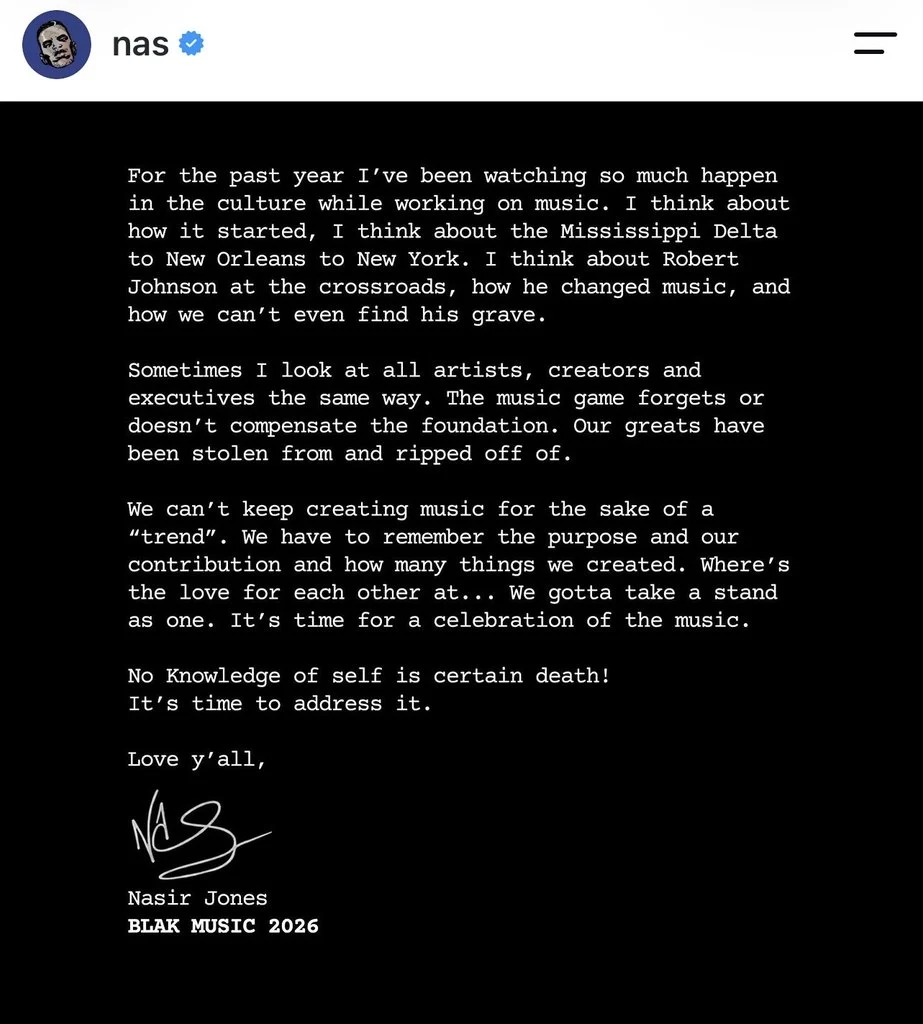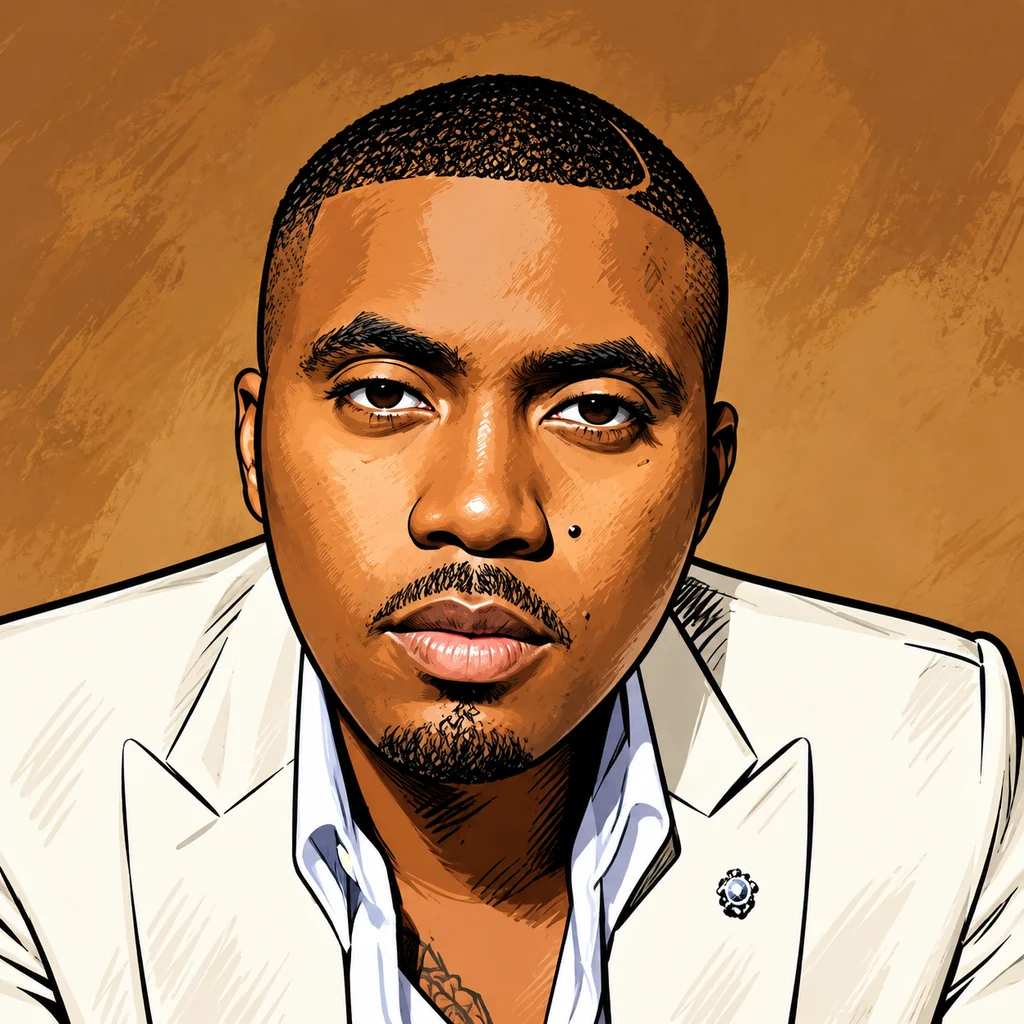
Nas has spent more than three decades inside the music business, and last week he used an open letter to say what it owes the people who built it. “The music game forgets or doesn’t compensate the foundation,” the Queens rapper wrote in a post shared on social media. “Our greats have been stolen from and ripped off of.”
The letter, first posted on X on Oct. 15, according to REVOLT, traced Black music from the Mississippi Delta to New Orleans to New York and urged artists to stop “creating music for the sake of a ‘trend.’” It ended with a call for unity, “It’s time for a celebration of the music,” and a line from the hip-hop lexicon: “No knowledge of self is certain death!” He signed it “BLAK MUSIC 2026,” which fans read as a hint at new music, though he has not announced a project.
A Blues Legend Without a Known Grave
Nas opened with Robert Johnson, the Delta blues guitarist whose recordings shaped rock and roll, and lamented that “we can’t even find his grave.” He was not exaggerating much. Johnson died in 1938, and three churchyards in Leflore County, Mississippi, each have a marker claiming to be his resting place, at Little Zion Missionary Baptist Church near Money, Mt. Zion Missionary Baptist Church in Morgan City and Payne Chapel in Quito, according to blues historians who track the sites.
That a musician this influential has three possible graves and no settled one is its own kind of verdict on how the industry treated the artists who came first. The music lasted and was resold for generations, while the people who made it were often left without money, records or even a fixed place in history.
The Record Supports His Point
The history of Black musicians being underpaid for their work is well documented. Willie Mae “Big Mama” Thornton recorded “Hound Dog” in Los Angeles in August 1952, and her version sold about 2 million copies, yet she received only $500 for it, according to the Encyclopedia of Alabama. Elvis Presley’s 1956 cover became one of the best-known records in American history.
Some of the gap is written into law today. AM and FM radio stations in the United States pay songwriters but not the performers on a recording, which means a singer can hear a song on the radio for decades without earning from that airplay. A bipartisan bill, the American Music Fairness Act, reintroduced in January 2025, would require broadcasters to pay performers, and its sponsors say the U.S. is the only democratic country where artists go unpaid for radio play.
An Industry Still Built on the Foundation
Nas is speaking at a time when the business around Black music is shifting again. SSC has reported on how R&B lost the label machine that once made its superstars and how Universal Music keeps growing while cutting the people who built the old business. The catalogs of earlier generations remain some of the most valuable assets companies own, even as the artists behind many of them saw little of that value.
His letter offers no policy plan, and it reads more as a call to artists than a demand to labels. Its argument is that remembering the foundation is part of the work, and that the industry owes those artists more than tribute. Coming from a rapper whose own catalog has become a blueprint, the message is likely to carry, whether or not a new album follows it.