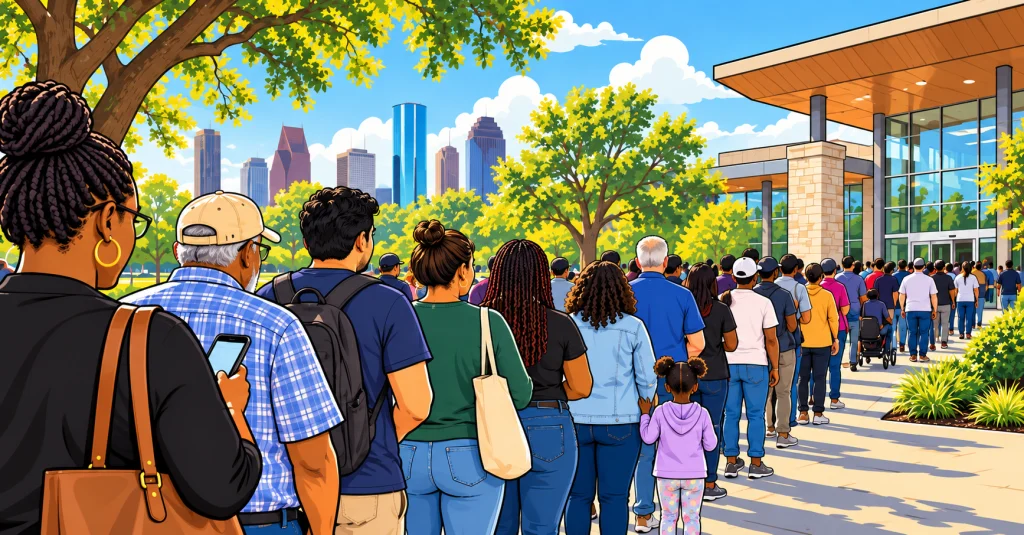
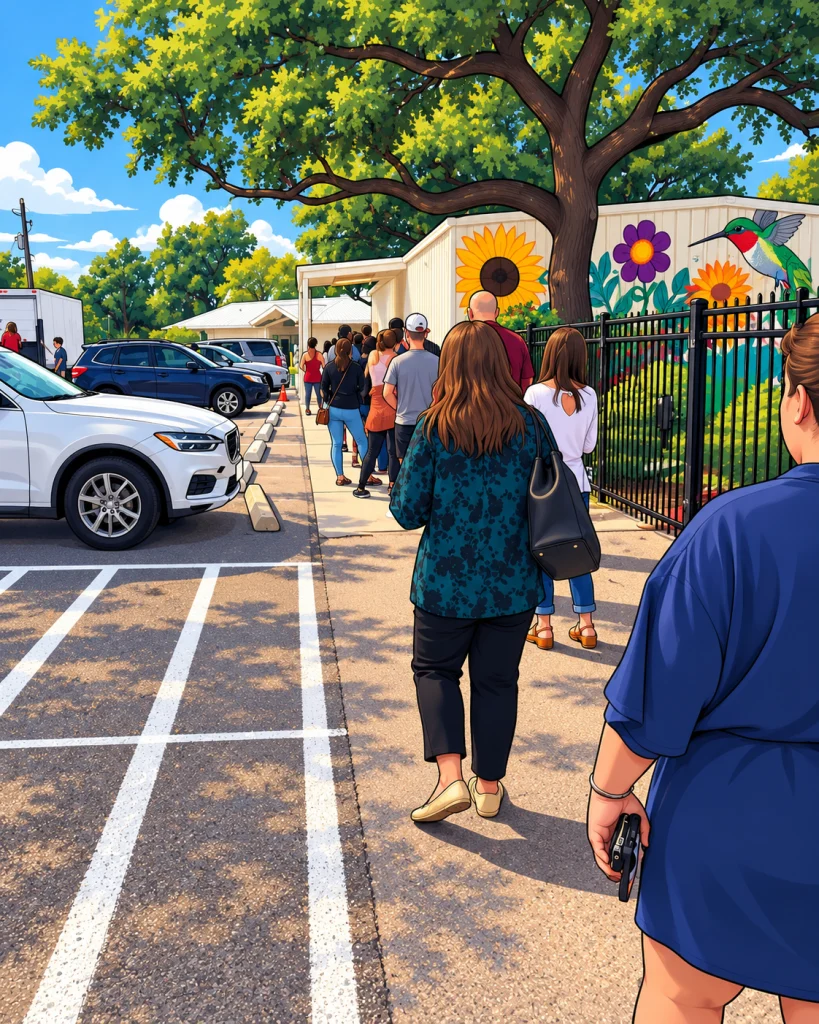
I stood in line to vote Monday, Oct. 19, surrounded by other Harris County residents who had made the same decision: rather than wait until Election Day, we were going to cast our ballots early. I took a photo of the line while I waited, not knowing that we were part of what would become a record-breaking opening day for early voting.
By 3:30 p.m., county officials reported that more than 70,000 voters had already been processed, passing the previous first-day midterm record of 63,188 set in 2018. By 6 p.m., the total had reached 104,201 ballots, according to the Harris County Clerk’s Office, as reported by KPRC Click2Houston. That’s about 65% above the old record, with polls still open. It is more than a statistical milestone. Americans spend a great deal of time arguing about politics, predicting outcomes and debating whether their votes matter, and more than 100,000 people in one Texas county decided to participate before the first day was over.
A Record That Deserves More Than a Headline
Harris County is one of the nation’s largest and most politically consequential counties. Its electorate reflects the demographic, economic and ideological complexity of metropolitan Houston, where public education, property taxes, housing affordability, immigration, public safety and economic opportunity are not theoretical. They shape how residents experience their communities every day.
The turnout was not concentrated in one corner of the county either. The busiest of the 75 early voting sites was the Richard and Meg Weekley Community Center, with 3,153 ballots by 6 p.m. Next came the Kingwood Community Center, Juergens Hall Community Center, the Metropolitan Multiservice Center on West Gray and the George Bush Community Center, each with more than 2,600 votes. Lines formed in the suburbs and inside the Loop alike.
Voters who spoke with KPRC pointed to the pressures many households are feeling. “The coffee that I buy two years ago was $12 for a big can and now it’s $25 for the same thing,” one voter said. Another listed the “cost of living,” the “war in Iran” and “our support to Ukraine.” Others cited immigration, and one framed the vote as a call for change after “30 years of one party dominating the state.”
Voters are not simply responding to a national political environment. They are also choosing the officials who govern their neighborhoods, administer local services and set priorities that will shape their lives long after the election. The 2026 ballot includes Congress, Texas governor, statewide offices and numerous local positions. In Harris County, that includes county judge, a position with substantial influence over the direction of county government, plus local ballot questions. Axios Houston’s election guide outlines several of the major contests.
What we cannot responsibly conclude from Monday’s turnout is which party benefits. A record number of ballots tells us participation is high. It does not tell us how those ballots were cast, what motivated individual voters or whether the pace will hold throughout early voting. Enthusiasm is not exclusive to any party, and high early turnout does not necessarily mean higher overall turnout, since some voters who would ordinarily vote on Election Day may simply be voting sooner. Still, the intensity of the first day deserves attention.
What Standing in Line Reminded Me About Voting
There is something about the physical experience of voting that gets lost in political coverage. We usually talk about elections through polls, fundraising, ads, endorsements and predictions, with most of the attention on candidates and strategy. But voting comes down to an individual decision to participate.
It means finding time, finding a polling location, bringing the right identification and sometimes waiting in line. For working adults, parents, caregivers and people with unpredictable schedules, even those ordinary steps take planning. Standing in line reminded me that democracy ultimately depends on people making that effort.
I can’t speak for the other voters around me. Some may have been enthusiastic about particular candidates. Others may have been frustrated with the direction of government, worried about a local issue or simply determined to do what they consider a civic duty. What we shared was the act of showing up.
That experience raises a broader question about access. Participation should not depend on whether someone can afford to take time off work, arrange childcare, find transportation or get past administrative obstacles. Just days before early voting began, the Associated Press reported that Texas officials had cleared a large voter-registration backlog caused by a software problem. More than 75,000 applications in Harris County alone had been affected, a reminder that administrative systems shape the voting experience before a voter ever reaches the polls. Record turnout is encouraging, and keeping participation accessible matters just as much.
The Political Meaning of 104,201 Votes
After a turnout announcement like this, the temptation is to immediately give the numbers a political meaning. Some will read the record as a backlash. Others will see enthusiasm for keeping the current direction. Campaigns on both sides will look for signals that confirm what they already expect.
Voting data is most valuable when we resist forcing it into a predetermined narrative. The first-day figure tells us Harris County voters are participating at a historic pace for a midterm opening day. It does not tell us who is winning.
The more consequential questions will emerge as early voting continues. Will participation stay elevated? Which communities are turning out? Are first-time and infrequent voters showing up? Will early voting expand the electorate or mostly shift the timing of votes that would have been cast anyway? Those questions matter because a broader electorate can change whose concerns get attention from elected officials, and participation doesn’t end when a ballot is cast. The same residents who stood in line to choose their representatives have a stake in whether those representatives deliver.
The Line Is Only the Beginning
Early voting in Harris County continues through Oct. 30 at 75 locations, and Election Day is Nov. 3. Officials are encouraging voters to plan ahead and use less crowded sites when possible. Polling locations, sample ballots and hours are available through the Harris County Clerk’s Office Elections Department.
Monday’s turnout offers an important snapshot of public engagement, but the full story won’t be written until the votes are counted and the electorate can be examined more completely. I’m glad I was one of the people who voted on the first day. That’s not because a turnout record guarantees any outcome. It’s because the experience reminded me of something the noise around American elections tends to bury: democracy isn’t sustained by commentary alone. It requires participation, access, accountability and a public willing to stay engaged after the election is over.
On Monday, 104,201 Harris County residents took that first step. I was one of them.
Reporting sources: Harris County Clerk’s Office, KPRC Click2Houston, Associated Press, Axios Houston