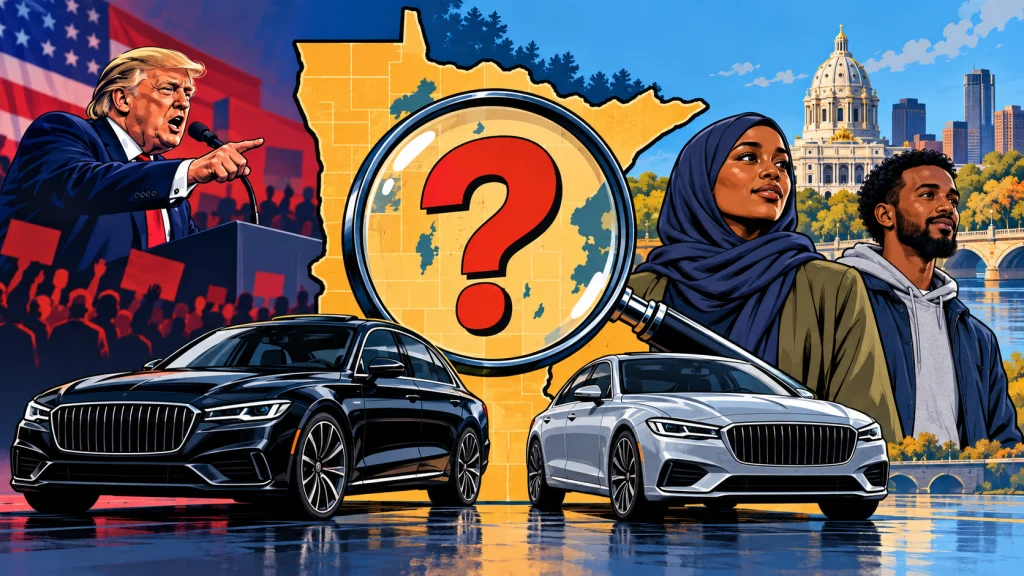
At an Ohio rally, Trump portrayed Somali immigrants as leading purchasers of German luxury vehicles while accusing the community of widespread fraud. The sales claim has no publicly demonstrated basis, but it serves a larger political argument about immigration and public benefits.
At an October 12 campaign rally in Youngstown, Ohio, Donald Trump claimed Somali immigrants were Minnesota’s leading buyers of Mercedes-Benz and BMW vehicles. Describing people who arrived in the United States with little money, he told supporters they were now driving expensive German automobiles. “They’re the number one buyers of Mercedes-Benz and BMWs in the state of Minnesota,” he said, according to the rally transcript published by Roll Call’s Factbase. He presented no sales figures, dealership records or registration data supporting the ranking. The claim appeared alongside attacks on Somali immigrants, Democratic Rep. Ilhan Omar and alleged fraud involving Minnesota’s public programs.
Trump described Somalia as a country defined by violence, accused members of Minnesota’s Somali community of stealing public money and characterized Somalis as unintelligent. He then invoked luxury vehicles as evidence of suspicious prosperity. The message connected three separate ideas: immigration, taxpayer-funded assistance and conspicuous consumption. Listeners were encouraged to view an expensive vehicle as evidence that public resources had been improperly diverted to immigrants, even though the purchase of a luxury automobile establishes neither a person’s immigration history nor the source of their income.
A Specific Claim Without Supporting Data
Trump’s assertion can be tested in principle. Establishing that Somali Minnesotans purchase more BMWs and Mercedes-Benz vehicles than any other group would require reliable sales or registration records, a defined comparison population and a credible method of identifying purchasers’ ancestry. Public vehicle-registration statistics do not ordinarily classify buyers by Somali heritage. No published analysis establishing the ranking was identified in the evidence reviewed for this article. That absence does not establish how many Somali Americans own luxury vehicles, but it leaves Trump’s specific claim unsubstantiated.
Minnesota’s own demographic research provides context that differs from the image presented at the rally. The Minnesota State Demographic Center’s 2026 report found that 19% of Somali households had no vehicle, compared with 7% statewide. These figures measure access to a vehicle, not purchases by brand, and cannot determine whether Somali Minnesotans lead luxury-car sales. They demonstrate the limits of treating an entire community as economically uniform. Household circumstances vary considerably, while an individual vehicle may be purchased used, financed, leased or owned through a business.
Fraud Cases and Collective Responsibility
Minnesota has experienced serious fraud involving government-funded programs. Federal investigations, including the Feeding Our Future case, have produced criminal charges and convictions involving the misuse of public money. Some defendants have Somali backgrounds, and public institutions responsible for administering those programs have faced scrutiny over failures to prevent improper payments. Those cases warrant accountability for the people and organizations involved. They do not establish that Somali immigrants generally obtain expensive vehicles through fraudulent public assistance or that the community collectively participated in criminal activity.
The difference between individual wrongdoing and collective accusation is central to evaluating Trump’s remarks. A December 2025 FactCheck.org investigation found insufficient support for several of his earlier claims about Somali Minnesotans and government benefits. The organization also reported information from Minnesota’s state demographer indicating that 95% of Somali Minnesotans were U.S. citizens and 58% were born in the United States. Those figures challenge the portrayal of the community as uniformly composed of newly arrived immigrants. Citizenship, birthplace and alleged criminal conduct are separate facts, each requiring its own evidence.
When Economic Success Becomes Suspicious
The luxury-car allegation also reveals a contradiction in how immigrant prosperity can be portrayed. Building businesses, earning higher incomes and accumulating wealth are commonly presented as examples of economic opportunity in the United States. In Trump’s account, however, the image of a Somali immigrant driving a Mercedes or BMW became a reason for suspicion. Prosperity was framed as possible evidence of wrongdoing rather than an outcome that might also follow employment, entrepreneurship or years of financial advancement. That framing allows an unverified consumer claim to reinforce a broader political argument without demonstrating any connection between vehicle ownership and fraud.
Minnesota’s fraud investigations require continued scrutiny, including examination of government oversight and failures that allowed public money to be stolen. Trump’s allegation about luxury-car purchases requires a different kind of proof: credible data identifying buyers and establishing the ranking he asserted. Conflating those subjects risks turning criminal cases involving particular defendants into an indictment of thousands of people who have not been implicated. When political leaders use statistical-sounding claims to characterize entire communities, the burden of evidence matters. Without the sales records needed to support Trump’s statement, the luxury-car image remains a political assertion rather than an established account of Somali Minnesotans’ economic behavior.