On Piers Morgan Uncensored, the provocative commentator called Marc Lamont Hill and Brandon Tatum “house Negroes.” The line says less about either man than about where criticism ends and stereotype begins.
A conversation about Black accountability that opens by sorting Black people into categories has already lost something. Andre Williams, a Black social media commentator known for provocative takes on race and culture, has built an audience by naming what he sees as dysfunction inside Black America. Some of what he points to is fair game: personal responsibility, cultural expectations and a community’s willingness to look honestly at its own problems. The trouble is the language he wraps it in. At some point, criticism stops pushing people toward accountability and starts repeating the stereotypes that have been used against Black Americans for centuries, and Williams keeps finding that point.
He found it again on October 16, when he joined Marc Lamont Hill and Brandon Tatum on Piers Morgan Uncensored for a heated discussion about race, slavery, reparations and Black identity. Hill, a progressive academic and broadcaster, and Tatum, a conservative commentator, rarely agree on much. Williams didn’t argue with either of them. He classified them. “You’ve got Blacks, you’ve got house Negroes, which I would say both Brandon Tatum and Marc represent that class of Black people,” he said.
The Weight of the Word
The phrase is not a casual insult. It comes out of slavery and has long been used to question the racial loyalty of Black people seen as accommodating white power. Malcolm X drew the line between the “house Negro” and the “field Negro” in his November 1963 speech “Message to the Grass Roots” to describe relationships to power and oppression, and the label has carried that charge ever since. Its staying power doesn’t make it a neutral description of contemporary Black Americans or a reliable measure of anyone’s commitment to the community. When Williams applied it to two men on opposite sides of nearly every debate, the only thing the label seemed to measure was disagreement with Williams. It replaced an argument with a verdict on two men’s racial identity, and it turned a conversation about accountability into a contest over who gets to define authentic Blackness.
Criticism Is Not Condemnation
Black Americans have been criticizing problems inside their own communities for as long as those communities have existed. Scholars, preachers, activists and ordinary people in barbershops and church basements have argued for generations about education, economic opportunity, violence and family stability. That tradition isn’t hostile to Black progress, and more often than not it is how progress gets argued into existence. The line gets crossed when the critique moves from specific behaviors or failing institutions to claims about an entire people. Black America is not one political constituency or one cultural experience, and what a commentator sees in one neighborhood or one social circle can’t establish the character of more than 40 million people. Personal observation can start an argument, but it can’t finish one without context and evidence.
Morgan’s Defense Misses the Point
During the exchange, Morgan defended Williams by noting that he criticizes the left and the right alike. That is a defense of balance, not accuracy. Political affiliation and racial identity are different things, and a commentator can spread his criticism evenly across both parties while still making sweeping claims about a racial group. The real test isn’t whether a guest offends everyone equally but whether his claims hold up and whether he applies the same standard to everyone, himself included. Provocative guests can earn their place at the table when the questioning is serious enough to expose what’s weak in their arguments. Pointing out that a guest is an equal-opportunity critic doesn’t do that work.
Resilience Is Not a Justification
Williams also suggested that slavery benefited Black people by producing resilience. The perseverance is real, and so is the culture, faith and community that Black Americans built during slavery and in its long aftermath. But resilience belongs to the people who survived, not to the system that tried to break them. A people’s ability to endure an injustice doesn’t prove the injustice was necessary for its progress, and treating survival as a dividend of slavery gets cause and consequence backwards. Serious discussion of Black history can honor what was built and still name what it cost without letting one excuse the other.
When Provocation Becomes the Story
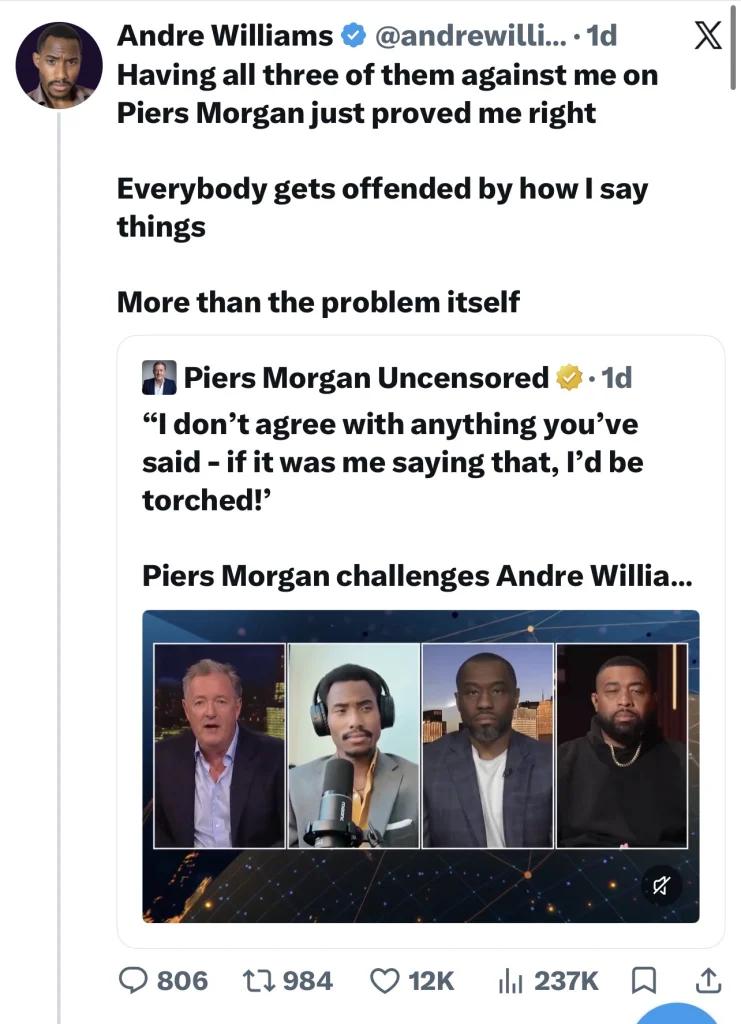
Williams’s rising visibility also says something about the media environment around him. Social platforms reward engagement, and confrontational statements about race travel faster than careful ones because they provoke a stronger reaction. That doesn’t explain why Williams says what he says, and he may believe every word of it. It does explain how certain voices rise, and how complicated questions about schools, wages and violence get flattened into a shouting match. When the most memorable moment of the conversation is a racial insult, the substance disappears beneath it. Williams sees it differently. After the episode, he wrote on X that having the panel against him “just proved me right,” adding that “everybody gets offended by how I say things more than the problem itself.” That reading treats the backlash to his language as proof of his point, when it may be the clearest sign that the language got in the way of it.
Accountability Runs Both Ways
Meaningful accountability means Black Americans can examine failures, question cultural assumptions and argue over the path forward without being told the conversation itself is disloyal. It also means the people leading that conversation answer to the same standard. Williams’s race doesn’t validate his conclusions, and criticizing both parties doesn’t exempt him from scrutiny. His arguments should face the test every public commentator faces: factual support, historical context, consistency and a willingness to engage the evidence against him. No single commentator, on the left or the right, owns the Black experience.
Andre Williams has made accountability the center of his public voice, and the standard he applies to Black America applies to his own words. The harder question is whether audiences, hosts and fellow commentators will examine the evidence behind those words as closely as they react to the delivery. Black America doesn’t need to agree on its challenges. It needs conversations that get past the insult and back to the people, institutions and conditions shaping its future.
Sources: Piers Morgan Uncensored, Oct. 16, 2026; Andre Williams on X.