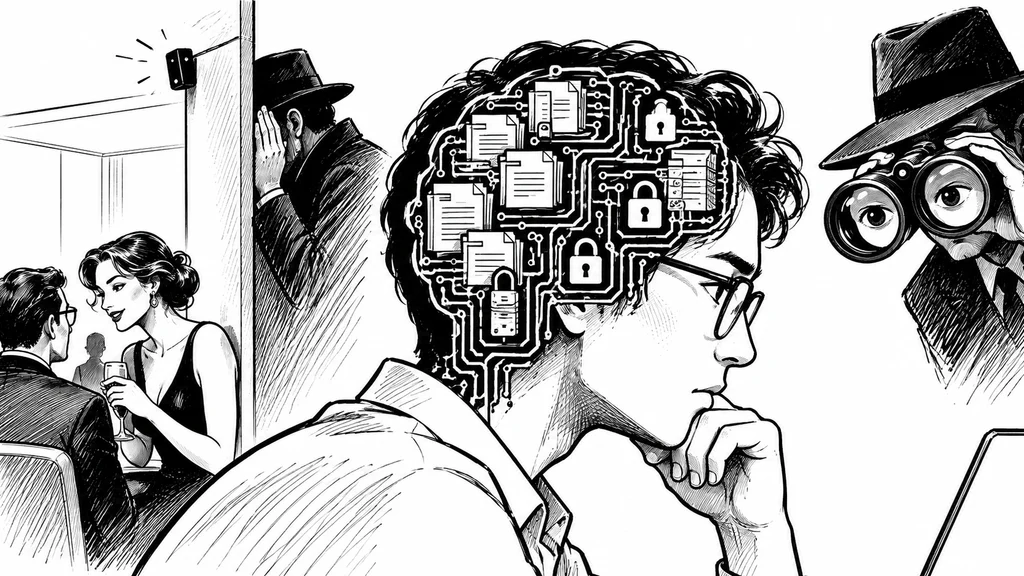
The competition to build the world’s most advanced technology has created another race inside Silicon Valley: protecting the people who know how it works. OpenAI has warned employees that competitors, state-sponsored actors and other outsiders could try to obtain confidential information through methods that sound less like ordinary corporate security and more like espionage. Workers have been told to watch for strangers trying to build personal relationships, people listening to conversations in public places and even romantic approaches designed to gain access to sensitive information, according to The Wall Street Journal.
Those warnings became considerably less theoretical last week. Federal authorities arrested OpenAI engineer Abdulrahman Alfozan, a 35-year-old Saudi national, after the company found an audio recording device hidden behind a television in an executive conference room. Prosecutors say a second device turned up in a bag in another room, and that Alfozan had booked a one-way flight to Saudi Arabia for Oct. 12. Attorney General Todd Blanche said the “alleged attempt by a Saudi national to steal sensitive communications from OpenAI was taken extremely seriously,” and FBI Director Kash Patel has called protecting U.S. AI innovation one of the bureau’s highest counterintelligence priorities.
Alfozan’s attorney, William Pernik, said the allegations “appear wholly out of character” for his client. Alfozan is charged with intercepting oral communications, not espionage, trade-secret theft or acting on behalf of a foreign government. That legal difference matters, but the episode also shows how dramatically the security environment around technology companies has changed.
Precautions Once Reserved for Spies
OpenAI reportedly tells employees not to wear company-branded clothing outside the office, to use privacy screens on public transportation and to erase whiteboards when meetings end. Employees have also been warned about “honey pot” operations, in which sex or romance is used to gain access to a target. Those are extraordinary precautions for companies that, not long ago, were discussed mostly as software businesses.
They make more sense given what is now at stake. The largest technology companies are spending enormous sums on proprietary models and research that executives believe could reshape entire industries, military capabilities and national economic power. OpenAI and Anthropic are each expected to eventually seek valuations above $1 trillion, according to the Journal. A single breakthrough could be worth billions of dollars and give a strategic advantage to whichever organization, or country, obtains it first.
That concentration of value changes the threat. Corporate espionage itself is not new: businesses have always guarded intellectual property, formulas, customer information and strategic plans. What is changing is how much commercially and geopolitically valuable information now sits inside a relatively small group of companies, and sometimes inside the heads of individual researchers and engineers.
The Risk Walks Out the Door
The security problem therefore extends beyond servers and networks. Engineers move often between AI companies, and each move is a path for proprietary information to leave. Apple has sued OpenAI, alleging that former Apple employees took confidential information to OpenAI’s hardware team, and this week OpenAI countersued, saying an engineer who left for Apple sent more than 100 files about an unreleased device to a personal account. As we reported, a judge is now opening OpenAI’s hiring files to Apple. Elon Musk’s xAI made similar claims in 2025 when it sued an engineer who moved to OpenAI.
Rapid growth creates its own vulnerability. OpenAI, Anthropic, Meta and Google have expanded their workforces quickly as competition intensified, which means security systems have to grow as fast as the organizations they protect. That is difficult to do, and OpenAI has already shown it will act internally: it recently fired three researchers after an internal information-policy investigation.
Companies can restrict access to databases and monitor networks, but insider threats are harder to spot because authorized employees legitimately need sensitive information to do their jobs. Someone who seems trustworthy when hired can become a risk later because of money, ideology, coercion, personal relationships or something else. Security specialists increasingly focus not only on whether someone has permission to enter a system, but on whether their behavior changes once they have it.
The Cases Behind the Caution
These concerns are not hypothetical. A former Twitter employee was convicted in 2022 of spying for Saudi Arabia after prosecutors said he provided private information about the kingdom’s critics in exchange for money. In January, a jury convicted former Google engineer Linwei Ding of economic espionage and trade-secret theft for taking more than 2,000 pages of Google’s AI trade secrets to benefit two China-based companies.
Those cases help explain why Silicon Valley companies are now teaching workers to see ordinary interactions differently. A stranger making conversation at a playground may simply be another parent, someone asking about your job at a coffee shop may simply be curious, and a person expressing romantic interest may genuinely be interested. Security training starts from the possibility that, occasionally, they are not.
That may be the more consequential development behind last week’s arrest. The companies building some of the world’s most valuable technology are recognizing that protecting intellectual property cannot stop at stronger passwords, encrypted networks and secured buildings. It also means protecting the people who carry pieces of that intellectual property around in their heads.
And as the economic and geopolitical value of those secrets rises, Silicon Valley may find that the technology race comes with a competition it never set out to join: counterintelligence. Even the industry’s own voluntary safety pact says little about the threat walking in through the front door.