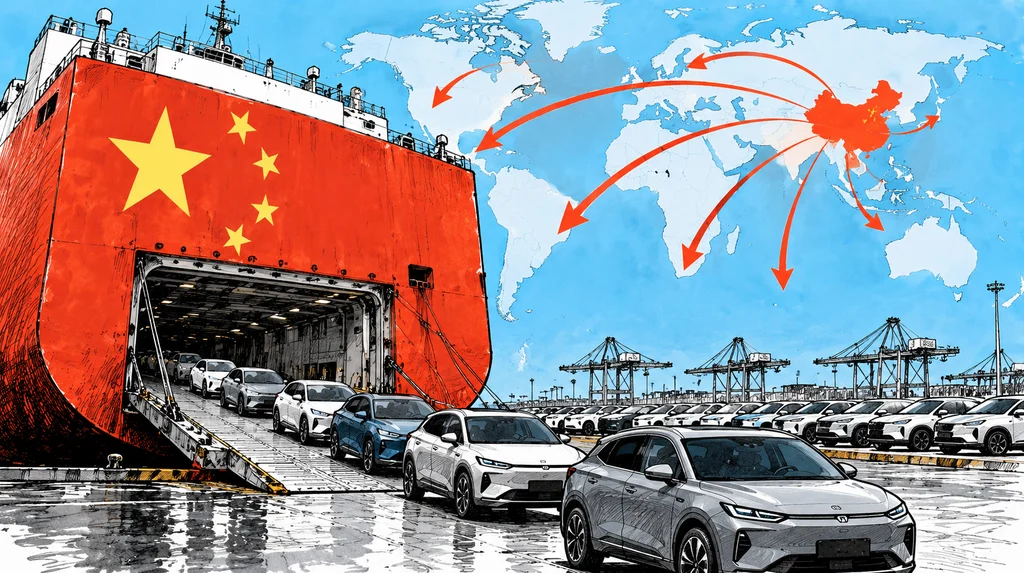
China’s passenger-vehicle exports surged in September even as sales at home weakened sharply, exposing how much the country’s auto industry is beginning to depend on buyers elsewhere. The China Association of Automobile Manufacturers said exports rose 64% from a year earlier to about 919,000 vehicles, while domestic passenger-car sales fell 27% to a little more than 1.6 million. In the first nine months of 2026, China exported more than 7.1 million passenger vehicles, up more than 70% from a year earlier, according to Associated Press reporting. The split is becoming one of the clearest signals in the global auto market: Chinese manufacturers have built enormous production capacity, but more of the growth needed to sustain it is now coming from abroad.
Export Growth Is Becoming the Release Valve
For Chinese automakers, exports are increasingly functioning as a release valve for a crowded domestic market. Consumer confidence has been weak, government subsidies have been scaled back, and competition among local manufacturers remains intense. Those conditions make overseas sales more important not only for growth but also for keeping factories busy. S&P Global Ratings analyst Stephen Chan told the Associated Press that the industry is relying more heavily on foreign markets for sales and profit growth as domestic demand softens. Consultancy AlixPartners and other analysts expect Chinese automakers could export around 10 million vehicles globally in 2026 if current momentum holds.
The destinations are broadening. Chinese automakers are expanding in Europe, Latin America, Southeast Asia and Africa, while Canada has also opened more room for Chinese electric vehicles under a tariff reduction agreement. BYD, Chery, SAIC and other manufacturers are no longer treating exports as a secondary business. They are building dealer networks, adapting models for local markets and, increasingly, investing in overseas factories. That shift matters because an export strategy based only on shipping finished vehicles from China is becoming harder to sustain politically.
Europe Is Already Pushing Back
Europe shows the limits most clearly. The European Union has agreed to cap imports of Chinese hybrid vehicles at 350,000 a year, with the ceiling expected to rise 6% annually over a four-year period. Reuters reported that Chinese hybrid exports to the EU reached $7.5 billion in the first half of 2026, triple the level from a year earlier. A separate Reuters report on the EU agreement said the quota could cut projected Chinese hybrid exports to Europe by more than half. Chinese brands had leaned into plug-in hybrids partly because those models were exempt from additional EU tariffs applied to battery-electric vehicles. The quota closes some of that opening.
The response is already changing where production happens. BYD is expanding in Hungary, Chery is producing in Barcelona, Geely plans to use a Ford plant in Spain and SAIC is establishing manufacturing capacity in Europe. That means the next phase of China’s auto expansion may create fewer export shipments from Chinese ports and more Chinese-owned production inside foreign markets. For host countries, that creates a more complicated policy question. Governments may succeed in limiting imports while still attracting factories, jobs and supply-chain investment from the same companies they were trying to restrain.
The Pressure Is Reshaping the Global Industry
The competitive pressure is not theoretical. Reuters reported Monday that Volkswagen’s global deliveries fell 14.3% in the third quarter, its steepest decline in more than four years, with deliveries in China down 38.5%. The company described weakness in the Chinese market as an industry-wide challenge. Chinese manufacturers are simultaneously dealing with that weaker market at home and using lower-cost vehicles to take share abroad. AlixPartners estimates cited by AP put the production cost of a Chinese-branded EV at roughly $20,000, compared with about $31,000 for a European equivalent. Those cost advantages help explain why foreign governments are reaching for tariffs, quotas and local-production requirements rather than relying only on conventional competition.
SSC’s assessment is that the next phase of the story is not simply whether China can export more cars. It is whether Chinese automakers can convert an export boom into a durable global manufacturing network before trade barriers tighten further. The September numbers show that overseas demand is already carrying more weight. The policy response in Europe shows that other governments have noticed. If Chinese automakers continue shifting production abroad, the industry’s expansion will become less about where the cars are sold and more about who owns the factories, where the jobs are created and which governments get to set the terms.