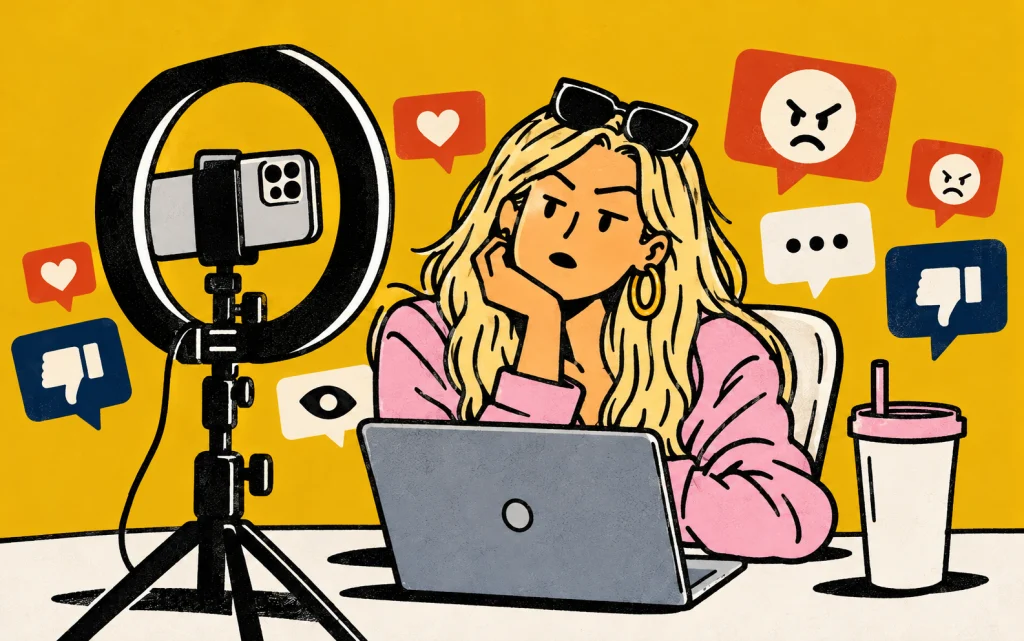
An influencer’s use of a racial slur sparked outrage and a refusal to apologize. The episode exposes a creator economy in which controversy can become a vehicle for visibility, even when the attention is overwhelmingly negative.
On October 7, a livestream about an influencer’s search for a house became the latest example of how quickly racial controversy can travel through the creator economy. Lily, the girlfriend of streamer Braden Peters, known online as Clavicular, used the N-word while responding to his request that she look at a property, according to coverage shared by Onsite. Rather than issue a conventional apology, Lily characterized the remark as a joke taken out of context and rejected demands for a public display of remorse. The incident raises a question that extends beyond one influencer’s behavior: when offensive content generates attention, who benefits from the backlash, and what does accountability look like in an economy built around being watched?
Controversy Is Already Part of the Business
Clavicular’s online reputation did not emerge from traditional entertainment. His content belongs to a livestreaming culture in which personal appearance, confrontation, provocation and spontaneous encounters become material for clips distributed across social platforms. GQ profiled his use of clipfarming, in which provocative moments are extracted from longer broadcasts and circulated to attract attention. WIRED reported on the circulation of his livestream clips and the experiences of women appearing in them. In that environment, an offensive remark does not necessarily disappear when the broadcast ends. It can become a second piece of content, detached from the original exchange and distributed to audiences who have never watched the streamer before.
The response to Lily’s remark followed a recognizable pattern. In screenshots of an Instagram post shared by Onsite, commenters challenged both her use of the slur and her insistence that she had been joking. One asked when racism had become a joke. Another questioned why people wanted to use the word in the first place. Others were less interested in debating intent than in questioning the attention being given to the influencer. One commenter argued that repeatedly posting about people audiences dislike only provides them with additional visibility. That observation gets at a contradiction in online accountability: the same people demanding consequences may also be participating in the distribution system that makes the offending creator more recognizable.
The Economics of Being Offensive
The relationship between controversy and financial success is more complicated than the assumption that every viral scandal produces a payday. Research on the monetization of toxicity on YouTube examined how controversial content, audience engagement and creator revenue can interact. Controversy can produce attention without guaranteeing revenue. But for creators whose businesses depend on audience growth, subscriptions, merchandise, sponsorships or appearances, the exposure itself may carry value beyond immediate advertising income.
That economic structure complicates the familiar argument that audiences should simply stop watching. Clips from a broadcast can reach people who never deliberately tune in to the streamer. Someone encountering a controversial clip on Instagram may never visit the original stream, but the circulation still introduces the creator to another audience. Whether that attention eventually becomes revenue depends on platform policies, audience behavior and the creator’s ability to convert recognition into something people will pay for. What remains difficult to measure is how much of that exposure comes from supporters and how much comes from people sharing the content specifically to condemn it.
When an Apology Becomes Another Performance
Lily’s response also reflects growing skepticism about the ritual of public apologies. In the statement reproduced by Onsite, she rejected the idea of making a tearful apology video, insisted she was not racist and said she intended to move on. Her language framed the controversy as a disagreement over how others interpreted her behavior rather than an acknowledgment that using a racial slur could cause harm regardless of intent. That approach rejects the expectation that an influencer should demonstrate remorse publicly. But it also leaves the audience with little evidence of reflection, changed behavior or an understanding of why the remark was offensive.
There is another consequence to this cycle that receives less attention. The people most directly affected by racist language can find themselves repeatedly exposed to it through commentary, reaction videos and news coverage, even when those posts are intended to criticize the original speaker. The controversy becomes entertainment for one audience, a business opportunity for another and an exhausting repetition of familiar behavior for people who experience the language as degrading. Some responses to Lily’s remarks also included threats or endorsements of physical retaliation, showing how quickly demands for accountability can turn into calls for harm.
The Audience Has a Role in What Comes Next
The broader challenge is that the creator economy does not require universal approval to make someone visible. It requires attention, and attention can come from admiration, curiosity, disgust or outrage. Lily’s remark and subsequent refusal to apologize have attracted criticism, but the available evidence does not establish whether the controversy has increased her earnings, expanded her audience or produced lasting professional consequences. Those outcomes would require additional reporting. What the episode does demonstrate is how easily a racial slur can travel from a livestream into a much larger conversation, with each repost creating another opportunity for the original personalities to become more widely known. If audiences want accountability rather than another cycle of viral outrage, they may have to examine not only what creators say, but how their own reactions help determine which creators remain impossible to ignore.