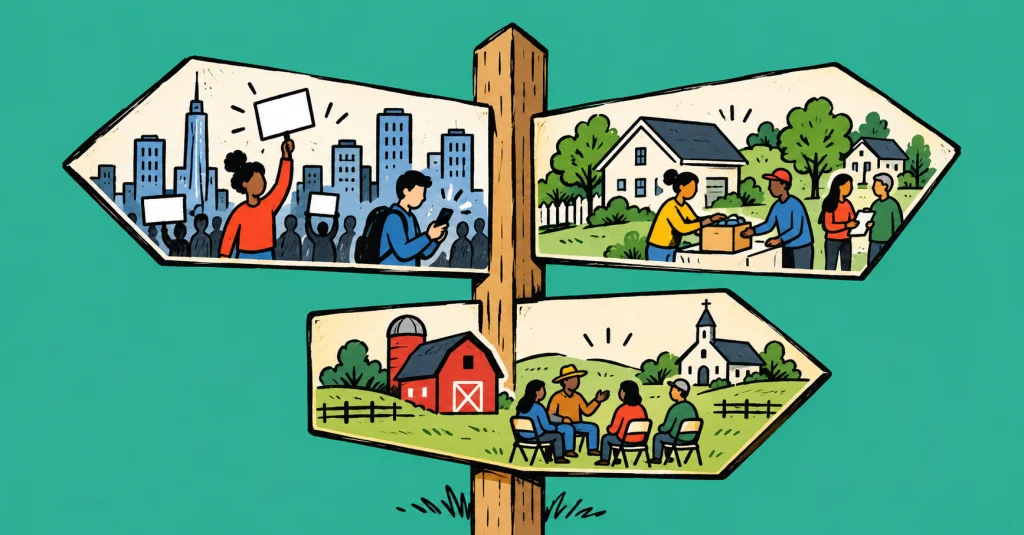
Suburban Americans are more likely to volunteer and join organizations. Rural residents gather in person more often. Urban residents are more likely to consume news and take to the streets. The geography of civic life still shapes how Americans show up.
Americans living in cities, suburbs and rural communities are almost equally likely to be among the country’s most civically engaged people. Pew Research Center found that 9% of urban adults, 9% of suburban adults and 10% of rural adults fall into its highly active “Mobilizer” group. At the other end, roughly a third of each population is largely disconnected from civic and political life. Geography, in other words, does not neatly divide America into places where people participate and places where they do not. What changes much more noticeably is how participation happens — whether community is built through clubs, churches, news consumption, political demonstrations or simply being physically present with other people.
The Suburbs Have More Connectors
Pew divided Americans into four broad engagement groups using 19 measures covering politics, civic activity, religion and news. Mobilizers participate heavily across nearly everything. Connectors volunteer, donate and join organizations but are less politically active. Spectators closely follow what is happening without participating as much directly. Outsiders participate relatively little. The suburban population stands out because 34% are Connectors, compared with 30% of rural residents and just 23% of urban residents. Suburban Americans were also more likely to report belonging to a group or organization — 37%, versus 33% of rural residents and 30% of urban residents — and 31% said they volunteered during the previous year, compared with 26% in both cities and rural communities.
Cities show almost the reverse pattern. One-third of urban Americans are Spectators, compared with 27% of suburban residents and 25% of rural residents. These are people who remain attentive to news and public affairs but are less likely to translate that attention into traditional civic participation. That finding connects directly with SSC’s recent examination of how Americans engage with news online. Pew separately found that much of the public’s interaction with news happens privately rather than through the visible comments, reposts and political arguments that dominate social feeds. Being attentive to public life, then, does not necessarily produce a membership card, volunteer shift or highly visible political identity.
Rural Community Is More Likely to Be Face-to-Face
The clearest geographic divide may be physical presence. Among adults who belong to an organization, 63% of rural residents said members mostly interact in person, compared with 57% in the suburbs and 47% in cities. Urban group members were more likely to say their organizations primarily interact online. Religious participation follows a similar geographic pattern: 42% of rural adults attend religious services at least monthly, either in person or online, compared with 37% of suburban residents and 33% of urban residents. Rural communities may therefore have fewer of some formal civic activities, but the institutions people do participate in are more likely to bring them physically into the same room.
That finding adds another layer to SSC’s recent look at the renewed demand for “third places” — coffee shops, libraries, bookstores, parks and other spaces outside home and work where people can encounter one another without scheduling a formal event. Digital communication has made participation easier to maintain across distance, but Pew’s findings suggest physical gathering remains unevenly distributed. In some communities, civic life still depends heavily on institutions that routinely place people together. In others, more of that interaction has migrated onto screens. That can change not only where people socialize, but where relationships strong enough to support volunteering, organizing and collective action are formed.
Politics Looks Different Too
Political participation is another example. Roughly a third of urban, suburban and rural Americans had taken at least one of the five political actions Pew measured, but their preferred actions differed. Nineteen percent of rural adults displayed a political sign, bumper sticker or clothing supporting a candidate or cause, compared with 15% of suburban adults and 14% of urban adults. Urban Americans went the other direction on demonstrations: 12% had participated in a protest or march during the previous year, twice the 6% share among rural adults. Pew notes that partisan composition helps explain the protest gap, because Democrats are more concentrated in cities and were more likely to participate in demonstrations during the period covered by the survey.
The research carries an important timing caveat. The primary survey of 5,195 adults was conducted in September 2025, although Pew published this geographic analysis in September 2026, and many questions asked respondents about activities during the previous 12 months. The numbers therefore should not be read as a real-time snapshot of October 2026. They are more useful as a map of civic infrastructure. Americans across cities, suburbs and rural communities are not separated by a simple engaged-versus-disengaged divide. They are participating through different channels, institutions and spaces. For anyone trying to reach a community — journalists, governments, nonprofits, campaigns or businesses — counting people is only the beginning. You also have to know where they gather, what they pay attention to and what participation looks like where they live.