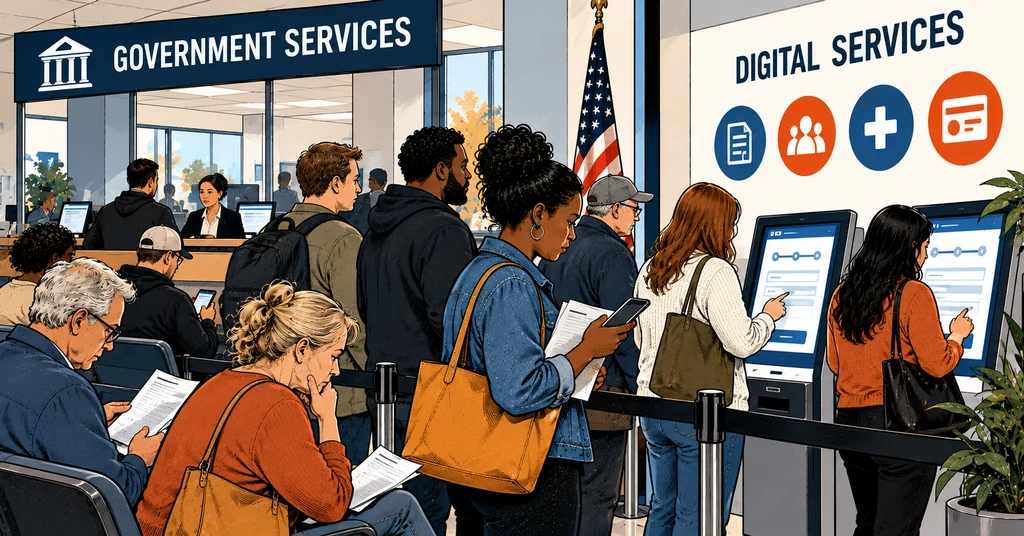
A 2026 Pew Research Center survey found that 54% of adults in households earning under $30,000 had home broadband, compared with 94% among adults in households earning at least $100,000. This 40-point gap is a measurable access constraint, not proof that any particular applicant was rejected. The person who needs a public benefit most urgently may also be the person least equipped to navigate a digital application. Imagine a worker whose hours have been cut and who must upload identity documents, retrieve a code sent to an old phone number and complete an application before a deadline. Each step may seem minor to a system designer. Together, they can determine whether a resident receives help on time. This is the central tension in digital government: convenience for the institution does not always translate into access for the public.
The Promise of Online-First Service
Public agencies have good reasons to modernize. Online portals can reduce mailing delays, allow residents to submit forms outside office hours and make case information easier to retrieve. Digital records can help agencies coordinate services and identify incomplete applications. For people with dependable broadband, current devices and familiarity with authentication tools, these improvements can be substantial. The federal customer-experience framework also calls for telephone and in-person assistance, acknowledging that a digital service should not be the only usable route.
But government services are not ordinary consumer products. A person who cannot complete an online retail purchase can usually walk away. Someone trying to renew identification, apply for unemployment benefits or respond to a government notice may have no practical alternative. The stakes are higher, and so is the obligation to design for residents who face technological, language, disability or documentation barriers. Pew found 34% of adults in households earning under $30,000 were smartphone-dependent, versus 4% of adults in households earning $100,000 or more. A phone-only applicant may still complete a form, but document uploads and verification must work on that device.
When Verification Becomes a Barrier
Identity verification is an especially difficult trade-off. Agencies need safeguards against fraud and unauthorized access, but a system can reject legitimate users when records do not match, a camera cannot capture an acceptable image or a person lacks the device required for a verification step. A failed digital check should not automatically become a failed claim to public service. A GAO review documented more than 30 IRS online applications and services using Login.gov or ID.me as of January 2025. That finding describes the IRS at the time, not every federal agency. Accessible appeal procedures and human assistance are part of a functional system, not optional extras.
The shift also changes who bears the administrative workload. A form once reviewed with a clerk may now require the resident to interpret instructions, scan documents, troubleshoot errors and track follow-up notices independently. A system can look more efficient on an agency dashboard while transferring hours of unpaid work to the people using it. Those costs are difficult to capture in conventional measures of digital adoption. NTIA data found 12% of people lived in households without an internet connection in 2023, down from 14% in 2021.
Designing Around Real People
A useful public-service benchmark would ask whether people can complete the task, not simply whether they started it online. Agencies should examine abandonment rates, repeated verification failures, language accessibility, mobile usability and the availability of in-person or telephone assistance. Residents with disabilities, older adults and people with unstable housing may need different pathways to reach the same outcome. SSC’s Access Shift series examines the gap between eligibility and usable access.
The question is not whether governments should abandon technology. It is whether modernization should require residents to adapt entirely to the system, or whether the system should adapt to the population it serves. Digital government can widen access when it is designed with alternatives, clear instructions and accountable support. Without those safeguards, the public counter does not disappear. It moves into the resident’s home, where the wait may be harder to see and harder to resolve.