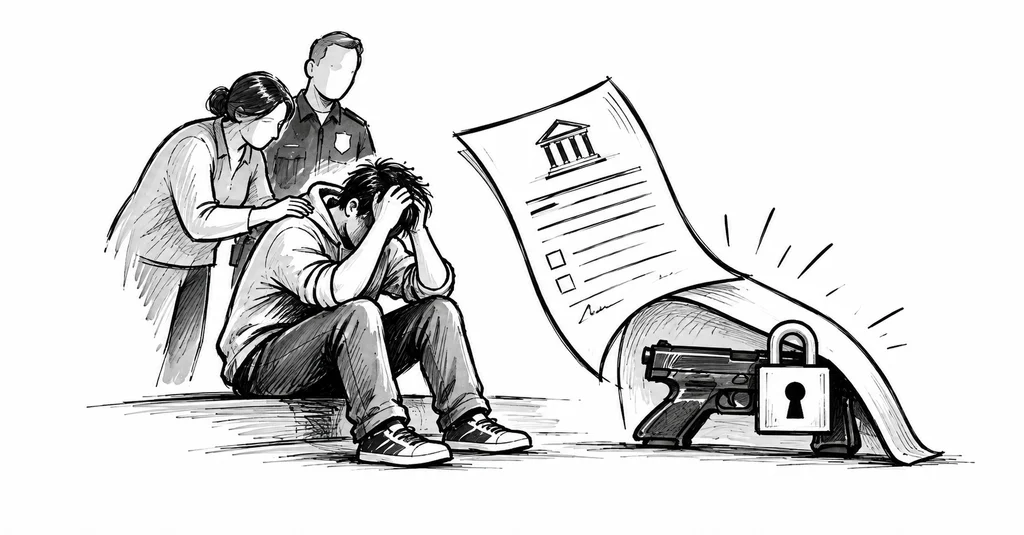
A mass shooting in Erie and a deadly attack on Riyadh’s airport landed on either side of World Mental Health Day. If the argument is about people, Pennsylvania still lacks one of the few laws built around them.
In the space of about a day, violence reached two very different places. On Friday evening, a gunman killed eight people, including two young children and a pregnant woman, at a home on Perry Street in Erie, Pennsylvania, before taking his own life, police said. On Saturday, a Houthi attack on King Khalid International Airport outside Riyadh killed at least 12 people and wounded more than 300, according to Saudi aviation authorities cited by Al Jazeera, the third attack on the airport in a week. Saturday was also World Mental Health Day, which meant many people scrolled past awareness posts and breaking news of mass death in the same few minutes.
Erie’s tragedy is the kind that usually sets off the same argument within hours, and one side of it reliably reaches for the phrase that guns don’t kill people, people do. The line is usually meant to end the conversation. Taken at its word, it opens a different one, because if people are the deciding factor, then the policy question becomes how a community recognizes a person in crisis and acts before that crisis turns lethal. Police in Erie have not released a motive, and no one has said publicly whether anyone saw warning signs. That uncertainty is exactly where policy either has a tool or it does not.
The tool most directly built around people is the extreme risk protection order, often called a red flag law. It lets family members or police ask a judge to temporarily remove firearms from someone shown to pose a danger to themselves or others, with a court hearing and a time limit. Twenty-two states, the District of Columbia and the U.S. Virgin Islands have enacted these laws, according to the University of Michigan’s Institute for Firearm Injury Prevention. Pennsylvania is not one of them. Red flag bills have passed the state House before, but they have stalled in the Senate, where Democratic senators have pressed Republican leaders to bring them up. Critics, including many gun-rights groups, argue the orders can take away a constitutional right without enough due process, and several Republican-led states have moved to restrict their use.
The “people” argument is strongest where most gun deaths actually happen. Of the 44,447 gun deaths in the United States in 2024, 62% were suicides, a total of 27,593, according to CDC data compiled by Pew Research Center, while mass shootings account for a small fraction of the total. Most people who die by a gun in this country are people in crisis turning it on themselves. That is a mental health emergency hiding inside a firearms statistic, and it is the strongest case for policies that reach people early.
The same argument goes wrong when it treats mental illness as the explanation for violence. People with serious mental illness are 11 times more likely than the general population to be victims of violent crime, according to a landmark Northwestern University study published in the Archives of General Psychiatry. Blaming a diagnosis after every mass shooting stigmatizes millions of people who will never hurt anyone, while missing the questions that matter: whether a person in crisis can get care, whether the people around them know what to do, and whether the law gives them a way to act.
Riyadh is a different kind of violence, a regional war carried to a civilian airport by drones and missiles, but readers met it in the same feed and on the same weekend. The cumulative weight of that exposure is part of the mental health story too, and it falls hardest on the people closest to the loss. Erie Mayor Daria Devlin said the city is working with local organizations to support families, neighbors, students and first responders, and warned that trauma may surface for weeks or months, Erie News Now reported. As SSC asked on Saturday, the real test of World Mental Health Day is what happens when the posts end.
The debate after Erie does not have to stall on whether guns or people are to blame. If the answer is people, then Pennsylvania faces a practical choice about whether families and police get a legal way to act when someone they love is in crisis, and whether communities fund the care that reaches people before they get there. Saturday’s awareness posts asked people to check on one another. Policy is how a state decides whether that check-in can lead anywhere.
If you or someone you know is struggling, call or text the 988 Suicide & Crisis Lifeline at 988, or chat at 988lifeline.org. In the Erie area, UPMC Crisis Services is available at 814-456-2014 or 1-800-300-9558.
Sources: Pittsburgh Post-Gazette; Erie News Now; Al Jazeera; University of Michigan Institute for Firearm Injury Prevention; Pennsylvania House of Representatives; WHYY; The Trace; Pew Research Center (CDC data); Psychiatric News (Archives of General Psychiatry)