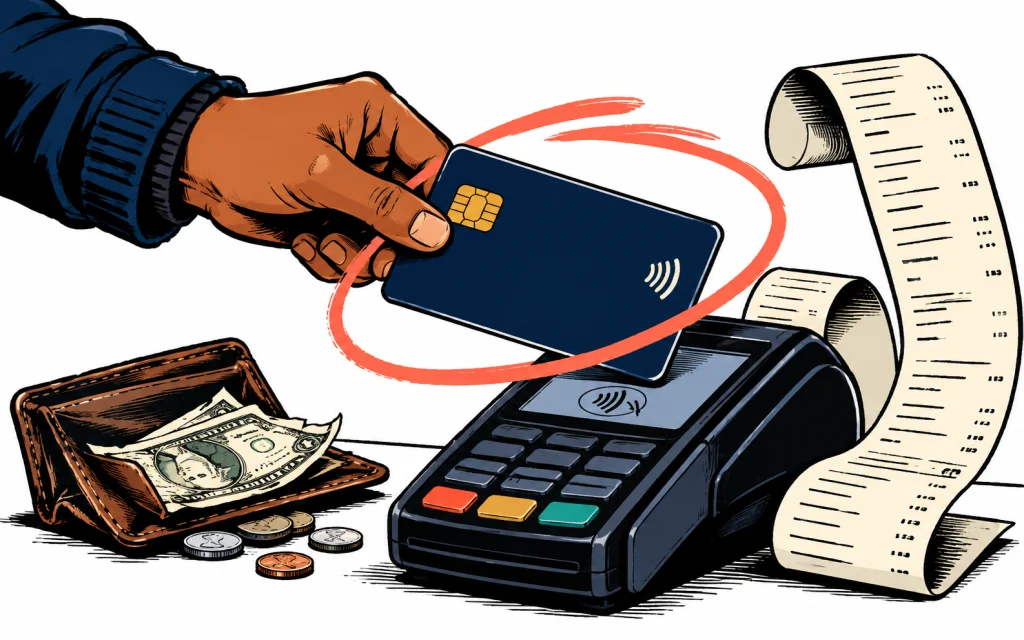
New Pew and Federal Reserve data show credit cards now account for the largest share of U.S. payments. The shift is about more than convenience: it is changing how Americans experience spending, debt and financial pressure.
Americans are not just carrying less cash. They are reorganizing everyday spending around credit. In 2015, cash accounted for 33% of all payments, making it the most common payment method in the country. By 2025, that share had fallen to 14%. Credit cards moved in the opposite direction, rising from 18% of payments in 2015 to 34% in 2025, making them the single most common way Americans pay. Debit cards accounted for another 31%, meaning credit and debit together now represent nearly two-thirds of all transactions. Pew Research Center’s September 30 analysis, drawing on Federal Reserve Bank of Atlanta payment data, shows a consumer economy where cash is no longer the default. It is becoming the exception.
The behavioral shift is even clearer when Americans are asked how often they use cash at all. Pew found that the share of adults who say they use cash for all or almost all of their purchases in a typical week has been cut in half, falling from 24% in 2015 to 12% in 2026. At the same time, 42% now say they do not use cash for any purchases during a typical week, compared with 24% a decade ago. This is not simply the result of stores adding card readers. Consumers increasingly prefer digital payments. In 2025, 78% of Americans said they preferred using credit or debit cards for in-person purchases, while only 16% preferred cash.
That preference matters because payment methods shape spending behavior differently. Cash creates an immediate physical constraint: once the money is gone, the transaction ends. Debit cards separate consumers from physical currency but still generally draw directly from existing funds. Credit allows the transaction to happen before the money has actually been earned or transferred. That does not automatically mean consumers are overspending, and many Americans pay their balances in full each month. But a financial system increasingly organized around credit makes borrowing frictionless in a way cash never could.
Credit Has Become Part of Everyday Consumption
The average credit-card purchase in 2025 was $80, compared with $74 for debit cards and $58 for cash, according to the Federal Reserve data cited by Pew. Those differences do not prove that credit cards make people spend more; transaction type, income and consumer preference all affect payment choice. But the larger shift still matters. Credit cards are no longer reserved primarily for travel, emergencies or large-ticket purchases. They have become the infrastructure people use for groceries, dining, subscriptions and other routine expenses.
That change is arriving during a period when affordability is already dominating the public’s economic concerns. SSC has been tracking rising anxiety around food, housing, healthcare and energy costs, and recent Pew polling found that majorities of Americans describe all four as significant economic concerns. When the payment system increasingly runs through credit, households have another mechanism for absorbing those costs temporarily rather than reducing spending immediately.
That can make financial pressure less visible in real time. A household paying $150 for groceries with cash sees $150 leave immediately. A household putting the same purchase on a card may not fully confront the expense until the statement arrives weeks later. If the balance cannot be paid in full, a grocery purchase effectively becomes debt carrying interest into future months. The transaction is complete, but the cost is not.
The Cash Decline Also Creates an Access Question
The movement away from cash is not equally convenient for everyone. Consumers without traditional bank accounts, people with limited access to credit and those who rely on prepaid or public-benefit cards still operate differently inside the payment system. Cash also provides something digital payments do not: the ability to conduct an ordinary transaction without creating a detailed electronic record.
For many consumers, that tradeoff is worth it. Digital payments are faster, easier to track and increasingly integrated into phones, watches and online accounts. Credit cards can also provide fraud protection and rewards that cash does not. But the normalization of card-only commerce means consumers increasingly need access to financial institutions simply to participate comfortably in everyday economic life.
That is why several cities and states have pushed back against businesses that refuse cash entirely. The debate is not really about nostalgia for dollar bills. It is about whether moving the payment system online and onto cards creates barriers for people whose financial lives remain partly outside traditional banking.
Credit Cards Passed Debit Cards in 2022
One of the more consequential changes in the Federal Reserve data happened quietly. Debit cards overtook cash as a share of payments in 2018. Then, beginning in 2022, credit cards overtook debit cards.
That second transition deserves more attention. Moving from cash to debit is largely a change in format: consumers are still generally spending money already held in their accounts. Moving from debit toward credit introduces borrowing into the transaction. Again, credit-card use does not mean credit-card debt; people who pay balances in full effectively use cards as payment tools rather than loans. But at the population level, the distinction becomes more important when revolving balances and interest rates are high.
It also creates an incentive structure that encourages card use. Rewards programs offer cash back, airline miles, hotel points and other benefits to consumers willing and able to route their spending through credit. People with strong credit histories can effectively receive discounts for using cards, while people carrying balances can pay substantial interest for accessing the same system. The payment economy therefore increasingly rewards consumers who already have the financial capacity to manage credit well.
Cash Is Not Dead, but It Is Losing Its Role
Cash remains useful, particularly for smaller transactions. Pew reports that the average cash purchase was $58 in 2025, lower than both credit and debit purchases. But even when Americans pay with cash, many would rather not. The Federal Reserve found that 70% of cash transactions were made by people who actually preferred another payment method, primarily credit or debit cards.
That may be the clearest sign that the shift is structural. Americans are not merely being pushed away from cash by technology. Many increasingly do not want to use it.
A decade ago, cash still represented one-third of American payments. Today, credit cards hold that position. That transformation makes purchasing easier, faster and more integrated with the digital economy. It also places more of everyday consumption inside a financial system built around banks, payment networks, data collection and — potentially — debt.
The disappearance of cash therefore tells us something larger about the modern American economy. We have moved from spending primarily what we physically hold toward a system where transactions are increasingly mediated by financial institutions and, in many cases, borrowing capacity. The question is no longer whether America is becoming cashless. It is what happens when credit becomes the default language of everyday spending.