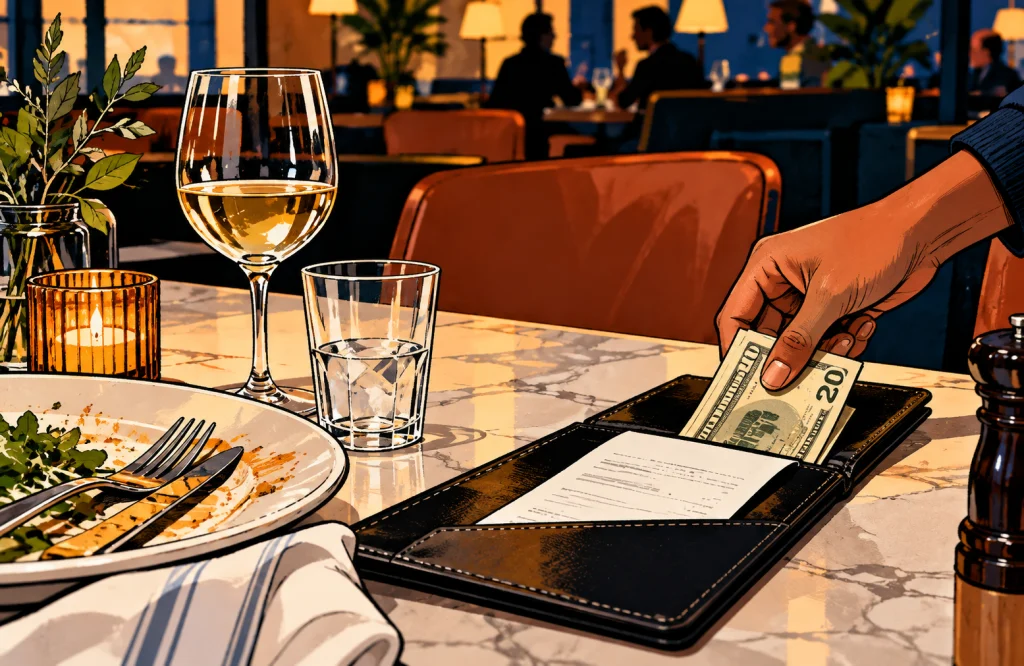
Nearly a decade of restaurant transaction data suggests the backlash against tipping has changed the conversation more than the behavior.
Americans have spent years complaining about tipping screens, service charges and the creeping expectation to leave gratuity in places where it once felt optional. But the receipts tell a more stubborn story. A 2026 report from restaurant technology company Toast, summarized by Food & Wine, analyzed card and digital transactions across 180,000 U.S. restaurant locations and found that tip percentages have barely moved. Full-service restaurant tips have generally stayed between 19.1% and 19.9%, while quick-service tips have held between 15.8% and 16.8%. About 92% of diners still leave a tip at full-service restaurants. The backlash is loud. The habit is still remarkably intact.
That durability is striking because it has survived a period when dining out itself has become more expensive. Restaurant prices have climbed alongside groceries, gasoline and other household costs, pushing consumers to eat out less often or trade down when they do. Yet when people reach the end of the meal, the familiar social script still appears to take over. The check arrives. The payment screen turns around. The customer chooses a percentage. Even when diners resent the expectation, most appear unwilling to be the person who breaks the norm in real time.
The numbers also show that tipping is not a single national behavior. Toast data cited by Food & Wine found meaningful differences by state, including an average of 17.1% in California and 21.4% in Delaware. Labor rules help explain some of that spread. In California, tipped workers must still receive the full state minimum wage before gratuities. In states that allow a tip credit, employers can count some of a worker’s tips toward minimum-wage obligations. Customers may not know the technical details of wage law, but local expectations are built around those systems over time.
That is why the tipping debate is about more than etiquette. It sits at the intersection of wages, prices and social pressure. Restaurants have long relied on gratuities to shift part of labor compensation directly onto customers. Workers rely on those tips because their earnings often depend on them. Diners, meanwhile, face a decision that feels voluntary on paper but socially mandatory in practice. A customer can dislike the structure and still recognize that withholding a tip may punish the worker rather than change the system.
The persistence also helps explain why “tip fatigue” has not automatically produced lower gratuities. People can reduce restaurant visits, order less, skip alcohol or choose takeout before they change what they leave for the server standing in front of them. That is a different kind of consumer response: instead of rejecting the custom, households absorb the pressure elsewhere. The restaurant bill gets scrutinized more closely. The night out happens less often. But the tip percentage survives.
For businesses, that creates an uncomfortable stability. The system continues to function because customers keep participating, even as many say they do not like it. Restaurants therefore have less immediate incentive to redesign compensation, while workers remain exposed to the uncertainty of customer behavior. Some operators have experimented with service charges or higher menu prices, but those approaches can create their own confusion if customers are unsure whether an additional tip is still expected.
The tipping debate may eventually produce a different model, but consumer irritation alone has not done it. The Toast data suggests that Americans are not simply making a calculation about service quality at the end of a meal. They are responding to a norm that has become embedded in the economics of dining out. People may be tired of tipping culture. For now, they are still paying into it.
Source: Food & Wine, October 10, 2026