
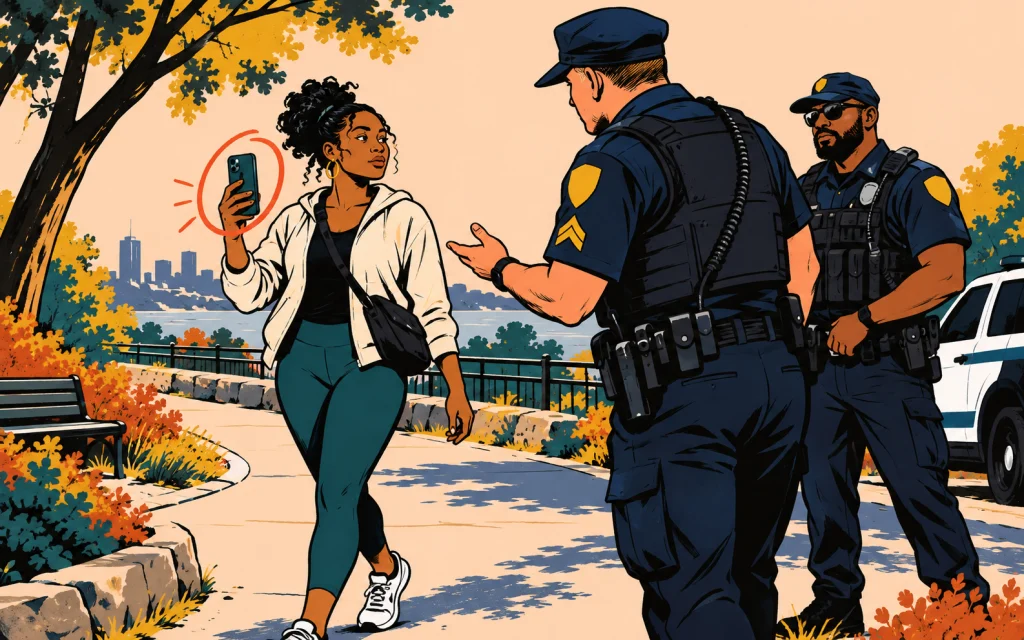
A Georgia woman who recorded police officers following and questioning her during a walk at Morgan Falls Overlook Park has filed a complaint alleging racial profiling. Marrón Bridges, a Sandy Springs resident, documented an October 7 encounter in which officers questioned her, requested identification and ultimately instructed her to leave. The footage circulated widely on social media, raising questions about when a police inquiry becomes a detention and what authority officers have to inspect a pedestrian’s vehicle.
An ordinary walk becomes a police encounter
In footage circulated by The Shade Room, Bridges describes being followed by officers while walking in the park. The outlet reports that officers surrounded her, opened her vehicle and checked her identification. Those claims require separate verification: the screenshots and selected clips do not establish the full sequence, whether she consented to any vehicle access or the officers’ grounds for their actions.
Police cite a trafficking investigation
According to local reporting, Sandy Springs police said officers were conducting a human trafficking investigation in the area. The department reported four arrests and four people rescued in the wider operation. That context explains the police presence but does not, on its own, establish why Bridges was approached or whether officers had individualized grounds to detain her. A department response specific to her complaint and any body-camera footage would be essential to assessing the encounter.
What the law requires
Under the Fourth Amendment, officers generally may approach a person and request information in a consensual encounter. An investigative detention requires reasonable suspicion supported by specific, articulable facts. A request for identification is not necessarily a command backed by legal authority, and a vehicle search raises separate questions about consent, probable cause and applicable exceptions. Georgia’s Supreme Court discussed the distinction between consensual encounters and detentions in Georgia v. Walker. The complete recording and officers’ reports would be needed to apply those principles to this incident.
Viral commentary adds another layer
The footage has also generated commentary about how citizens should respond to police. In a comment visible beneath The Shade Room’s post, an account identified as “sirr__rome” wrote, “She handled this correctly,” but added that they would not have allowed officers into the vehicle. The commenter speculated that officers could plant evidence. That is an unsubstantiated fear expressed by a social media user, not evidence that officers planted or intended to plant anything. The comment illustrates how a disputed police encounter can quickly become a broader debate over trust, consent and personal safety. Engagement counts on the screenshots indicate substantial attention to the post, but cannot establish the facts of the encounter.
Questions still unanswered
What specifically led officers to approach Bridges? Was she free to walk away? Did she consent to access to her car, and what did officers actually do there? Was the park closed or restricted during the operation? Those questions can be addressed through body-camera footage, dispatch records, park rules and the department’s account. Investigating trafficking and respecting constitutional protections are not mutually exclusive obligations. An accountable public explanation should distinguish the legitimate operation from the specific actions taken toward a person who says she was simply out for a walk.
Sources and further reporting: Rough Draft Atlanta; Georgia v. Walker; The Shade Room Instagram footage and comments provided to SSC. SSC has not independently authenticated the full video or obtained the police incident report.