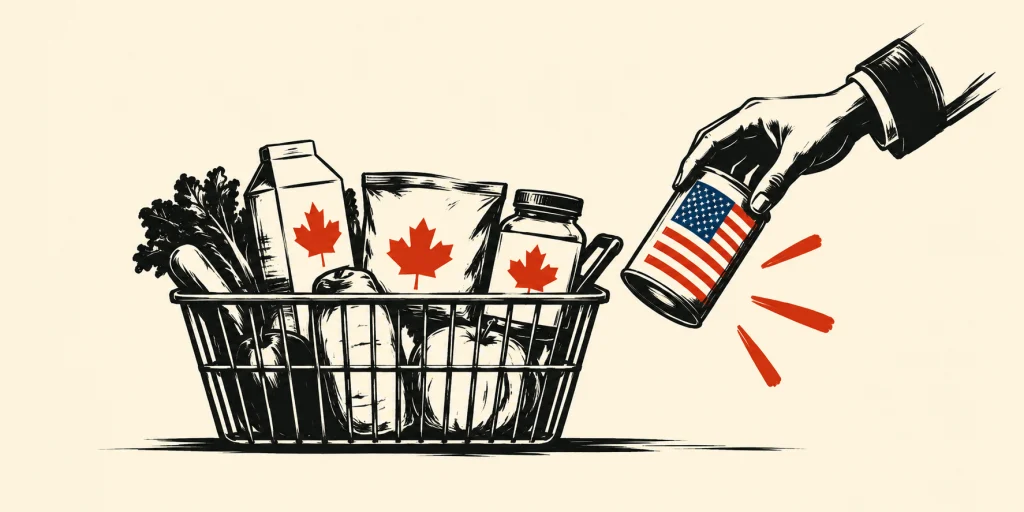
Nineteen months into the trade fight between Washington and Ottawa, Canada’s “Buy Canadian” shoppers have not gone back to American brands. If anything, they are acting on it more.
More than half of Canadians (51%) say they have tried not to buy American products, up from 38% in February 2025, when Donald Trump first threatened tariffs on Canada, according to a new Abacus Data survey first reported by Retail Brew. The poll of 1,479 Canadian adults was conducted Sept. 4 to 9.
The shift comes after a year and a half of “51st state” taunts from Donald Trump, escalating tariffs and, most recently, outright import bans. Trade talks between the two countries broke down on Aug. 21, triggering a new round of tariffs and counter-tariffs, Reuters reported.
Shoppers want grocers to take sides
Canadians are asking grocery stores to do more of the work for them. According to Abacus:
- 70% want grocers to remove as many American-made products from shelves as possible.
- 87% want stores to stock more alternatives from Canadian or other non-U.S. suppliers.
- 89% want products made in Canada to be clearly labeled.
Those numbers have barely moved since early 2025, which is the point. The demand has held steady for more than a year and a half.
Retailers are responding. Loblaw, Canada’s largest food retailer, brought back large maple leaf signs in its produce and fresh-food sections in August and reintroduced a “T” tag to flag products affected by tariffs, according to Reuters. Metro, the country’s third-largest grocer, said it will keep prioritizing local products. Giancarlo Trimarchi, president of Ontario independent grocer Vince’s Market, told Reuters that about 90% of the produce in his four Toronto-area stores is now Canadian. “Now it’s quality versus price versus country of origin,” he said.
From feeling to habit
The most telling finding is the gap between attitude and action. The share of Canadians who say they want to avoid American products entirely or buy as few as possible is essentially unchanged at 77%, compared with 78% in February 2025. What changed is follow-through. More Canadians are now doing what they said they would do.
Between February 2025 and September 2026, the share of Canadians who:
- Bought more Canadian products rose from 53% to 61%.
- Canceled a planned trip to the U.S. rose from 32% to 52%, the biggest change Abacus recorded.
- Avoided American gas stations rose from 33% to 39%.
- Avoided American retailers such as Walmart rose from 20% to 26%.
- Cut back on Amazon purchases rose from 21% to 26%.
- Canceled American streaming services rose from 14% to 20%.
The resolve is easing slightly in most age groups, but not among young adults. The share who say they do everything they can to avoid American products held at about one in three among Canadians under 30, the only age group that did not soften. Among those 60 and older, it fell from 54% to 48%.
The limits of patriotic shopping
Price is still the biggest obstacle. Six in 10 Canadians (61%) believe Canadian-made products usually cost more, and earlier Abacus research from July found that only about one in five will buy Canadian when it costs noticeably more.
Shoppers also aren’t always sure what is Canadian. Nearly half (48%) believe most packaged food in Canadian grocery stores is made in Canada, and about a quarter think Nestlé is a Canadian company.
And supply chains don’t change overnight. The U.S. still provides more than half of Canada’s fresh produce imports, although its share of vegetable imports fell to 62.6% in July from 69% in July 2023, according to Reuters. University of Guelph food economist Mike von Massow told Reuters that nationalism is outweighing economics for now, but that U.S. products could win back share if tensions ease because they are often cheaper.
Why it matters
Canada is one of America’s largest trading partners. A boycott that started as a protest has become a shopping habit, one that is now reshaping grocery shelves, travel plans and supply chains. The longer the trade fight lasts, the harder those habits may be to reverse.
Sources: Retail Brew, “More than half of Canadians avoid buying American products,” by Andrew Adam Newman, Oct. 8, 2026; Abacus Data, “Nineteen months on, the Buy Canadian shopper has not gone home,” by David Coletto, Oct. 1, 2026; Reuters via GV Wire, Sept. 12, 2026.