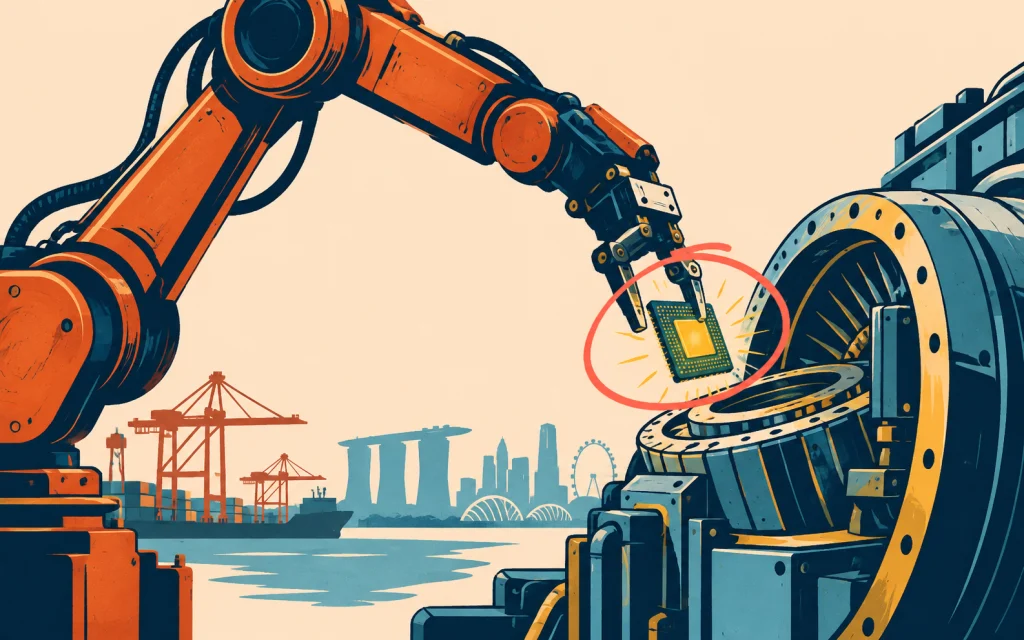
PhysicsX’s new Asia-Pacific base shows how Singapore is positioning AI inside factories, engineering systems and physical infrastructure.
Singapore’s latest artificial-intelligence investment is not centered on chatbots or consumer software. British deep-tech company PhysicsX opened its Asia-Pacific hub in Singapore on October 8, with plans to expand its local workforce from about 20 employees to more than 100 over the next three years. The company builds AI systems for industrial engineering, including applications involving jet engines, semiconductor equipment and complex manufacturing systems. The expansion follows a US$300 million Series C round led by Singapore state investor Temasek and includes a five-year, S$40 million partnership with A*STAR, Singapore’s national research agency.
The move fits a larger strategy. Singapore already has a substantial manufacturing base, accounting for roughly 18.5% of GDP in 2025, and the country produces about one in 10 of the world’s chips and roughly one-fifth of global semiconductor equipment. Rather than treating AI principally as a software sector layered on top of the existing economy, Singapore is increasingly positioning it as infrastructure for industries the country already knows how to operate: semiconductors, aerospace, biomedical manufacturing, energy and precision engineering.
The AI Opportunity Is Moving Into the Physical Economy
PhysicsX works at the intersection of artificial intelligence, physics and engineering. Its systems can simulate physical processes and allow engineers to test far more design options digitally before committing time, equipment and materials to the physical version. That could matter in industries where a design error is considerably more expensive than regenerating a piece of text. The company says its technology has applications across aerospace, automotive manufacturing, semiconductors, energy and materials, areas where Singapore already has industrial depth.
There is already a local proof point. Singapore-based offshore and marine engineering group Seatrium has used PhysicsX technology to reduce the time required to optimize some pipe-layout designs by about 40%, according to reporting on the expansion. That is the more consequential AI story for industrial economies: not whether a model can answer a question faster, but whether artificial intelligence can compress engineering cycles, reduce material waste, improve energy efficiency or make expensive infrastructure easier to design.
Singapore Has an Existing Industrial Base to Build On
The timing also helps explain why Singapore is an attractive location. Manufacturing output was 15.4% higher year over year in August 2026, according to Singapore’s official statistics, while manufacturing value added reached S$132.8 billion in 2025. The country also has one of the world’s highest concentrations of industrial robots, at roughly 730 robots for every 10,000 manufacturing workers according to Singapore’s Economic Development Board. Those numbers describe an economy already accustomed to capital-intensive production and automation rather than one attempting to build an AI-manufacturing ecosystem from scratch.
Singapore’s government is now trying to move companies beyond isolated AI experiments. Deputy Prime Minister Gan Kim Yong said at the PhysicsX launch that the country’s National AI Missions are targeting advanced manufacturing, connectivity, finance and healthcare, sectors that together account for more than 40% of Singapore’s GDP. The ambition is to embed AI more deeply into operating systems while redesigning jobs and developing workers alongside the technology.
The Competition Is About Where Industrial Intelligence Lives
That approach changes the geography of the AI competition. Much of the global discussion has focused on where models are trained, where data centers are built and which companies control the most advanced chips. Singapore is making another wager: countries can capture value by becoming the place where AI is integrated into the physical industries those chips ultimately serve. Its advantage is not simply access to software. It is the combination of engineering talent, semiconductor production, advanced manufacturing infrastructure, research institutions and capital that allows companies to move from an AI model to an industrial application.
For Singapore, PhysicsX is therefore more than another regional headquarters announcement. It is evidence of a strategy to make the country a testing and deployment ground for industrial AI across Asia. The next phase will show whether those investments translate into broader productivity gains and new technical jobs rather than simply more automation inside already sophisticated factories. But the direction is becoming clearer: as the AI economy moves beyond the screen, Singapore wants to be one of the places where intelligence gets attached to machines, factories and the systems that build the physical world.