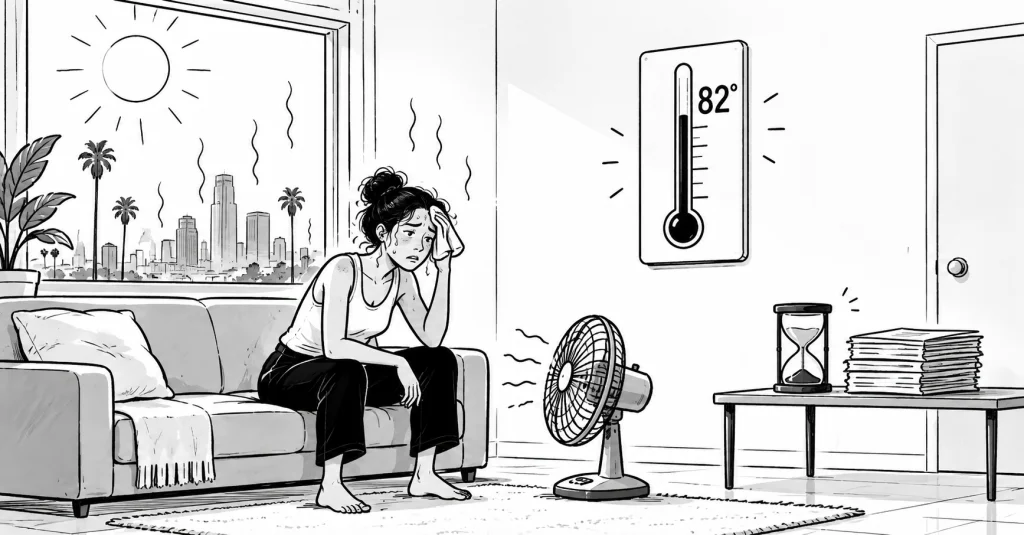
An 82-degree county standard exposes the gap between recognizing extreme heat as a housing problem and delivering enforceable protection.
82 degrees Fahrenheit is the maximum indoor temperature adopted for rental housing in unincorporated Los Angeles County, according to the county’s Cool & Healthy Homes guidance. For small landlords, the guidance identifies January 1, 2027 as the deadline for at least one habitable room per unit and January 1, 2032 for all habitable rooms. These are jurisdiction-specific requirements, not a blanket statement that every Los Angeles renter already has the same enforceable protection. The rules show how a climate hazard becomes a housing obligation through thresholds, implementation dates, and the boundaries of local authority.
The City of Los Angeles is a separate government. A February 17 city announcement says the council unanimously passed a motion directing the city toward adopting a comparable standard. That vote should not be described as proof that a completed city ordinance is already being enforced. In an October 8 commentary, SAJE’s Grace Hut argues that city tenants are still waiting for protection. Her advocacy account supplies the current concern; the official documents establish why residents must check which government and implementation stage apply to their home.
A Cooling Standard Changes the Housing Contract
A maximum-temperature rule shifts the discussion from whether a tenant would prefer air conditioning to whether a rental home can remain within a defined limit. That change can make cooling part of basic habitability rather than an amenity negotiated through rent. It still leaves practical questions about the equipment or building improvements required to meet the standard. An owner may need to consider passive measures, portable equipment, or other code-compliant methods. The resident needs to know what performance is required, rather than infer that the presence of a particular appliance automatically guarantees a safe or comfortable indoor environment.
Jurisdiction creates another barrier. People often describe their address as Los Angeles without knowing whether a county rule, a city rule, or another municipality’s code governs it. A protective policy can therefore be announced nearby without immediately changing a tenant’s rights. This is not merely a communications problem: the applicable authority determines whom a resident can contact and what an inspector can require. Clear guidance should connect an address with the relevant standard and enforcement route. Otherwise, residents may assume protection exists where it does not, or fail to use protection that is available to them.
Equipment and Affordability Have to Meet
The county’s tenant and owner guidance describes implementation and complaint procedures, but the effectiveness of a cooling policy also depends on everyday operation. Equipment cannot provide relief if a resident cannot afford to run it, and a temperature requirement needs a workable response when a unit fails to perform. Those are implementation questions, not evidence that every qualifying home will face the same difficulty. They explain why installation, maintenance, utility affordability, and complaint handling should be assessed together. A policy is most useful when the obligations are understandable before the next period of dangerous heat arrives.
The burden of obtaining enforcement also deserves scrutiny. A tenant may need to document conditions, identify the appropriate agency, and arrange access for an inspection while continuing to work and care for a family. Rules that are easy to announce can become difficult to use if the process requires repeated follow-up or information the resident does not have. Effective implementation should make reporting straightforward and explain what happens next. Measuring complaints resolved, time to correction, and residents’ ability to remain safely housed would provide more meaningful evidence of success than counting how many people received an informational notice.
Recognition Needs an Operating System
Los Angeles’s heat debate shows a policy moving through several stages at once: an adopted county standard, phased deadlines, a city directive, and demands for faster protection. Those stages should remain visible in the coverage. The next useful evidence is whether the city completes its rules and whether county implementation makes the temperature standard reliable in residents’ homes. Cooling policy succeeds when a renter can understand the obligation, obtain a response, and live within the promised conditions. The measure of progress is the temperature and stability of the home after the announcement, not the announcement standing on its own.