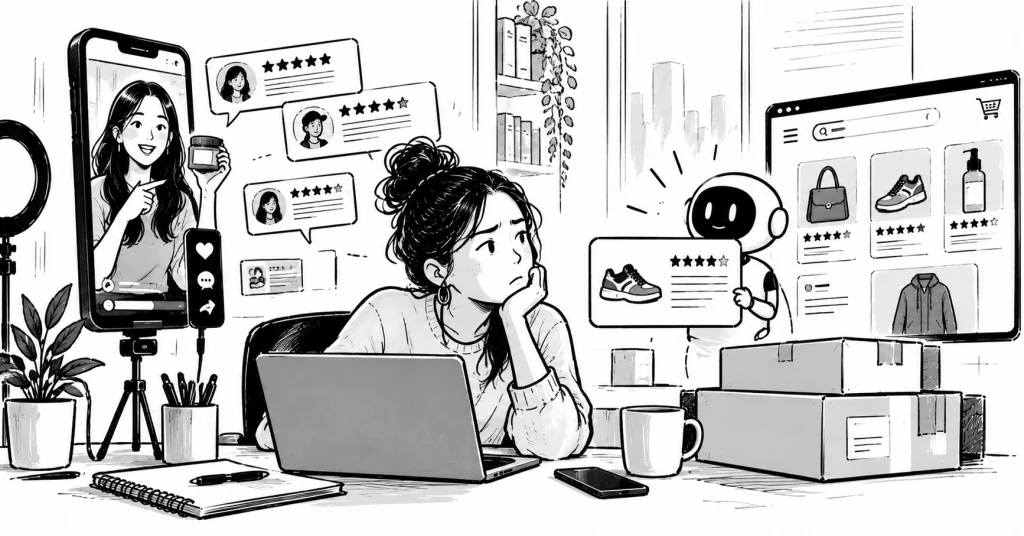
Small creators, AI chatbots and livestreams are reshaping how people decide what to buy. The same shift is making it harder to tell who is actually being honest with you.
The way people decide what to buy has been moving out of the store and off the brand’s own website for years. Now it lives in TikTok Shop, in ChatGPT answers, in a stranger’s unboxing video and in the group chat where somebody swears by a product. Reporting by Jordyn Grzelewski for Retail Brew lays out how that shift has turned trust into the currency of modern retail, and how brands are scrambling to earn it. Read closely, the same reporting shows something less comfortable: the industry that keeps preaching authenticity is also building the tools to fake it.
Trust is getting cheaper to fake
Chris Ribeiro, founder of the market research firm Starlight Analytics and a former customer insights leader at VF Corporation and PVH Corp., described a growing business of companies paying to slip into Reddit communities. They plant comments praising a product, then plant replies to those comments, because that kind of chatter can lift a brand in Google results and in answers from AI assistants. As he put it, buyers are reaching a point where “now you don’t know what to trust.” Add fake reviews, bots and a flood of AI-generated content, and the signals shoppers have relied on for a decade start to lose their value.
That is the part of this story that matters most for everyday people. A product review used to be one person telling another what happened. Increasingly, it is also raw material that machines collect and repeat back as consensus. When an AI assistant tells you what “people say” about a blender or a moisturizer, it is summarizing whatever got posted most often in the places it reads. That gives brands a powerful incentive to flood those places, and it leaves shoppers with less ability to see who is behind the voices they are hearing.
Smaller creators, smaller checks, more scrutiny
The money is moving too. Citing Emarketer research, Morning Brew reported that about 45% of brand spending on influencer marketing this year will go to creators with fewer than 20,000 followers, up from 19.5% in 2021, and roughly one-fifth will go to so-called nanoinfluencers with fewer than 5,000. Vivien Garnès, co-CEO of the influencer platform Upfluence, said working with large numbers of very small creators has become the more efficient bet, and that smaller deals can leave creators freer to give an honest take.
There is real opportunity in that shift for everyday creators, including the barber, the home cook and the teacher with a loyal following who never had a shot at a celebrity endorsement deal. But it also turns recommendation into piecework. Brands spread their budgets across thousands of people, pay each of them less, and ask them to carry the trust the brand could not build on its own. Ribeiro noted that the model demands far more management, because brands have to vet every creator, check that their content fits the brand’s values and watch for signs of fake content. The person whose credibility is on the line is the creator, not the company.
Garnès described a spectrum in how brands use creators, from treating them as a distribution channel to co-creating products with them or giving them an ownership stake. The deeper end of that spectrum, he said, produces the most genuine content and outperforms creators being used as human billboards. That is a useful marker for audiences, too. A creator with a real stake in a product has a reason to tell you about it, and a reason to be honest about its flaws.
Search is splitting, and AI is in the middle
The path to purchase is also fragmenting. A report from the clickstream data firm Datos found that shoppers now routinely bounce between search engines, social platforms, retail sites, AI assistants, online communities and brand websites before they buy. AI-driven visits are still small, roughly a tenth of traditional search traffic and half of e-commerce site visits, but they are growing and they are shaping decisions. The report’s advice to brands includes building pages that compare themselves directly against competitors and gathering video reviews described in searchable language, so AI tools are more likely to pick them up.
Eli Goodman, Datos’s president and co-founder, warned brands not to game the system with bot-written reviews, while also stressing the importance of having many people vouch for a brand so AI systems notice. Those two ideas sit uncomfortably together. When the reward for being talked about is that a chatbot repeats you, the line between earning a reputation and engineering one gets thin.
Livestream shopping adds another layer. Market research company MRI-Simmons estimates that more than 90 million U.S. adults have been exposed to livestream shopping, and that livestream buyers are 60% more likely than the average adult to click on in-app video ads for the products they see. The strategy there is speed, getting from a moment of interest to checkout before a viewer has time to think it over.
The store becomes the place to check
Physical retail is adjusting rather than disappearing. Jessica Gangoso, vice president of emerging brands at Cushman & Wakefield, wrote on LinkedIn that trust, not location, is now what sets a store apart, and urged brands to treat stores more like platforms built around drops, collaborations and community moments that give people a reason to come back. Ribeiro said many shoppers now arrive already knowing what they want, using the store to try and verify rather than to discover. That is why in-store features such as visible ratings, real-time inventory, buy-online-pickup-in-store and consistent pricing across channels have become baseline expectations.
The brands that seem to be getting it right are the ones willing to be corrected in public. Ribeiro recalled a creator posting about getting soaked in a North Face rain jacket while he was at VF Corporation. Instead of ignoring it or pushing back, the brand ran a campaign to make it right and was rewarded for the response. That kind of honesty is harder to automate, which is exactly why it still carries weight.
For shoppers, the practical takeaway is that the loudest consensus is not always the most reliable one. Specific reviews that describe a real experience, including what went wrong, are worth more than a wall of five-star praise. The same goes for creators who show their work and disclose their deals, and for brands that respond to criticism instead of burying it. Trust has always been what people pass along to each other. The question now is how much of it is still coming from people.
Source: This story draws on “The trust economy: How peers, creators, and live audiences replaced the sales pitch,” by Jordyn Grzelewski, published by Retail Brew on August 27, 2026, including research cited from Emarketer, Datos and MRI-Simmons.