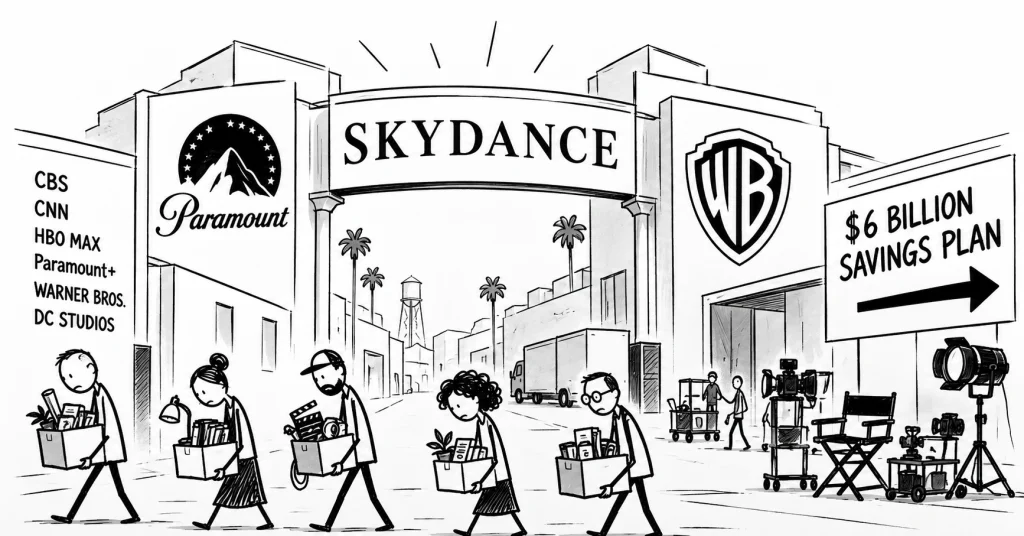
Skydance brings major studios, streaming services and news networks under one owner. The next decisions will determine who keeps a job, who gets a project funded and how much choice survives the consolidation.
Paramount completed its roughly $110 billion acquisition of Warner Bros. Discovery on October 6, creating a combined company called Skydance. Reuters reporters Anzar Mehraj and Harshita Mary Varghese reported that the transaction puts CBS, CNN, HBO Max, Paramount+, Warner Bros. and DC Studios under one corporate structure. The purchase price includes debt; Associated Press reporter Wyatte Grantham-Philips puts the equity takeover at $81 billion, with the total approaching $111 billion when debt is included. For audiences, familiar brands remain. For the people making and distributing their work, ownership has become considerably more concentrated.
The financial pressure begins with management’s $6 billion planned savings target and approximately $80 billion in expected debt. Reuters reports that Paramount says a substantial portion of savings will come from combining streaming technology and cloud providers, while job reductions are also expected. Eliminating duplicate systems can lower expenses without eliminating every position attached to them. But integration gives management the opportunity to reassess departments, vendors and staffing across both companies. The savings target establishes the destination before employees know which changes will get the company there.
More Brands, Fewer Independent Buyers
Combining ownership changes the market for creative work even when studio names survive. A producer pitching a project to two separately owned companies has two potential sources of financing, each with its own priorities and appetite for risk. Under common ownership, those brands can still commission different projects, but their budgets ultimately compete inside the same corporate structure. Our reading is that the merger reduces independent decision-making at the ownership level. A recognizable logo can preserve a studio’s identity without preserving its previous freedom to spend, negotiate or take a chance on unfamiliar work.
That pressure reaches beyond actors and directors. Productions employ crews, editors, designers and other workers whose next assignment depends on projects receiving funding. Corporate consolidation can also affect the outside businesses selling services to those productions. A company seeking savings has an incentive to consolidate purchasing and negotiate larger contracts with fewer suppliers. That could benefit vendors able to serve the combined business while making access harder for smaller firms. These are potential consequences of integration, rather than announced cuts, but they explain why employment risk extends beyond the company’s permanent payroll.
The Settlement Protects Output. Hiring Remains a Separate Test.
The legal agreement clearing the merger attempts to limit some of those consequences. Reuters reporters Jody Godoy and Deborah Mary Sophia reported that Paramount committed to 30 theatrical films annually in the first two years, rising to 32 annually for the following three. It also promised at least $300 million in additional annual U.S. production spending, with a $30 million penalty per film for missing the release requirements. Those commitments put enforceable boundaries around production output. They do not guarantee that existing departments, individual jobs or the same distribution of opportunities will survive the integration.
Common ownership also brings CNN and CBS News into the same business. The settlement requires a news editorial independence board, Reuters reported, creating a safeguard between ownership and editorial judgment. Budget decisions remain another source of influence: staffing, reporting resources and investment determine what a newsroom can pursue even when nobody dictates a headline. For viewers, the planned combination of HBO Max and Paramount+ raises a related issue. One service could simplify access, but its eventual price, packaging and catalog policies will determine whether convenience translates into better value.
The next phase will reveal how Skydance balances its production obligations against its savings target. If management protects release volume while reducing the staff and suppliers supporting it, more responsibility could fall on fewer people. If budgets favor established franchises, meeting a film quota may still leave less room for emerging creators. The merger’s cultural consequences will take shape through those ordinary business decisions: which projects receive money, which workers receive contracts and which stories reach audiences.