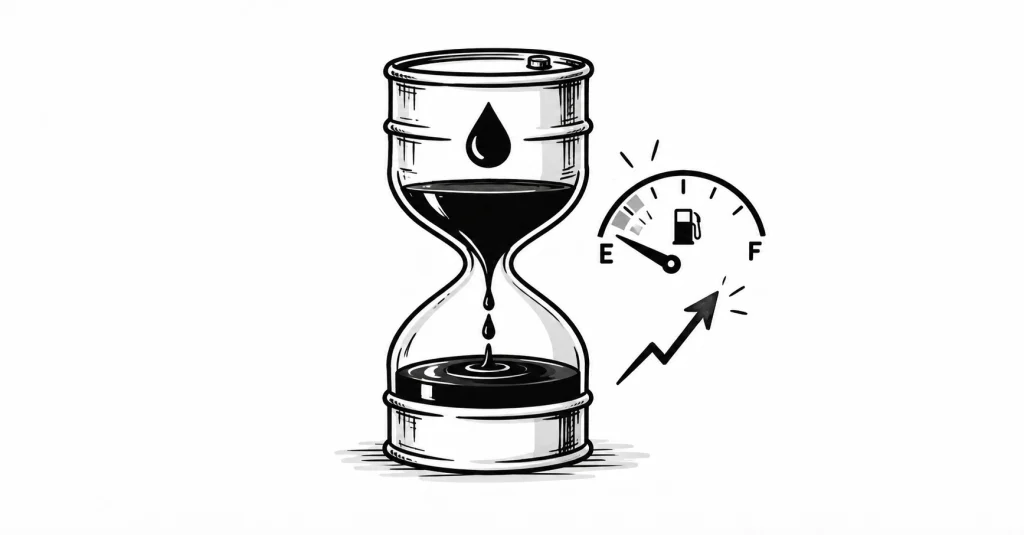
Rebuilding depleted inventories could prolong pressure on fuel markets, with consequences for household budgets and business planning.
Replenishing global oil and fuel inventories could take up to two years, Saudi Aramco chief executive Amin Nasser warned October 5 at an industry conference in London. Brent crude traded just above $100 a barrel that day, while U.S. benchmark West Texas Intermediate was near $90, according to Reuters’ report on the executives’ warnings. Nasser’s estimate concerns rebuilding stockpiles while serving ongoing demand. It is not a guarantee that gasoline will remain at a particular price for two years. The warning nevertheless raises a practical concern: restoring supplies after prolonged disruption can take longer than reopening a shipping route.
The Work Behind a Supply Recovery
The useful point in the warning is the difference between getting more fuel moving and rebuilding the cushion that helps markets withstand another interruption. Inventories can support consumption when normal supply is disrupted. Once those stocks are drawn down, replenishing them requires additional supply beyond what is needed for current use. That creates competing demands on available output. The pace of recovery would depend on production, transport, refining and consumption, along with developments in the conflict. Treating the two-year estimate as a scenario keeps the analysis grounded without dismissing the underlying challenge that the executive is describing.
Nasser was speaking as the head of a major oil producer, so his assessment should be read with that position in view. Industry executives have direct knowledge of their operations and commercial conditions, but their expectations are not neutral guarantees about the future. Other assumptions about demand, production or shipping could produce different outcomes. The appropriate response is to track whether observable supply conditions support the warning over time. A conference statement can identify a risk worth examining; it cannot establish the full path of an international market or the bills households will receive months from now.
Fuel Costs Reach Beyond the Gas Station
For consumers, the most immediate connection is often the cost of driving. The broader exposure includes businesses that depend on transportation to move goods or provide services. Higher fuel expenses can put pressure on delivery operations, travel and the movement of products through supply chains. How much reaches customers depends on contracts, competition and the choices firms make about absorbing costs. A rise in crude prices therefore should not be converted into a matching increase across household purchases. It is better understood as a source of pressure that can travel through several stages before appearing in a retail price.
That uncertainty complicates planning even when a business is not directly buying crude oil. An owner considering new delivery routes, travel commitments or longer contracts needs to make assumptions about future operating expenses. Volatile fuel markets can make those assumptions harder to defend. Some companies may have arrangements that reduce exposure; others may face changes more quickly. The reporting on the conference does not establish how any individual business is responding. Follow-up stories should ask owners what costs have changed, what protection their contracts provide and whether they have adjusted prices or plans as a result.
Recovery Must Be Measured in Usable Supply
The household consequences are also uneven. Someone with a long commute or limited transportation alternatives has less flexibility to reduce fuel use than someone who can change travel habits. That difference does not require a prediction that prices will keep climbing. It explains why prolonged uncertainty can carry different burdens even when everyone sees the same posted price. The relevant questions are how much of a budget is exposed, what alternatives are available and whether income can absorb another increase. Coverage that follows those conditions can make an international energy warning understandable through everyday decisions.
The next test is whether production, refining and shipping recover enough to meet demand and restore depleted reserves. Those developments would provide a firmer basis for judging the executives’ expectations than a single day’s price movement. Watch the availability of usable fuels as well as crude, and keep projections separate from observed results. For now, the warning gives businesses and households a reason to consider continued volatility when making plans. A durable recovery would mean a supply system with enough capacity and reserves to handle ordinary demand and another disruption, with fewer sudden costs passed through to the people at its end.