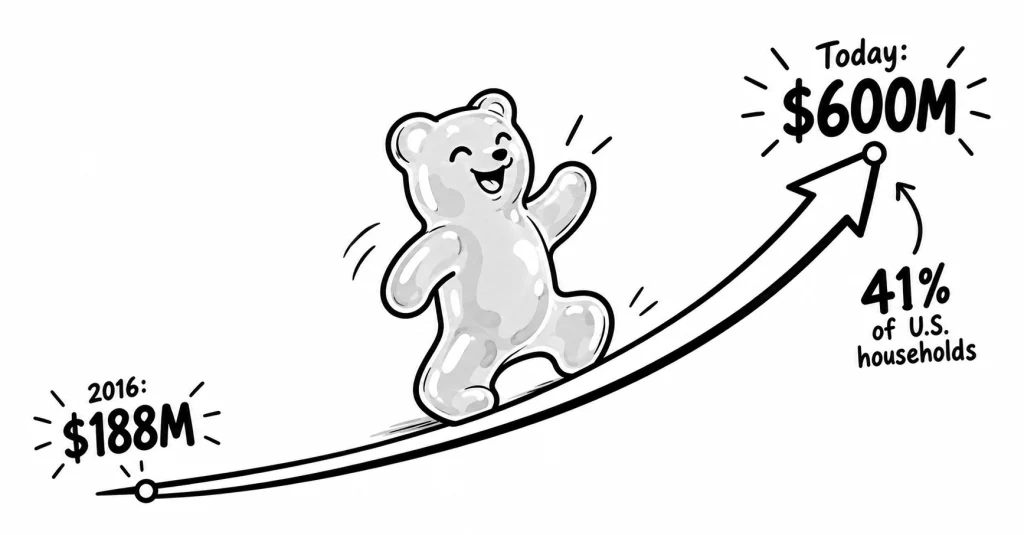
The gummy maker grew American retail sales from $188 million to $600 million by expanding products, manufacturing locally and turning an imported brand into an everyday one.
At a moment when consumer brands routinely chase viral attention, Haribo offers a different growth story. The German candy company has increased U.S. retail sales from $188 million in 2016 to $600 million today, while its products now reach approximately 41% of American households. The company did it without suddenly appearing in the American market: Haribo has sold candy here since 1982.
The Product Got Bigger Than Goldbears
A decade ago, Haribo’s American presence largely revolved around its signature Goldbears. The company now sells nearly 20 product lines in the United States and has increasingly built products around American seasonal shopping habits, including Valentine’s Day, Easter, Halloween and Christmas.
That strategy gives the company repeated opportunities to get consumers to try something new without abandoning the product people already recognize. Seasonal packaging and limited products can function as marketing, sampling and shelf expansion simultaneously.
Haribo has also localized its operations. In 2023, it opened its first U.S. manufacturing facility in Pleasant Prairie, Wisconsin, reducing its dependence on candy imported from factories in Germany, Spain and Turkey. This summer, the company went further by opening its first two U.S. retail stores in New York and Massachusetts.
Familiarity Became the Growth Strategy
The numbers are useful because they challenge the idea that consumer growth has to arrive suddenly. Haribo’s U.S. expansion has taken decades, with much of the acceleration occurring only after the company increased distribution, broadened its portfolio and adapted a global brand to American buying occasions.
The retail stores push that strategy further. Instead of competing for a few feet of supermarket shelf space, Haribo can present dozens of varieties, international products, merchandise and pick-and-mix candy in an environment it controls.
Going from $188 million to $600 million is more than a candy story. It is a reminder that durable consumer brands can still be built through repetition: more products, more occasions, more distribution and eventually more places where the brand owns the customer experience itself.
Source: Retail Brew