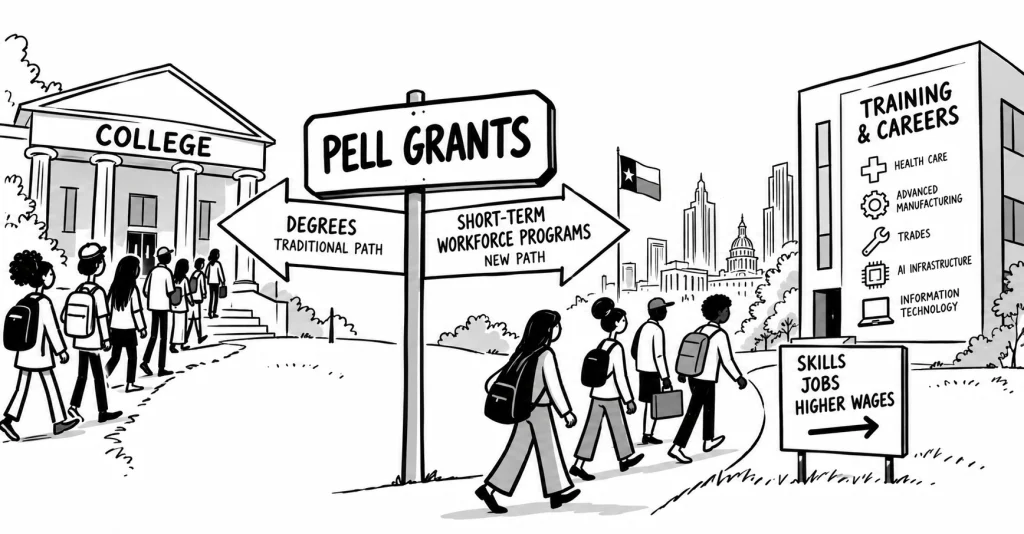
Five Texas community colleges can now use federal Pell aid for short-term workforce programs. The change moves one of higher education’s central access tools closer to the labor market.
For decades, Pell Grants have represented a straightforward federal promise: students without substantial financial resources should still have a path into college. Texas is now helping test a broader version of that promise. Five community colleges in the state have received federal approval to offer Workforce Pell aid for short-term programs tied to high-skill, high-wage and in-demand occupations.
At the same time, a consortium led by Northwest Vista College in the Alamo Colleges District has received approximately $10.4 million from the U.S. Department of Labor to expand and strengthen short-term workforce programs. The initiative is expected to serve 22,532 participants, with particular attention to health care, advanced manufacturing, industrial trades, artificial-intelligence infrastructure and information technology.
Financial Aid Is Moving Closer to the Job
The change addresses a longstanding gap in the financial-aid system. Traditional Pell eligibility was built primarily around longer academic programs, even as employers increasingly sought workers with certificates, licenses and specialized technical training that could be completed in months rather than years.
That created an access problem. A student could qualify for federal assistance to pursue a multiyear degree but struggle to finance a shorter credential designed specifically for an available job. Workforce Pell begins closing that gap by allowing aid to follow students into approved short-term training.
The Texas programs also reveal how much the definition of postsecondary education is changing. Health care, energy, construction and skilled trades require training beyond high school, but they do not always require a bachelor’s degree. Artificial-intelligence infrastructure adds another dimension: the AI economy does not run only on software developers. It also depends on data centers, electrical systems, networking, cooling equipment and the technicians who maintain physical infrastructure.
A Different Measure of College Access
There is still an important question about quality. Shorter credentials can create faster routes into employment, but only if programs consistently lead to jobs, wage gains and credentials employers actually value. The Texas grant explicitly includes improved tracking of employment outcomes, a recognition that enrollment itself cannot be the sole measure of success.
That changes the access conversation. For much of modern higher-education policy, expanding opportunity meant getting more students through the college door. Workforce Pell shifts some of the emphasis toward what happens after students enter: how long training takes, what it costs, whether employers recognize it and whether the credential produces enough additional income to justify the investment.
The result is not the end of the traditional degree. It is a widening of the federal definition of education worth subsidizing. Pell was built around the idea that income should not determine who can attend college. Texas is now helping test whether that promise should also mean income does not determine who can afford the shorter training required to enter a better-paying job.