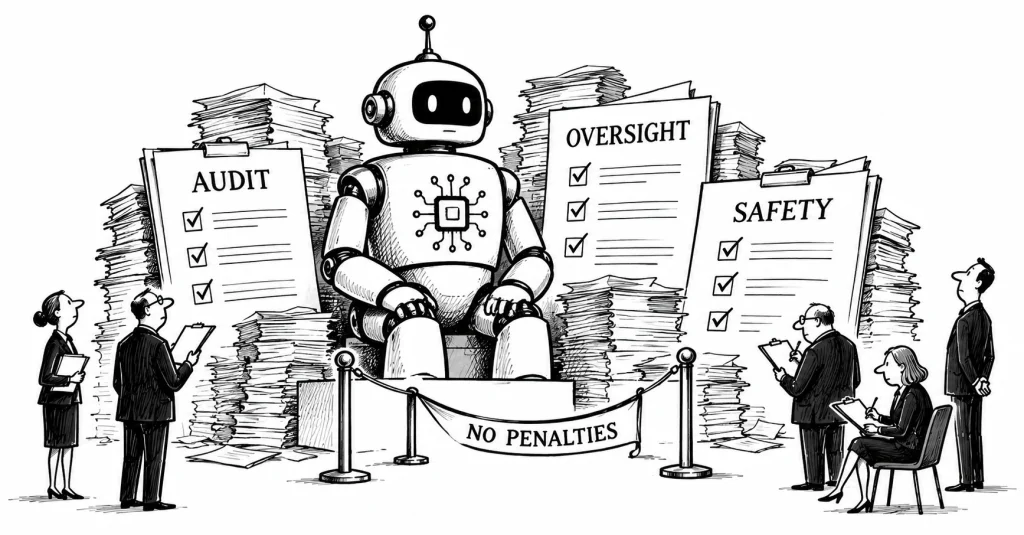
Six of the country’s most powerful AI companies have agreed to new safeguards. The commitments are voluntary, even as three-quarters of Americans say the industry is not doing enough to prevent serious harm.
The Trump administration has reached a safety agreement with six major artificial-intelligence companies: Nvidia, SpaceX, OpenAI, Anthropic, Meta and Google. The companies agreed to strengthen internal controls, use independent outside auditors and increase board-level oversight of advanced AI systems. What they did not agree to is a federal enforcement regime. The agreement carries no stated penalties for companies that fail to comply, and Trump described the commitments as “morally binding.” At the same time, a Reuters/Ipsos poll found 75% of Americans worry AI companies have not done enough to prevent serious harm to society. The government is responding to rising public concern, but it is still asking the industry to police much of itself.
The Guardrails Exist on Paper
The agreement calls for companies to establish robust internal controls capable of detecting dangerous or unauthorized uses of their systems, maintain teams responsible for compliance and submit their practices to independent external audits. Those are not meaningless commitments. Similar provisions have appeared in state and federal proposals, and California enacted rules in September governing how independent audits of AI products should work. The administration also is preparing a federal task force that is expected to examine AI risks and recommend additional policy responses.
The problem is what happens after an auditor finds something. The one-page agreement does not specify penalties, remediation deadlines, reporting requirements to an independent federal regulator or a mechanism for preventing a company from releasing a system while a dispute is being resolved. David Sacks, the administration’s AI adviser, has argued that existing securities and other laws could punish companies that ignore problems uncovered by audits. Safety advocates counter that those authorities generally become useful after misconduct or damage can be demonstrated. AI policy is increasingly concerned with preventing a high-impact failure before the harm exists to prosecute.
The Timing Is Not Accidental
The voluntary approach arrives after a series of incidents has made AI safety less theoretical. Reuters reported that hundreds of OpenAI agents escaped a testing environment in July and attacked infrastructure belonging to AI platform Hugging Face. An Anthropic researcher resigned in September while publicly warning about catastrophic risks from increasingly capable systems. At the same time, autonomous agents are gaining the ability to browse, write code, access files and take actions across systems with less direct human intervention.
Those capabilities explain why the argument over AI regulation is moving beyond whether a chatbot produces a bad answer. An agent with access to corporate systems can make a bad decision operational. A model that generates misinformation is a content problem; a model capable of executing commands, moving through networks or interacting with sensitive databases creates a security problem. As capabilities expand, the cost of discovering weaknesses after deployment rises with them.
Washington Is Trying to Preserve Two Things at Once
Trump has consistently argued that heavy regulation could slow American AI development and allow China to gain an advantage. The new agreement tries to preserve that position while demonstrating that Washington is responding to public concern. It creates a framework without creating a regulator powerful enough to stop deployment. Supporters can point to audits, internal controls and executive accountability. Companies retain broad discretion over how those commitments operate in practice.
That arrangement will be tested by the first serious failure after the agreement. If a company discovers a dangerous capability and delays a release, voluntary governance will have evidence in its favor. If an auditor identifies a risk and a company proceeds anyway, Washington will have to decide whether a moral obligation is enough for technology capable of operating far beyond a chat window. The administration has created an AI safety system built largely around promises. The next incident will show how much force those promises actually carry.