
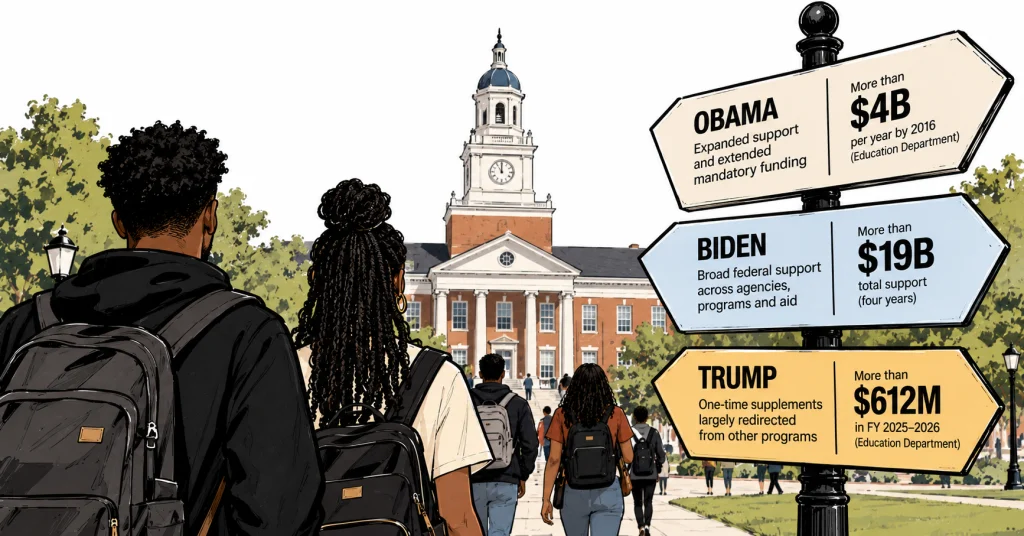
The administration has directed more than $600 million in additional money to HBCUs. That does not mean it has outspent Obama or Biden. The numbers being compared measure different things.
The Trump administration has a number it can point to when it talks about historically Black colleges and universities: more than $612 million in additional HBCU funding across fiscal years 2025 and 2026. The Education Department added $438 million in one-time HBCU funding in September 2025 and announced another $174 million on September 22, 2026. Both are substantial investments. They have also fueled a broader perception that the current administration is giving HBCUs more federal support than the Obama or Biden administrations did, and the federal record does not support that conclusion without major qualifications. The $612 million measures additional one-time funding, not total federal support for HBCUs. Biden-era totals counted billions of dollars flowing through multiple agencies, programs and forms of assistance over four years. Obama-era support included billions in annual federal funding and extended the mandatory funding stream that Trump later made permanent.
The $612 Million Did Not Appear From Nowhere
Where the money came from is central to understanding the number. In September 2025, the Education Department ended roughly $350 million in fiscal 2025 discretionary funding for several Minority-Serving Institution programs, including grants for Hispanic-serving, Asian American and Native American Pacific Islander-serving, Alaska Native and Native Hawaiian-serving, Native American-serving nontribal and Predominantly Black institutions. The department called those programs racially discriminatory because of their racial and ethnic eligibility criteria and moved the money to other priorities. That same month, it announced a one-time $495 million supplement for HBCUs and tribal colleges, with $438 million going to HBCUs. Part of that increase, in other words, was federal education money moved from one group of minority-serving institutions to another, rather than Congress creating an entirely new HBCU funding stream.
The 2026 announcement followed the same pattern. The Education Department describes the $174 million as a one-time investment, and Inside Higher Ed reported that it was drawn from a Hispanic-Serving Institutions STEM grant program, part of $235 million redirected to HBCUs and tribal colleges. The money sits on top of the regular HBCU appropriations that already move through programs such as Title III. That is meaningful support, but the fair comparison is supplemental funding against supplemental funding, or total federal support against total federal support. Setting one category from one administration against an all-of-government total from another produces a political talking point rather than a clean fiscal comparison.
Biden's Number Was Much Broader
By the end of the Biden administration, the White House Initiative on HBCUs put total federal support at more than $19 billion. A May 2024 White House accounting had already reached more than $16 billion, and that figure was intentionally broad. It included more than $11.4 billion in grants, contracts and institutional assistance, plus more than $4 billion supporting HBCU students through financial aid and veterans benefits. Within the institutional total were nearly $4 billion in pandemic relief, $2.6 billion for institutional capacity, more than $1.6 billion in competitive federal grants and cooperative agreements, almost $950 million for research capacity, roughly $719 million for STEM and other high-demand programs, and $1.6 billion in HBCU capital-financing debt relief.
That number comes with its own qualification. Biden did not originate every dollar in the $19 billion. Some of it came from congressional appropriations, existing federal programs and pandemic legislation that spanned administrations. The $1.6 billion capital-financing debt discharge, for example, was authorized by legislation signed in December 2020, before Biden took office, although the relief was carried out afterward. That is precisely why presidential funding comparisons require caution: federal higher-education money rarely begins and ends neatly with one person in the White House.
Obama Built Part of the Structure Trump Made Permanent
The Obama record adds another complication. By 2016, the Obama White House reported that the Education Department was responsible for more than $4 billion a year in funding associated with HBCUs, and that Pell Grant dollars received by HBCU students had risen from $523 million in 2007 to $824 million in 2014. More consequentially, legislation Obama signed in 2010 extended a mandatory $255 million annual funding stream for HBCUs and other Minority-Serving Institutions through fiscal 2019. Congress first created that stream in 2007, and the HBCU share was about $85 million a year.
Trump signed the bipartisan FUTURE Act in 2019, making that funding permanent. It was an important accomplishment, but the frequently repeated claim that the law created $255 million a year for HBCUs is inaccurate. The $255 million covers several categories of minority-serving institutions, with roughly $85 million reserved for HBCUs, and the stream itself predates Trump; Congress had sustained it through the Obama years before making it permanent. Current Education Department data show about $80.2 million a year still reaching HBCUs through that mandatory Title III Part F program after sequestration.
More Money in One Column Can Coexist With Cuts in Another
The current record holds the same kind of internal contradiction. While adding $612 million in supplemental funding, the administration's fiscal 2026 budget request also sought to cut Howard University's federal appropriation by $64 million, from $304 million to $240 million. The administration says $50 million of that reduction reflects the completed federal financing of Howard's new hospital and that the remaining $14 million returns operating support to its 2021 level. Core Title III HBCU funding continues alongside those proposals, including roughly $401 million in discretionary Strengthening HBCUs funding and the mandatory stream carried over from earlier legislation.
So the accurate story is neither that Trump has abandoned HBCUs nor that his administration has funded them more generously than every administration before it. The $612 million is real. What misleads is using that number without saying what it measures. Obama expanded federal HBCU support and extended the mandatory funding stream. Trump made that stream permanent during his first term. Biden oversaw more than $19 billion in broad federal HBCU and student support over four years. The current administration has channeled hundreds of millions into one-time HBCU supplements, largely by redirecting money from other minority-serving programs, while proposing reductions elsewhere. The numbers tell different stories because they are different numbers, and any comparison that hides those categories makes the headline easier and the accounting less accurate.
Sources: U.S. Department of Education, "U.S. Department of Education Ends Funding for Racially Discriminatory Discretionary Grant Programs at Minority-Serving Institutions" (September 2025), https://www.ed.gov/about/news/press-release/us-department-of-education-ends-funding-racially-discriminatory-discretionary-grant-programs-minority-serving-institutions; U.S. Department of Education, "U.S. Department of Education Makes Historic Grant Investments in Programs That Bolster Educational Outcomes" (September 15, 2025), https://www.ed.gov/about/news/press-release/us-department-of-education-makes-historic-grant-investments-programs-bolster-educational-outcomes; U.S. Department of Education, "U.S. Department of Education Makes Significant Investment in America's Historically Black Colleges and Universities" (September 2026), https://www.ed.gov/about/news/press-release/us-department-of-education-makes-significant-investment-americas-historically-black-colleges-and-universities; Inside Higher Ed, "ED Redirects $235M in MSI Funds to HBCUs, Tribal Colleges" (September 23, 2026), https://www.insidehighered.com/news/quick-takes/2026/09/23/ed-redirects-235m-msi-funds-hbcus-tribal-colleges; White House Initiative on HBCUs, "Biden-Harris Impact on Historically Black Colleges and Universities" (January 2025), https://sites.ed.gov/whhbcu/files/2025/01/BidenHarris-Impact-on-HBCUs.pdf; The White House, "Fact Sheet: Biden-Harris Administration Announces Record Over $16 Billion in Support for HBCUs" (May 16, 2024), https://bidenwhitehouse.archives.gov/briefing-room/statements-releases/2024/05/16/fact-sheet-biden-harris-administration-announces-record-over-16-billion-in-support-for-historically-black-colleges-and-universities-hbcus/; U.S. Department of Education, Howard University Fiscal Year 2026 Budget Request, https://www.ed.gov/media/document/fy-2026-congressional-justification-howard-university-110139.pdf