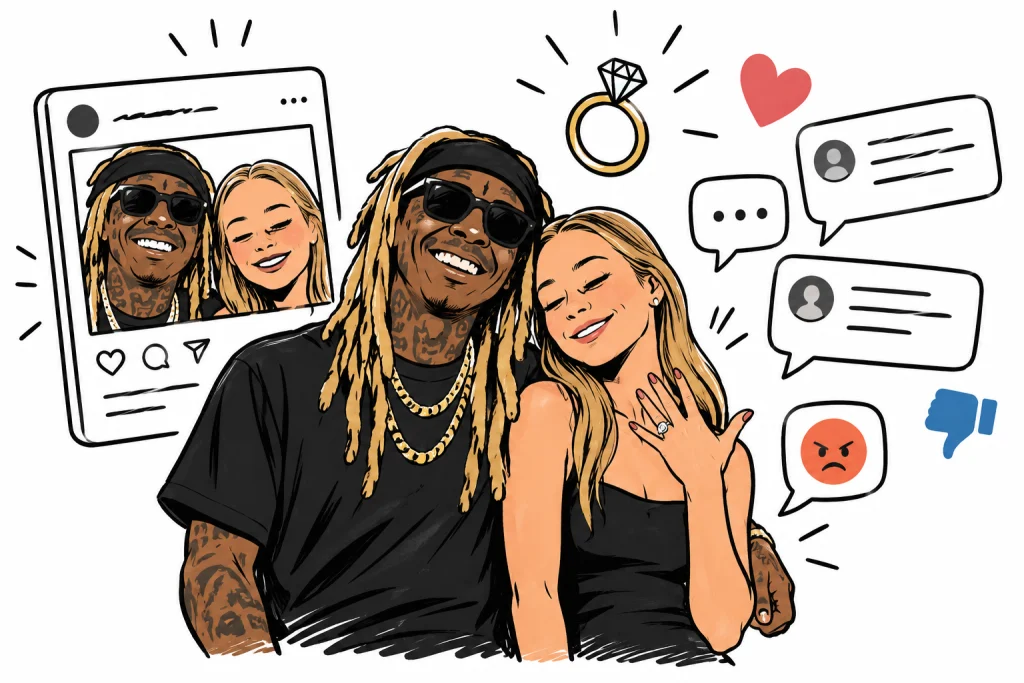
The reaction to their 21-year age gap is about more than two numbers. It sits at the intersection of gender, power, race, celebrity and a persistent question about whether we actually trust young women to make choices we would not make ourselves.
Lil Wayne is 44. Madi Cannon is 23. Wayne recently referred to Cannon as his fiancée in a video posted by fellow rapper B.G., months after publicly denying that he was engaged and saying the relationship had ended. Their reconciliation might ordinarily have been another piece of celebrity news. Instead, much of the conversation has centered on one fact: Cannon is 21 years younger than Wayne and four years younger than his oldest daughter, Reginae Carter.
I understand why people stop at those numbers. Twenty-three and 44 can represent dramatically different levels of experience, money, professional standing and social power. Add celebrity to the equation and the imbalance becomes more pronounced. Wayne has spent most of Cannon’s lifetime famous, wealthy and culturally influential. But our discomfort with relationships like this often moves quickly from recognizing those differences to deciding what they must mean. He must be taking advantage of her. She must be naïve. She will understand when she gets older. What could they possibly have in common? Those assumptions sound protective, but they also reveal how uncertain we become about women’s agency when a woman’s choice makes us uncomfortable.
We believe in women’s agency until their choices make us uncomfortable
At 23, a woman can vote, enlist in the military, sign a mortgage, start a business, marry, divorce, become a parent, decline parenthood and make financial decisions capable of following her for decades. We recognize those decisions as part of adulthood even when parents, friends or strangers believe she is making a mistake. Put that same woman in a relationship with a man two decades older, however, and suddenly adulthood seems negotiable. She becomes “too young,” while he becomes predatory by implication, sometimes before we know anything about how the relationship actually functions.
There are legitimate reasons to examine power here. Wayne has money, celebrity, influence and decades more life experience than Cannon. Any one of those things can create leverage inside a relationship. But age is hardly the only source of unequal power between adults. One person may earn considerably more, have stronger family connections, possess greater professional status or simply exercise more emotional control. The useful evidence is how that power gets used. Does one partner control the other’s money, isolate her from friends, make leaving financially difficult or exploit inexperience to dictate the terms of the relationship? Those behaviors tell us something. Looking at a 23-year-old woman and assuming vulnerability because the man beside her is 44 mostly tells us what we think about 23-year-old women.
Reverse the genders and watch what happens
Older women who date younger men certainly get judged. We even have a sexist word ready for them: “cougar.” An older woman can be mocked for chasing youth, accused of refusing to age gracefully or treated as though attracting a younger man is some surprising accomplishment. Yet the younger man in those relationships is rarely treated as someone who needs rescuing from his own romantic judgment. A 23-year-old man dating a wealthy, attractive 44-year-old woman might be called lucky. People might joke that he found a sugar mama. His friends might congratulate him. What we are considerably less likely to do is decide that he is simply too young to understand why he wants her.
Young women do not receive the same presumption. Her attraction requires an explanation: money, daddy issues, fame, insecurity, manipulation or naïveté. The older man may be scrutinized for wanting someone so young, but the younger woman is simultaneously scrutinized for wanting him back. We have taken a legitimate modern conversation about power and attached it to a very old gender assumption: men make romantic and sexual choices while women, particularly young women, are more susceptible to having those choices shaped for them.
The numbers also help explain why a relationship like this stands out. Pew Research Center found that 51% of opposite-sex married couples in 2022 were no more than two years apart, and the average gap between husbands and wives was only 2.2 years. Husbands were at least three years older in 40% of marriages, compared with only 10% in which the wife was at least three years older. A 21-year gap is far outside the dominant American marriage pattern, but older husbands are hardly a new phenomenon.
Lil Wayne doesn’t arrive here as a blank slate
There is another layer that cannot be separated completely from the reaction: this is Lil Wayne. People have been forming opinions about him for nearly three decades, and his public history around race and politics means some audiences will bring considerably more to this engagement than a calculator. The scrutiny of Cannon also unfolds visually. Reliable public reporting does not clearly establish her racial identity, and photographs cannot do that for us. But social media routinely makes racial assumptions based on appearance, meaning perceptions about race can enter a conversation even when the underlying assumption has never been established as fact.
For Black audiences in particular, that can activate a much older conversation about successful Black men, interracial relationships, colorism and who appears to become desirable when money and status expand a man’s choices. Cannon should not be turned into a racial category she has not publicly claimed, and Wayne does not owe Black women his romantic attention. Still, it would be naïve to pretend those cultural conversations disappear simply because we choose not to name them. Celebrity relationships often become screens onto which people project broader frustrations about beauty, desirability and who seems to benefit when traditional dating hierarchies intersect with fame.
Wayne’s own record adds another complication. His 2016 comments distancing himself from Black Lives Matter generated significant backlash, and in 2020 he publicly met with Donald Trump and praised Trump’s proposed “Platinum Plan” for Black Americans. Trump later pardoned Wayne in January 2021 after the rapper had pleaded guilty to a federal firearms offense. Those facts tell us nothing about whether Wayne is a good romantic partner, and they should not be stretched into evidence about his relationship with Cannon. They do help explain why some people may encounter this engagement with opinions about Wayne already firmly in place.
That is important when trying to understand the intensity of the response. People are rarely reacting to celebrity relationships in isolation. They are reacting to the celebrity they already believe they know. For someone who disliked Wayne’s comments about race or his association with Trump, a controversial age-gap relationship can become one more piece of an existing judgment about him. For someone who has followed his music for decades without attaching much importance to his politics, 44 and 23 may be the only issue. Those reactions can look identical in a comment section even when they originate from very different places.
Our discomfort with older men has a history, too
None of this means the suspicion surrounding older men and younger women was invented by social media. Men have traditionally been allowed to accumulate romantic value alongside money, status and professional success, while women have been bombarded with messages suggesting their desirability is closely connected to youth. A successful middle-aged man choosing a woman barely into her twenties therefore arrives with cultural baggage that a 44-year-old woman dating a 23-year-old man does not carry in precisely the same way.
There is plenty to interrogate there. Why do some successful older men consistently seek younger women? How much of male attraction has been shaped by a culture that treats female youth as a premium? Why can gray hair and professional success make a man appear distinguished while women spend billions trying to conceal evidence that they are aging? Those questions reach beyond Wayne and Cannon into the way heterosexual desirability has been constructed for generations. They also explain why some women may look at a relationship like this and see not romance but another example of a familiar social arrangement.
Where I become uncomfortable is when criticism of that system gets transferred entirely onto the younger woman. If our concern is that society overvalues youth in women, it makes little sense to respond by treating a young woman as an object with no meaningful desires of her own. Cannon can exist inside a gendered system and still exercise agency within it. She can be influenced by fame and genuinely attracted to Wayne. She can be inexperienced and know what she wants. Human relationships are rarely clean enough to give us only one explanation.
Twenty-three is young. Adulthood still has to mean something.
Cannon will almost certainly understand parts of her life differently at 33 or 43 than she does today. So will many people who marry someone their own age at 23. Age-gap relationships do not have a monopoly on decisions people later reconsider. Adults marry the wrong people, ignore warning signs, stay too long, leave too soon and make choices their older selves would never repeat. We generally do not use the possibility of future regret as evidence that they lacked the right to make the decision in the first place.
If 23 is too young for a woman to knowingly choose a 44-year-old partner, we eventually have to decide when she becomes old enough. Twenty-five? Thirty? Does the answer change if the older man is not famous? What if she earns more money than he does? What if the younger partner is a man? Once we start trying to construct an unofficial age of romantic competence for legal adults, the standard becomes remarkably difficult to apply consistently.
I am not arguing that 21 years is insignificant or that people should ignore obvious disparities in money, experience and influence. I am arguing against converting those disparities into a verdict without evidence about how two people actually treat each other. Concern should make us pay attention to behavior, not give us permission to write the ending before we have read the story.
Lil Wayne and Madi Cannon may build a lasting marriage. They may eventually discover that 21 years of difference creates problems neither anticipates today. We do not know enough about their private relationship to predict either outcome. What we do know is how quickly many of us looked at their ages and decided who possessed the power, who was vulnerable and who understood what was happening.
We have spent generations examining why seasoned men want younger women, and there are good reasons to keep examining it. Perhaps we should also become comfortable with a possibility that complicates the story considerably: sometimes younger women know exactly how old the man is, know exactly what other people will think, and want him anyway.