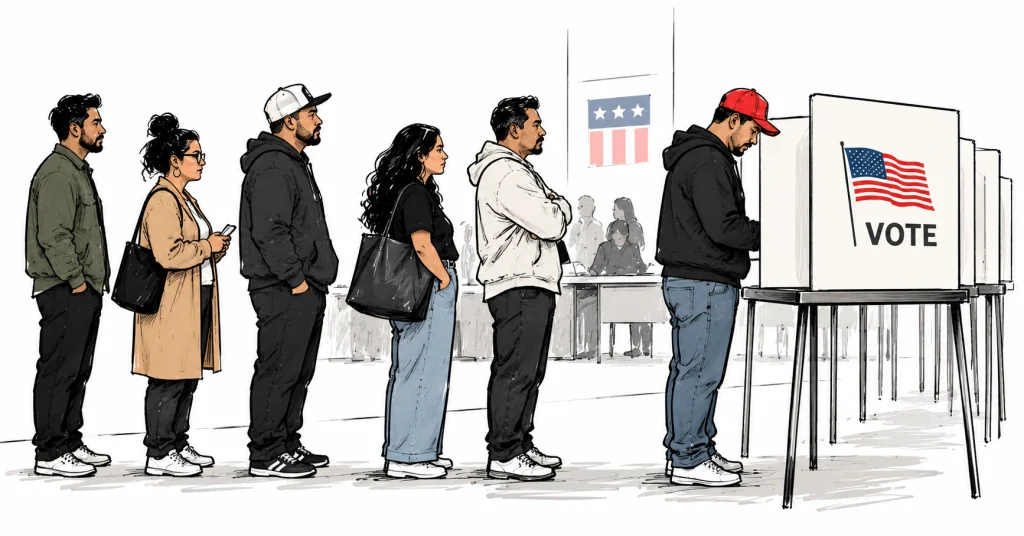
The question has moved back into public view after Los Angeles Times columnist Gustavo Arellano argued this week that Latino men who helped expand Trump’s coalition in 2024 could become a decisive voting bloc in the midterms. His column is explicitly an appeal to Latino men to reject Trump. The underlying data, however, points to a broader question: whether the 2024 shift represented a durable partisan realignment or a more conditional response to the economy, immigration and dissatisfaction with Democrats.
Trump made historic gains with Hispanic voters in 2024, particularly men. Less than five weeks before the midterms, immigration enforcement, affordability and declining approval are testing whether those voters were becoming Republicans—or simply making a different choice in one election.
The 2024 shift was substantial
Nearly half of Hispanic voters—48%—backed Donald Trump in 2024, up from 36% four years earlier, according to Pew Research Center’s analysis of validated voters. Kamala Harris still narrowly carried the group, 51% to 48%, but the result represented one of the most significant changes in the presidential electorate. Preliminary national exit polling from Edison Research showed an even sharper gender divide: 54% of Hispanic men voted for Trump.
Those numbers immediately produced a familiar political shorthand: Latino men had moved to the right. But the evidence since then suggests something more fluid. Pew found that much of Trump’s 2024 improvement among Hispanic voters reflected changes in who turned out, rather than enormous numbers of longtime Democratic voters permanently switching parties. Among Hispanic voters who participated in 2024 after sitting out 2020, 60% backed Trump. Hispanic adults also remain less consistent voters than White adults: just 25% voted in the 2020, 2022 and 2024 elections, according to Pew.
Latino men are not one political constituency
New research from UCLA’s Latino Policy & Politics Institute adds another layer. Using a May survey of 1,912 Latino registered voters in California, researchers found that Latinas were consistently more likely than Latino men to place high importance on protecting immigrant communities, opposing the White House agenda and defending voting rights. On immigration, 69% of Latinas called protecting immigrant communities “very important,” compared with 52% of Latino men. On democracy and voting rights, the split was 87% to 77%.
The gaps became considerably wider when researchers separated voters by age and education. Among Latinos without bachelor’s degrees, 73% of women versus 51% of men said protecting immigrant communities was very important. Among voters under 30, 92% of Latinas described defending democracy and voting rights as very important, compared with 74% of Latino men. Among college graduates, however, many of those gender differences became much smaller. The finding challenges the idea that gender alone explains Latino political behavior. Education, generation, economic position and turnout are operating alongside it.
The coalition is now being tested
Republicans are getting signs that the 2024 coalition cannot simply be assumed to return. Florida Republican Rep. María Elvira Salazar, campaigning in a heavily Hispanic Miami-area district, took the unusual step last month of publicly warning Trump that immigration enforcement had “gone too far.” She said Hispanic voters who helped return him to the White House now “feel betrayed.” Reuters reported that Trump’s approval on immigration had fallen to 39% nationally, while his overall approval stood at 35% in its September polling.
Immigration may not even be the most consequential issue in November. Recent polling shows voters increasingly focused on affordability. An AP-NORC survey conducted September 24–28 found registered voters favored Democrats over Republicans 38% to 27% on handling the cost of living, while confidence in both parties remained weak. Separate polling has shown deteriorating perceptions of Trump’s economic management as high gasoline prices, housing costs and borrowing expenses continue to pressure households.
That leaves both parties confronting the same mistake from opposite directions: treating Latino men as a constituency that has already been won or lost. Republicans gained voters who were dissatisfied with the economy, attracted to Trump or disconnected from Democrats in 2024. Democrats cannot assume dissatisfaction with Trump automatically brings those voters back. Republicans cannot assume a presidential vote two years ago represents lasting partisan identification.
The midterms will provide the next measurement. If Latino men continue supporting Republicans despite dissatisfaction over prices and immigration enforcement, the 2024 result will look more like a durable realignment. If they move back toward Democrats—or simply stay home—it will suggest something else: one of the most discussed demographic shifts of the last election may have been less about ideological conversion than about turnout, conditions and which party voters believed was listening at that particular moment.