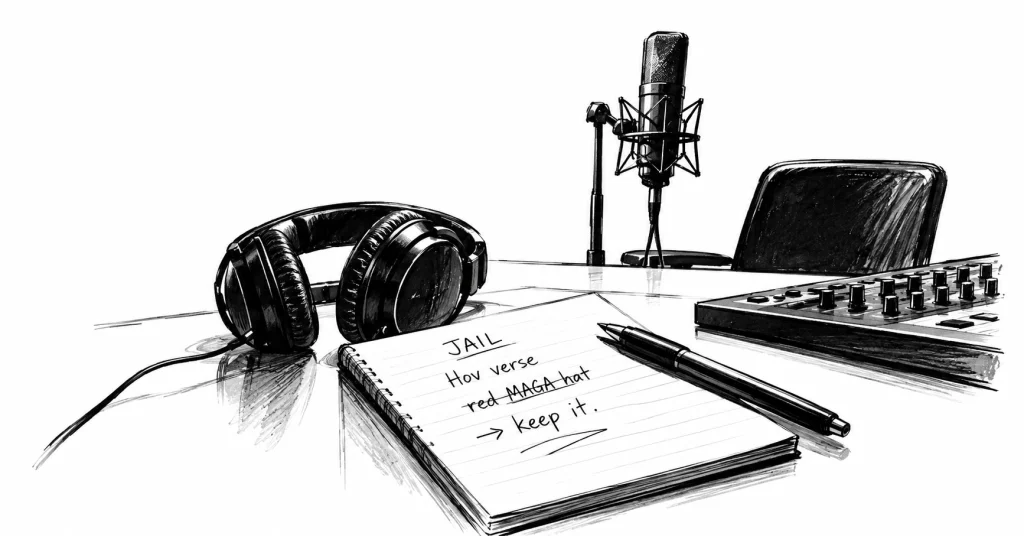
Five years after “Jail,” Jay-Z says Kanye West objected to one political line in his verse. His response established a different boundary: the collaborator could reject the work, but he could not rewrite what Jay-Z believed.
A single line on Kanye West’s 2021 album Donda produced roughly two weeks of disagreement between West and Jay-Z, according to a new account from Jay-Z. The dispute centered on Jay-Z’s guest verse on “Jail,” which included a reference to West’s association with the red MAGA hat. In Episode 6 of HBO’s JAŸ-Z in 8, released October 2, Jay-Z told Rick Rubin that West was uncomfortable with the reference and wanted it changed. Jay-Z declined.
What happened next makes the exchange more revealing than another disagreement between two famous artists. Jay-Z did not argue that his status entitled him to remain on West’s album. Instead, he separated two decisions that collaborations often blur together: West had authority over what appeared on his project, while Jay-Z retained authority over what he was willing to say under his own name.
The boundary was unusually clear
Jay-Z recalled West telling him that the reference was making him uncomfortable. His response was straightforward: “Sorry, I’m not gonna change it. That’s how I feel.” He then told West that if the objection was strong enough, West should remove the verse entirely because Donda was West’s project and the final record should reflect what West wanted.
That created an unusual compromise: there did not have to be one.
Jay-Z could preserve the work he had written without requiring West to publish it. West could exercise final control over his album without gaining control over Jay-Z’s words. The available choices became accept the contribution or remove it—not negotiate the contributor into saying something else.
West ultimately kept it.
“Jail” appeared as the second track on Donda when the album was released August 29, 2021, with Jay-Z’s verse intact. The song therefore preserved both sides of the disagreement: West released a record containing criticism connected to his own political associations, while Jay-Z participated without removing the line that had caused the dispute.
Collaboration does not require agreement
The new account arrives through JAŸ-Z in 8, an eight-part HBO series built around conversations between Jay-Z and longtime friend and producer Rick Rubin about his music, lyrics and creative process. Episodes five and six were released October 2; the series uses individual songs to revisit decisions across roughly three decades of Jay-Z’s career.
The “Jail” story offers a particularly clean example of how creative power can operate when neither participant gives up authorship. West did not have to agree with Jay-Z’s message to release it. Jay-Z did not have to soften his message to remain eligible for the collaboration. Either person could walk away from the contribution without requiring the other to surrender control of his own work.
Five years later, the lyric itself is only part of the story. The decision behind it provides the more durable lesson: collaboration can accommodate disagreement when everyone knows where their authority ends. Jay-Z gave West control over whether his voice appeared on Donda. He did not give him control over what that voice would say.
Beat: Culture in Motion
Possible dek alternative: The disagreement over one line in “Jail” lasted for weeks. What survived was a model of collaboration in which both artists kept control over their own work.