
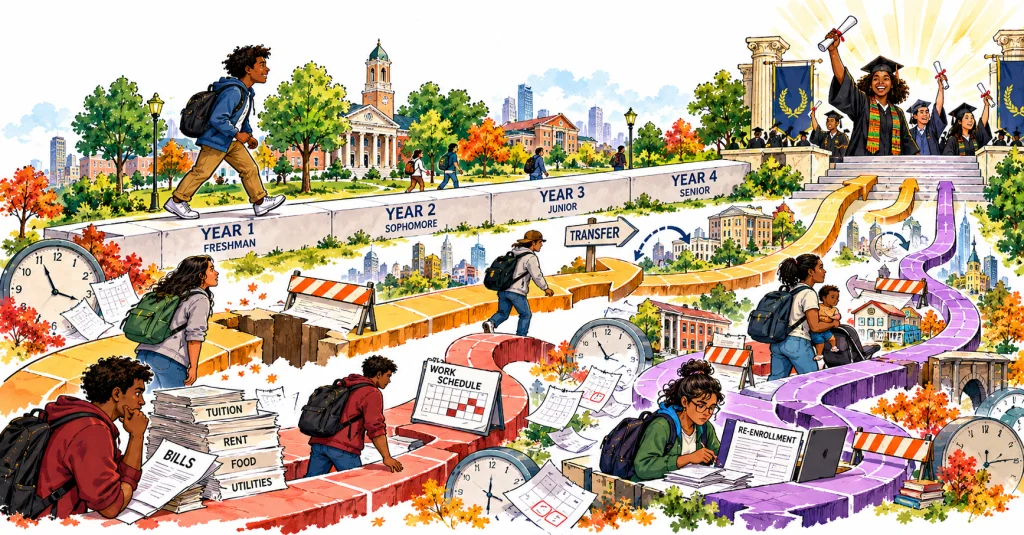
New graduation data shows racial disparities in completion time. A central finding helps explain them: the gaps narrow among students who remain continuously enrolled.
Just 44 percent of Black bachelor’s degree recipients finished in four years or fewer, compared with about 62 percent of white graduates and 67 percent of Asian graduates, according to figures reported by Inside Higher Ed from the National Student Clearinghouse Research Center’s new Time to Degree report. Released October 1, the research examines students who earned credentials during the 2024–25 academic year. These are people who reached graduation, but their timelines reveal different experiences getting there. The familiar four-year college journey remains achievable for many students. For others, finishing requires navigating interruptions that can stretch the same educational goal across much more of their lives.
Where the Timelines Separate
The national headline is encouraging: the median time to a bachelor’s degree earned as a student’s first undergraduate credential was 3.7 years, roughly four traditional academic years. But a midpoint cannot describe every route to graduation. About one-quarter of Black and Native American graduates took seven years or longer, compared with approximately 18 percent of Hispanic graduates and 12 percent of white graduates, Inside Higher Ed reported. Those figures describe time to completion among graduates, rather than the likelihood that a student entering college will eventually graduate. A student who never finishes is outside this report’s frame, making its reassuring headline a partial picture of college outcomes.
One of the report’s most consequential findings concerns what happens when enrollment remains uninterrupted. Differences in completion time across demographic groups were minimal among students who did not stop out.Gaps emerged among those who experienced breaks, with interruption patterns helping explain a substantial share of racial and ethnic disparities. That finding shifts attention toward the conditions that allow students to keep attending. It does not establish why any individual left or prove that preventing a break would eliminate every disparity. It does suggest that judging delayed graduation only as a matter of academic pace misses a central part of the story: whether students can sustain enrollment long enough to finish.
Leaving Adds More Than Time Away
The Clearinghouse defines a stopout as a break in enrollment lasting more than 123 days, beyond the usual interval between spring and fall semesters. Among first-time bachelor’s earners, median elapsed completion time rose from 3.7 years with no stopouts to 5.1 years with one and 7.3 years with two. Students with three or more interruptions took more than a decade. The report also separates elapsed time from active enrollment time, which excludes periods away. Students who stopped out generally needed more time actively enrolled as well. Returning, in other words, was associated with additional enrolled terms, beyond the calendar time already lost during the break.
Transfers and movement across institutions add another layer. The report associates more complex pathways with longer completion timelines, including longer active enrollment. That should prompt colleges to examine how well their systems accommodate students arriving with prior coursework or returning after an absence. Transfer credit reviews, course availability and clear degree plans are practical places to look, although this research does not isolate their individual effects. A longer route also should not automatically be treated as a failed route. Students may transfer or pursue credentials in stages for sound reasons; institutions still need to make those choices navigable.
What Colleges Should Measure Next
The HBCU findings offer useful context. Among Black bachelor’s recipients, 78.9 percent of those graduating from HBCUs had no stopouts, compared with 63.1 percent at non-HBCUs. Yet median bachelor’s completion time was 4.3 years in both groups. The comparison shows why institutions need more than one measure of success. Enrollment continuity and overall completion time capture related experiences, but they are not interchangeable. These results also concern graduates; they do not establish that HBCU attendance itself caused students to remain enrolled.
For colleges, the next step is to examine where enrollment breaks occur and what returning students encounter. Institutions should track interruptions alongside graduation timelines, then assess whether their support and reentry processes help students maintain progress. The report documents people who persisted long enough to earn a credential, including those whose journeys lasted years beyond the expected schedule. Their achievement deserves recognition. Their experience also gives colleges a concrete task: make staying enrolled easier, and make returning a workable path to completion.